
[논문 리뷰] Listen, Think, and Understand
LTU는 강력한 오디오 인식 인코더와 오픈 소스 LLM을 결합한 다중모달 오디오 기반 모델로, 오디오 이해와 emergent 오디오 추론을 가능하게 하며, 대규모 OpenAQA-5M 오디오 질문-답변 데이터셋으로 학습되었습니다.
The ability of artificial intelligence (AI) systems to perceive and comprehend audio signals is crucial for many applications. Although significant progress has been made in this area since the development of AudioSet, most existing models are designed to map audio inputs to pre-defined, discrete sound label sets. In contrast, humans possess the ability to not only classify sounds into general categories, but also to listen to the finer details of the sounds, explain the reason for the predictions, think about what the sound infers, and understand the scene and what action needs to be taken, if any. Such capabilities beyond perception are not yet present in existing audio models. On the other hand, modern large language models (LLMs) exhibit emerging reasoning ability but they lack audio perception capabilities. Therefore, we ask the question: can we build a model that has both audio perception and a reasoning ability? In this paper, we propose a new audio foundation model, called LTU (Listen, Think, and Understand). To train LTU, we created a new OpenAQA-5M dataset consisting of 1.9 million closed-ended and 3.7 million open-ended, diverse (audio, question, answer) tuples, and have used an autoregressive training framework with a perception-to-understanding curriculum. LTU demonstrates strong performance and generalization ability on conventional audio tasks such as classification and captioning. More importantly, it exhibits emerging audio reasoning and comprehension abilities that are absent in existing audio models. To the best of our knowledge, LTU is one of the first multimodal large language models that focus on general audio (rather than just speech) understanding.
연구 동기 및 목표
- 소리와 장면에 대한 추론으로 나아갈 수 있도록 오디오 인식 그 이상을 다루는 AI 시스템 구축을 촉진합니다.
- 고성능 오디오 인식 모듈을 대형 언어 모델과 통합하여 통합된 오디오 이해와 추론을 실현합니다.
- 오디오 기반 지시 실행 모델을 학습시키기 위한 대규모이고 다양한 오디오 QA 데이터셋(OpenAQA-5M)을 생성합니다.
- LTU가 기존의 오디오 작업(분류, 자막 생성)과 emergent 오디오 추론을 모두 수행할 수 있음을 보여줍니다.
- 지각에서 이해로의 학습을 안내하는 학습 커리큘럼(지각-이해)을 제공합니다.
제안 방법
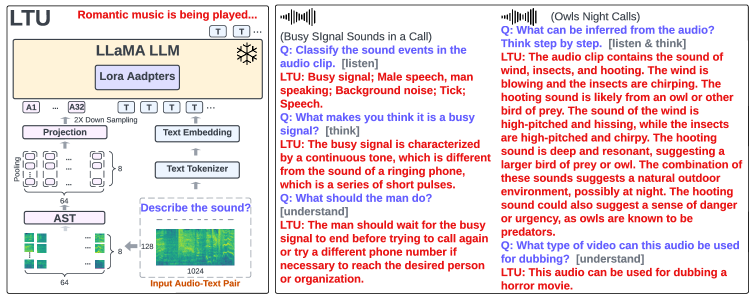
- 오디오 인코더로 Audio Spectrogram Transformer(AST)을 사용하고, AudioSet-2M에서 미세조정하며, LLaMA 임베딩과 일치하도록 4096-차로 투사합니다.
- LLaMA의 자기 주의 계층에 LoRA 어댑터를 부착하여 작은 매개변수 예산(4.2M)으로 효율적인 미세조정을 가능하게 합니다.
- 32개의 오디오 임베딩을 텍스트 임베딩과 결합하여 LLaMA 기반 언어 모델의 LTU 입력을 형성합니다.
- 지각-이해 커리큘럼을 여러 단계에 걸쳐 사용하여 학습합니다. 폐쇄형 작업에서 시작하여 점차 개방형 QA를 포함합니다.
- 여덟 개 데이터셋에서 재레이블링된 오디오와 GPT 기반 Audio Instruction Generation(AIG)을 활용하여 다양하고 풍부한 오디오 QA 쌍(OpenAQA-5M)을 생성합니다.
- 과거 토큰과 참조 오디오를 조건으로 다음 토큰 예측으로 학습을 최적화합니다. 생성 설정은 (temperature 0.1, TopK 500, TopP 0.95) 사용합니다.
실험 결과
연구 질문
- RQ1하나의 모델이 일반적인 오디오 이벤트를 동시에 인식하고 오디오 장면에 대해 추론할 수 있을까요?
- RQ2오디오 인코더를 LLM과 통합하면 사실 정확성과 지시 이행을 갖춘 개방형 오디오 질문 응답이 가능해질까요?
- RQ3오디오 중심 다중모달 LLM를 효과적으로 학습시키기 위해 어떤 데이터와 커리큘럼이 필요한가요?
- RQ4전통적인 오디오 작업과 emergent 오디오 추론 작업에서 LTU의 성능은 어떠한가요?
- RQ5LTU가 환각을 피하고 적절할 때 대답 불가능한 질문을 거부할 수 있나요?
주요 결과
- LTU는 8개의 분류 벤치마크에서 기존의 오디오-텍스트 CLAP를 능가하며 평균 상대 개선율이 23.6%입니다.
- LTU는 더 다양한 데이터로 학습했음에도 불구하고 SPICE로 측정한 AudioCaps와 Clotho에서 최첨단 자막 생성 모델과 경쟁력이 있습니다.
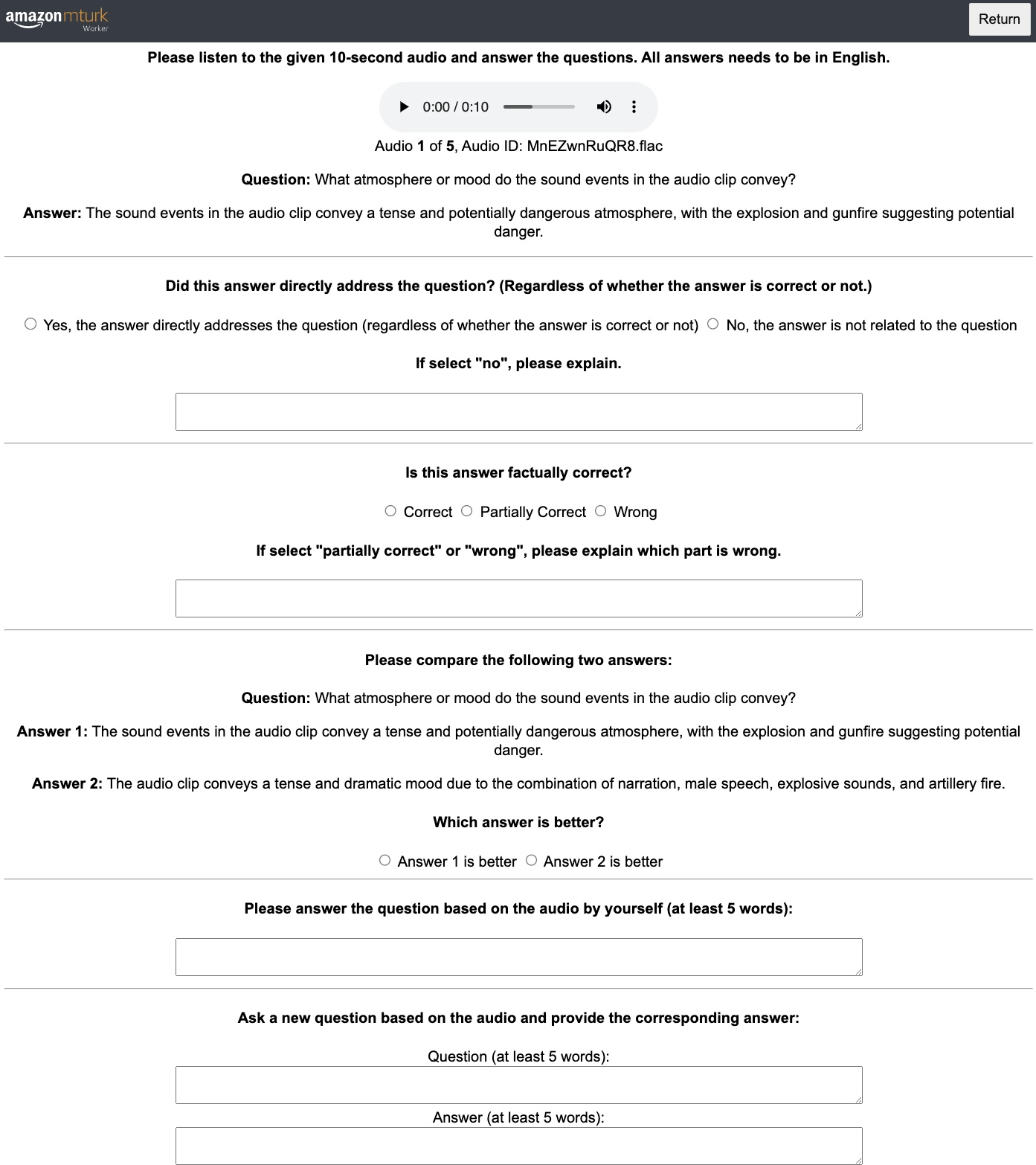
- LTU는 emergent 오디오 추론 및 이해 능력을 보이며, 지시 이행률이 약 82.9%의 사실적 정확성과 함께 개방형 질문 응답을 포함합니다(사람 평가).
- LTU는 추론 시 미리 정의된 레이블 세트 없이도 텍스트 라벨을 직접 출력하며, 보지 않은 데이터셋과 작업에서도 강한 일반화 능력을 보입니다.
- 지각-이해 커리큘럼은 매우 중요하며, 이를 제거하면 성능이 크게 저하하고, LoRA 어댑터를 가진 고정된 LLaMA는 재앙적 망각 없이도 효과적인 오디오 정합성을 가능하게 합니다.
이 논문 읽기
누빈트 뷰어에서 원문을 열고, 읽으면서 궁금한 곳을 바로 물어보세요.
누빈트에서 이 논문 읽기이 리뷰는 AI가 논문 원문을 바탕으로 만들었습니다. 인용하기 전에 원문을 확인해 주세요.