
[논문 리뷰] LLM-Enhanced User-Item Interactions: Leveraging Edge Information for Optimized Recommendations
본 논문은 특수 프롬프트와 사전학습/미세조정을 통해 주의(attention)에 그래프의 1차 및 2차 인접 정보를 주입하는 그래프-주의형 GPT-2 기반 추천 시스템을 제안하며, 여러 Amazon 데이터셋에서 추천 성능을 개선한다.
Graph recommendation methods, representing a connected interaction perspective, reformulate user-item interactions as graphs to leverage graph structure and topology to recommend and have proved practical effectiveness at scale. Large language models, representing a textual generative perspective, excel at modeling user languages, understanding behavioral contexts, capturing user-item semantic relationships, analyzing textual sentiments, and generating coherent and contextually relevant texts as recommendations. However, there is a gap between the connected graph perspective and the text generation perspective as the task formulations are different. A research question arises: how can we effectively integrate the two perspectives for more personalized recsys? To fill this gap, we propose to incorporate graph-edge information into LLMs via prompt and attention innovations. We reformulate recommendations as a probabilistic generative problem using prompts. We develop a framework to incorporate graph edge information from the prompt and attention mechanisms for graph-structured LLM recommendations. We develop a new prompt design that brings in both first-order and second-order graph relationships; we devise an improved LLM attention mechanism to embed direct the spatial and connectivity information of edges. Our evaluation of real-world datasets demonstrates the framework's ability to understand connectivity information in graph data and to improve the relevance and quality of recommendation results.
연구 동기 및 목표
- 대형 언어 모델(LLMs)과 그래프 구조 데이터를 추천에 통합하여 엣지 정보를 활용해 복잡한 사용자-아이템 관계를 포착하려는 동기를 부여한다.
- 그래프-주의형 LLM 백본을 개발하여 1차 및 2차 그래프 연결성을 주의 메커니즘에 통합한다.
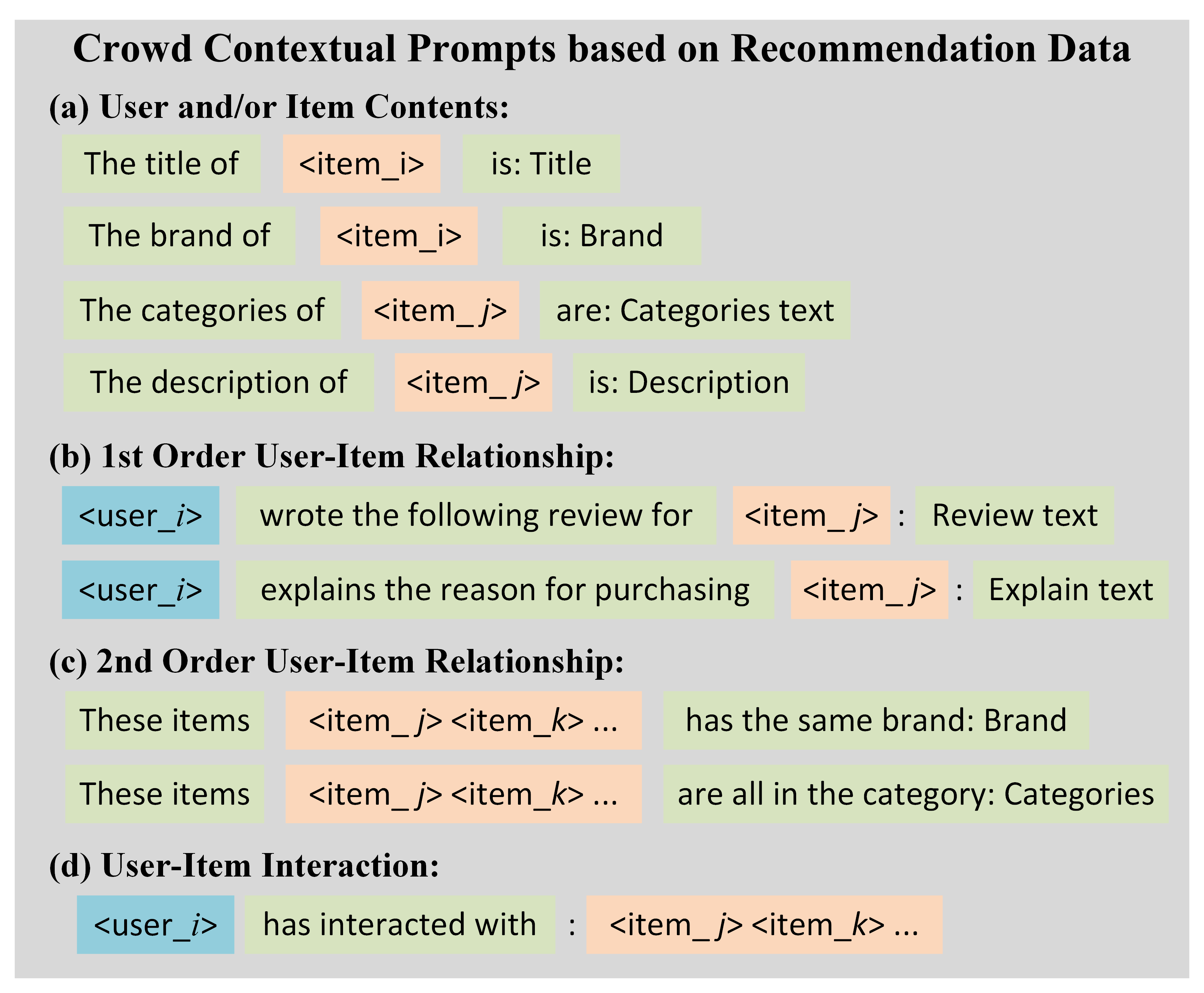
- 사람 군집 맥락 프례트를 사전 학습에 사용하고, 개인화 예측 프롬프트를 미세 조정하여 추천 품질을 최적화한다.
제안 방법
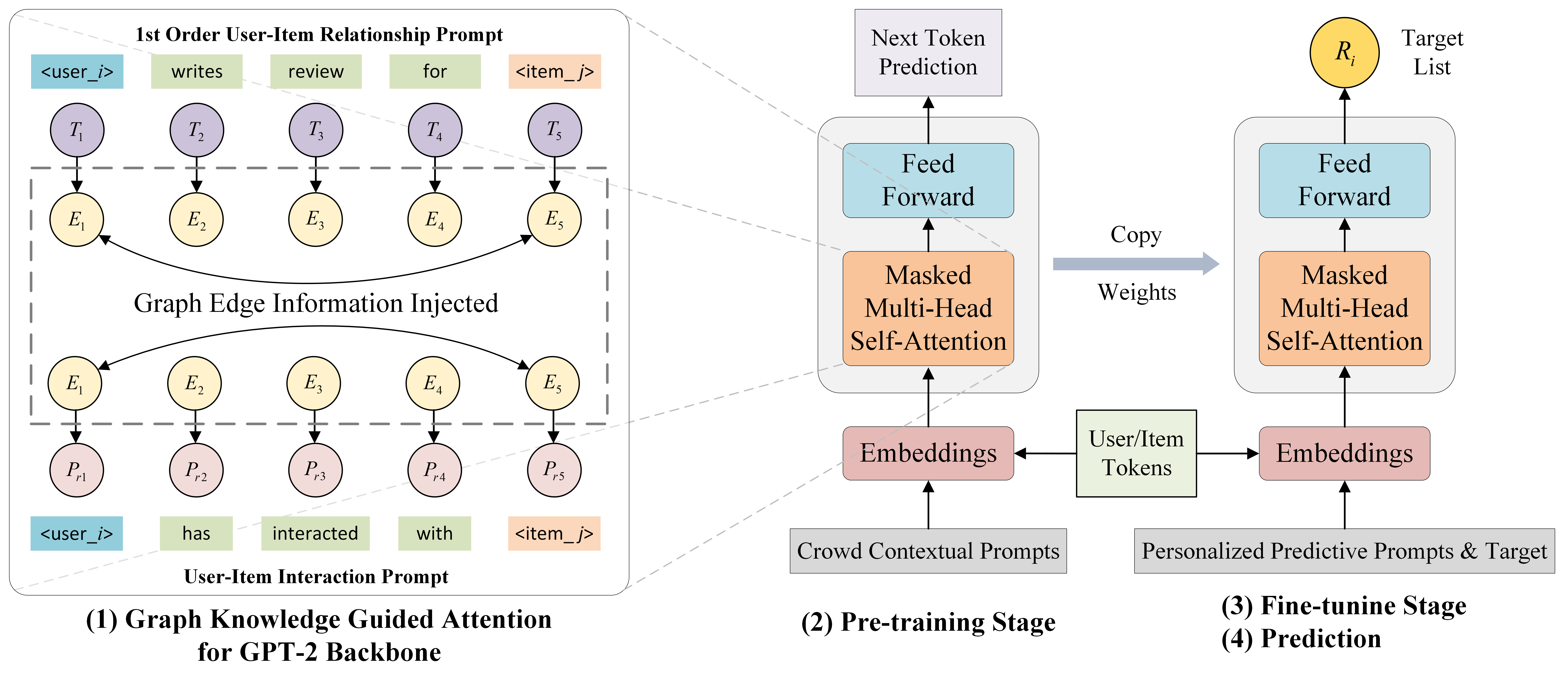
- GPT-2를 기본 LLM으로 사용하고 엣지 인코딩 항 R을 주의 계산에 주입하여 그래프 엣지 지식을 주의 메커니즘에 포함한다.
- 직접(1차) 및 간접(2차) 그래프 연결성을 R = R^conn + R^path로 표현하며, R^conn은 인접성 유사 항이고 R^path는 정규화된 최단 경로 점수에서 파생된 값이다.
- 사용자/아이템 토큰, 아이템 속성 및 사용자-아이템 상호 작용 이벤트를 포함하는 군집 맥락 프롬프트에서 그래프-주의형 LLM을 사전 학습시켜 토큰 생성 가능성을 최대화한다.
- 사용자 이력을 과거 시제로 바꾸고 미래 시제 트리거를 적용하는 개인화 예측 프롬프트로 미세 조정하여 추천 정확성을 최적화한다.
- 생산 환경에서 프롬프트를 사용해 사용자-아이템 쌍에 대한 추천 점수를 생성하고, 대기 시간 관리를 위해 오프라인 배치와 온라인 캐시를 활용한다.
- 7개의 Amazon 데이터셋에서 Recall@20, Recall@40, 및 NDCG@100으로 평가하고, 사전 학습, 미세 조정, GKIA(그래프 지식의 주의 반영), GHIP(그래프/히스토리 프롬프트) 등을 포함한 차등 실험을 수행한다.
실험 결과
연구 질문
- RQ1그래프-주의형 LLM 프레임워크가 실제 데이터셋의 baselines 대비 추천 정확도를 개선할 수 있는가?
- RQ21차 그래프 연결성과 2차 그래프 연결성이 추천 성능에 어떤 기여를 하는가?
- RQ3사전 학습, 미세 조정, 그래프 보강 주의 구성 요소가 결과에 어떤 영향을 미치는가?
- RQ4아이템의 배경 정보 및 2차 관계를 포함하는 것이 추천에 도움이 되는가?
- RQ5그래프 정보를 반영한 LLM 추천에서 서로 다른 프롬프트 구조 및 주의 주입 방법은 얼마나 효과적인가?
주요 결과
- 제안된 그래프-주의형 LLM은 7개 Amazon 데이터셋에서 baselines보다 Recall@20, Recall@40 및 NDCG@100이 더 우수하다.
- 차별적 실험은 사전 학습과 미세 조정이 성능에 큰 영향을 미치며 학습 파이프라인의 유효성을 검증한다.
- GKIA 주의 메커니즘을 통해 그래프 엣지 정보를 포함하고 2차 관계를 이용하는 것이 결과를 개선한다.
- 2차 아이템 관계와 아이템 배경 정보를 포함하는 프롬프트가 최상의 성능을 낳았고, 이러한 구성 요소가 없는 모델보다 우수하다.
- 다양한 주의 주입 방법은 엣지-지식을 LLM의 주의 다이나믹에 임베딩하는 것의 중요성을 보여준다.
이 논문 읽기
누빈트 뷰어에서 원문을 열고, 읽으면서 궁금한 곳을 바로 물어보세요.
누빈트에서 이 논문 읽기이 리뷰는 AI가 논문 원문을 바탕으로 만들었습니다. 인용하기 전에 원문을 확인해 주세요.