
[논문 리뷰] Local Implicit Normalizing Flow for Arbitrary-Scale Image Super-Resolution
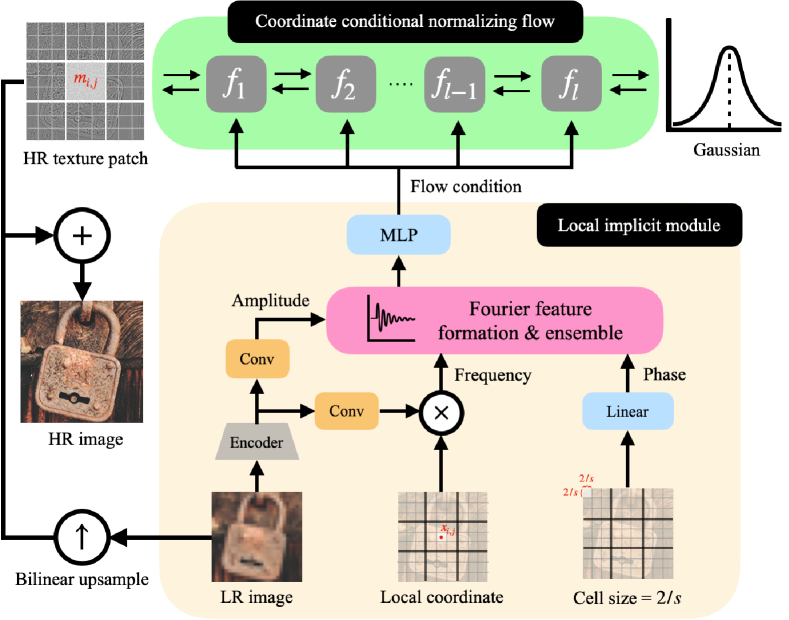
이 논문은 좌표 조건부 정규화 흐름과 국소 은닉 신경망 표현을 결합한 새로운 프레임워크인 국소 은닉 정규화 흐름(LINF)을 제안한다. 이는 사진처럼 사실적인 고해상도 결과를 얻을 수 있도록 임의의 확대 비율에서 이미지 초해상도 복원을 가능하게 한다. 저해상도 입력, 확대 비율, 푸리에 특징을 조건으로 하여 국소 무늬 패치의 분포를 모델링함으로써, LINF는 임의의 확대 비율에서 세밀하고 시각적으로 현실적인 이미지를 생성한다. 이는 이전 방법들보다 시각적 품질과 추론 속도 면에서 뛰어나다.
Flow-based methods have demonstrated promising results in addressing the ill-posed nature of super-resolution (SR) by learning the distribution of high-resolution (HR) images with the normalizing flow. However, these methods can only perform a predefined fixed-scale SR, limiting their potential in real-world applications. Meanwhile, arbitrary-scale SR has gained more attention and achieved great progress. Nonetheless, previous arbitrary-scale SR methods ignore the ill-posed problem and train the model with per-pixel L1 loss, leading to blurry SR outputs. In this work, we propose "Local Implicit Normalizing Flow" (LINF) as a unified solution to the above problems. LINF models the distribution of texture details under different scaling factors with normalizing flow. Thus, LINF can generate photo-realistic HR images with rich texture details in arbitrary scale factors. We evaluate LINF with extensive experiments and show that LINF achieves the state-of-the-art perceptual quality compared with prior arbitrary-scale SR methods.
연구 동기 및 목표
- 초해상도 복원 문제의 불안정성 문제를 해결하기 위해 고해상도 이미지 생성을 결정론적 회귀 과제가 아닌 분포 문제로 모델링한다.
- 아키텍처 변경 없이도 임의의 확대 비율로 일반화할 수 없는 고정된 확대 비율 초해상도 모델의 한계를 극복한다.
- 패ixed L1 손실 대신 무늬 세부 정보 분포를 포착하는 흐름 기반 생성 접근 방식을 도입하여 시각적 품질을 향상시킨다.
- 푸리에 특징 통합을 통해 국소 기반 추론 속도를 향상시키고, 추론 효율성을 높이는 패치 기반, 좌표 조건부 정규화 흐름 아키텍처를 통해 임의의 확대 비율 초해상도 복원을 효율적으로 수행한다.
- 정규화 흐름의 샘플링 온도 조절을 통해 신뢰도(PSNR)와 시각적 품질(LPIPS) 간의 균형을 이루며, PSNR와 LPIPS 지표 간의 트레이드오���을 가능하게 한다.
제안 방법
- LINF는 좌표 조건부 정규화 흐름 모델을 사용하여 국소 무늬 패치의 분포를 학습하는 초해상도 복원 문제를 설정한다.
- 흐름 모델은 저해상도 이미지, 각 국소 패치의 중심 좌표, 그리고 원하는 확대 비율에 조건이 된다.
- 국소 은닉 신경망 표현이 각 패치 위치에서 푸리에 특징을 추정하여 흐름 모델의 조건부 신호를 제공한다.
- 더 효율적이지 않은 국소 앙상블 메커니즘을 대체하기 위해 푸리에 특징 통합 기법을 도입하여 추론 속도와 성능을 향상시킨다.
- 패치 기반 접근 방식(n×n 영역)을 사용하여 국소 무늬의 일관성을 유지하고 생성 과정 중 전파 횟수를 줄인다.
- 정규화 흐름의 샘플링 온도를 제어하여 신뢰도(PSNR)와 시각적 품질(LPIPS) 간의 균형을 이루며, 트레이드오프 최적화를 가능하게 한다.

실험 결과
연구 질문
- RQ1정규화 흐름이 고정된 확대 비율이 아닌 임의의 확대 비율 초해상도 복원에 효과적으로 적용될 수 있는가?
- RQ2패ixed 회귀 대비 국소 무늬 패치 분포를 모델링함으로써 이미지 세부 정보 복원에 어떤 개선이 이루어지는가?
- RQ3국소 은닉 표현이 정규화 흐름이 임의의 확대 비율에서 다양하고 현실적인 무늬를 생성하기 위해 충분한 조건부 지도를 제공할 수 있는가?
- RQ4패치 크기가 정규화 흐름 기반 초해상도 복원에서 무늬 일관성과 추론 효율성에 어떤 영향을 미치는가?
- RQ5정규화 흐름에서 온도 제어 샘플링이 임의의 확대 비율 초해상도 복원에서 PSNR와 LPIPS 간의 트레이드오프에 어떤 영향을 미치는가?
주요 결과
- LINF는 DIV2K 검증 세트에서 최신 기준의 시각적 품질을 확보하였으며, τ=0.6일 때 LPIPS가 0.158로 이전 방법들을 크게 앞서며 뛰어난 성능을 보였다.
- TITAN X에서 이미지당 1.44초의 추론 시간을 기록하여 국소 앙상블 기반 모델 대비 약 33% 빠른 속도를 달성하였다.
- 푸리에 특징 통합 메커니즘 덕분에 자동화된 회귀 모델 대비 27.2배, 정규화 흐름 기반 기준 모델 대비 2.6배 더 빠른 추론 속도를 확보하였다.
- 패치 기반 모델(n>1)은 픽셀 기반 모델(n=1)보다 더 뛰어난 시각적 일관성을 보였으며, 무작위 샘플링에서 발생하는 국소 일관성 결여 문제를 방지하였다.
- τ=0일 때 픽셀 기반 모델는 높은 PSNR(28.85)를 기록했지만 시각적 품질은 낮았고(LPIPS 0.273), 패치 기반 모델는 τ=0.6일 때 더 낮은 LPIPS(0.158)를 기록하며 시각적 품질이 향상되었다.
- 푸리에 특징 통합에서 진폭 스케일링을 제거하면 성능이 약간 저하되었으며(LPIPS 0.271 vs. 0.270), 이는 가중치 진폭 스케일링의 중요성을 입증한다.
이 논문 읽기
누빈트 뷰어에서 원문을 열고, 읽으면서 궁금한 곳을 바로 물어보세요.
누빈트에서 이 논문 읽기이 리뷰는 AI가 논문 원문을 바탕으로 만들었습니다. 인용하기 전에 원문을 확인해 주세요.