
[논문 리뷰] MagicAnimate: Temporally Consistent Human Image Animation using Diffusion Model
MagicAnimate은 DensePose 모션에 의해 가이드되는 시간적으로 일관되고 고충실도인 사람 이미지 애니메이션을 생성하기 위해 시간 모델링과 새로운 appearance encoder를 갖춘 확산 기반 프레임워크를 도입하여 TikTok 및 TED-talks 데이터셳에서 베이스라인보다 우수한 성능을 보입니다.
This paper studies the human image animation task, which aims to generate a video of a certain reference identity following a particular motion sequence. Existing animation works typically employ the frame-warping technique to animate the reference image towards the target motion. Despite achieving reasonable results, these approaches face challenges in maintaining temporal consistency throughout the animation due to the lack of temporal modeling and poor preservation of reference identity. In this work, we introduce MagicAnimate, a diffusion-based framework that aims at enhancing temporal consistency, preserving reference image faithfully, and improving animation fidelity. To achieve this, we first develop a video diffusion model to encode temporal information. Second, to maintain the appearance coherence across frames, we introduce a novel appearance encoder to retain the intricate details of the reference image. Leveraging these two innovations, we further employ a simple video fusion technique to encourage smooth transitions for long video animation. Empirical results demonstrate the superiority of our method over baseline approaches on two benchmarks. Notably, our approach outperforms the strongest baseline by over 38% in terms of video fidelity on the challenging TikTok dancing dataset. Code and model will be made available.
연구 동기 및 목표
- 인간 이미지 애니메이션에서 시간적 불일치와 참조 appearance 재현성 문제를 다룬다.
- 프레임 간의 시간 정보를 인코딩하는 비디오 확산 모델을 개발한다.
- 정체성, 의상, 배경 디테일을 보존하기 위한 밀집된 appearance 인코더를 도입한다.
- 겹치는 구간에 걸친 간단한 비디오 융합 전략을 통해 긴 영상 애니메이션을 가능하게 한다.
- 이미지-비디오 공동 학습 및 세그먼트 인지 조건화를 통해 프레임당 충실도를 향상시킨다.]
- method:["2D UNet에 시간 주의(attention) 블록을 확장하여 3D 시간 UNet을 형성하고 확산 모델을 비디오 도메인으로 확장한다.","노이즈 제거 과정에서 공간 자기 주의에 밀집한 참조 이미지 특징을 주입하는 appearance 인코더를 도입하여 정체성과 배경 보존을 향상시킨다.","DensePose 시퀀스를 자세 ControlNet으로 조건화하여 모션 전이를 유도한다.","긴 비디오를 슬라이딩 윈도우 겹침으로 세그먼트 단위로 처리하고 중첩 프레임에 대해 예측을 평균화하여 매끄러운 전이를 보장한다.","더 풍부한 appearance 단서를 위해 대규모 이미지 데이터세트를 활용하고 프레임당 충실도를 유지하기 위해 이미지-비디오 공동 전략으로 학습한다.","추론 시 간단한 비디오 융합 기법을 사용하여 중첩 세그먼트 출력을 혼합해 매끄러운 장시간 애니메이션을 구현한다."]
- research_questions:[
- Can a diffusion-based framework achieve superior temporal coherence for human image animation compared to frame-by-frame methods?
- Does a dedicated appearance encoder improve identity preservation and background fidelity over CLIP-based appearance conditioning?
- What is the impact of temporal attention and image-video joint training on per-frame quality and video fidelity?
- How effective is simple overlap-based video fusion at inference for long video smoothness?
- To what extent does MagicAnimate generalize to unseen domains and multi-person scenarios?
제안 방법
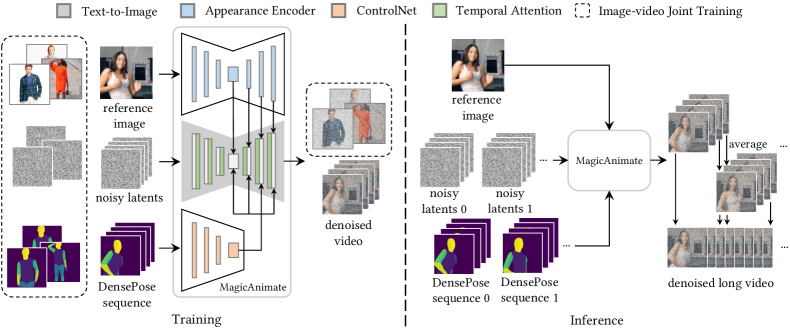
- Extend diffusion models to a video domain by inflating 2D UNet with temporal attention blocks to form a 3D temporal UNet.
- Introduce an appearance encoder that injects dense reference-image features into spatial self-attention during denoising, improving identity and background preservation.
- Condition animation on DensePose sequences via a pose ControlNet to drive motion transfer.
- Perform segment-by-segment processing of long videos with a sliding-window overlap and average predictions for overlapping frames to ensure smooth transitions.
- Train with an image-video joint strategy to leverage large image datasets for richer appearance cues and maintain per-frame fidelity.
- Use a simple video fusion technique at inference to blend overlapping segment outputs for seamless long-duration animation.]
- research_questions:["Can a diffusion-based framework achieve superior temporal coherence for human image animation compared to frame-by-frame methods?","Does a dedicated appearance encoder improve identity preservation and background fidelity over CLIP-based appearance conditioning?","What is the impact of temporal attention and image-video joint training on per-frame quality and video fidelity?","How effective is simple overlap-based video fusion at inference for long video smoothness?","To what extent does MagicAnimate generalize to unseen domains and multi-person scenarios?"]
- key_findings:[
- ,
- ,
- ,
- ,
- ],
- table_headers monuments.
실험 결과
연구 질문
- RQ1Can a diffusion-based framework achieve superior temporal coherence for human image animation compared to frame-by-frame methods?
- RQ2Does a dedicated appearance encoder improve identity preservation and background fidelity over CLIP-based appearance conditioning?
- RQ3What is the impact of temporal attention and image-video joint training on per-frame quality and video fidelity?
- RQ4How effective is simple overlap-based video fusion at inference for long video smoothness?
- RQ5To what extent does MagicAnimate generalize to unseen domains and multi-person scenarios?
주요 결과
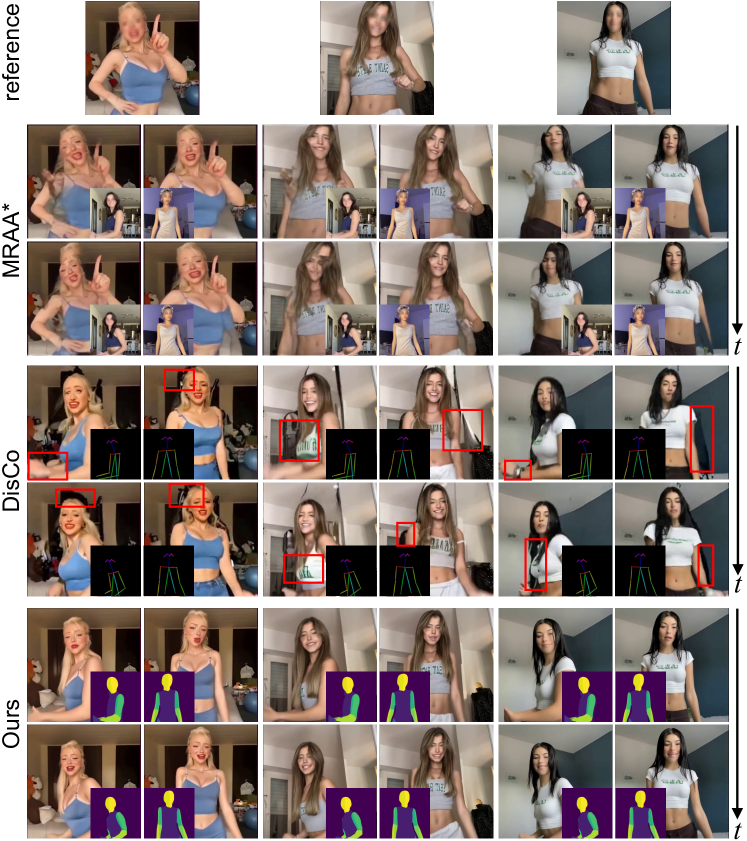
- MagicAnimate achieves state-of-the-art performance on TikTok and TED-talks datasets across image and video fidelity metrics.
- On TikTok, MagicAnimate surpasses the strongest baseline by over 38% in terms of video quality (FVD) and 38% in FID-VID.
- It attains the best FID-VID and FVD on TED-talks, with notable improvements over baselines.
- Ablations show temporal modeling and the appearance encoder substantially improve SSIM and LPIPS, and the image-video joint training enhances overall fidelity.
- The simple video fusion strategy yields smoother transitions for long videos and improves temporal consistency.
이 논문 읽기
누빈트 뷰어에서 원문을 열고, 읽으면서 궁금한 곳을 바로 물어보세요.
누빈트에서 이 논문 읽기이 리뷰는 AI가 논문 원문을 바탕으로 만들었습니다. 인용하기 전에 원문을 확인해 주세요.