
[논문 리뷰] MaGS: Reconstructing and Simulating Dynamic 3D Objects with Mesh-adsorbed Gaussian Splatting
MaGS는 변형 중 메시에 3D 가우시안을 떠다니게 하는 상대 변형 필드를 학습하여 3D 재구성 및 동적 객체 시뮬레이션을 통합하고, 변형 중에 메시에 가우시안이 떠다니도록 하여 높은 렌더링 품질과 현실적인 모션을 달성한다.
3D reconstruction and simulation, although interrelated, have distinct objectives: reconstruction requires a flexible 3D representation that can adapt to diverse scenes, while simulation needs a structured representation to model motion principles effectively. This paper introduces the Mesh-adsorbed Gaussian Splatting (MaGS) method to address this challenge. MaGS constrains 3D Gaussians to roam near the mesh, creating a mutually adsorbed mesh-Gaussian 3D representation. Such representation harnesses both the rendering flexibility of 3D Gaussians and the structured property of meshes. To achieve this, we introduce RMD-Net, a network that learns motion priors from video data to refine mesh deformations, alongside RGD-Net, which models the relative displacement between the mesh and Gaussians to enhance rendering fidelity under mesh constraints. To generalize to novel, user-defined deformations beyond input video without reliance on temporal data, we propose MPE-Net, which leverages inherent mesh information to bootstrap RMD-Net and RGD-Net. Due to the universality of meshes, MaGS is compatible with various deformation priors such as ARAP, SMPL, and soft physics simulation. Extensive experiments on the D-NeRF, DG-Mesh, and PeopleSnapshot datasets demonstrate that MaGS achieves state-of-the-art performance in both reconstruction and simulation.
연구 동기 및 목표
- 동일한 렌더링 품질이나 변형의 리얼리즘을 희생하지 않고 동적 3D 재구성 및 시뮬레이션을 위한统一된 접근 방식을 제안한다.
- 가우시안 스플래팅의 유연성과 메쉬 일관성을 결합한 mesh-adsorbed Gaussian 표현을 제안한다.
- 메쉬와 가우시안 간의 상대적 운동을 모델링하는 학습 가능한 Relative Deformation Field (RDF)를 도입한다.
- ARAP 기반의 메쉬 변형과 RDF를 활용하여 현실적이고 제어 가능한 다이나믹스를 달성한다.
- 메쉬, 가우시안, RDF를 공동 최적화하여 재구성 정확도와 변형 리얼리즘을 향상시킨다.
제안 방법
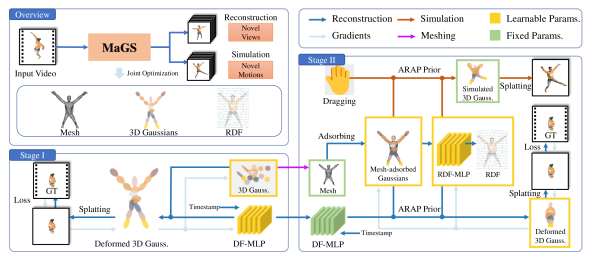
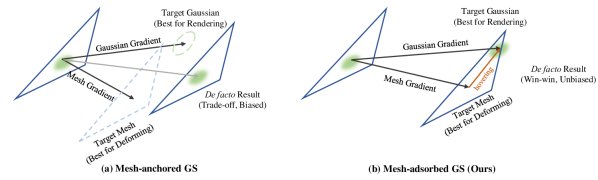
- MaGS를 도입하여 Gaussian을 메쉬 표면 위에 떠다니도록 제약하는 Mesh-adsorbed Gaussian Splatting을 제시한다. 이는 하이브리드 표현을 위한 구성이다.
- Stage I에서는 변형 필드 MLP (DF-MLP)를 사용하여 코스 변형 필드를 추정하고 프레임을 렌더링하며 깊이 기반 Gaussian 렌더링과 Marching Cubes를 통해 코스 메쉬를 얻는다.
- Stage II에서는 가우시안을 메쉬에 흡착시키고 RDF-MLP를 사용하여 상대 변형 필드를 계산하며, 이를 통해 가우시안이 메쉬를 따라 떠다니고 변형되도록 한다.
- ARAP 프리이어를 확장하여 변형 중 비강체, 각 가우시안의 비강체 운동을 포착한다.
- Poisson-disk 샘플링을 이용해 변형 핸들을 배치하고 ARAP를 적용하여 국소 강성을 보장하는 동시에 RDF가 더 미세한 비강체 운동을 포착하도록 한다.
- 3D 가우시안 스플래팅을 통한 차별화 가능한 렌더링을 가능하게 하여 가우시안, 메쉬, RDF를 엔드-투-엔드로 최적화한다.
- 메시를 드래그하고 RDF 기반 조정을 통해 가우시안 위치를 개선하여 사용자가 상호 작용하는 시뮬레이션을 제공한다.
실험 결과
연구 질문
- RQ1단안 비디오에서의 정확한 3D 재구성 및 현실적인 동적 변형을 모두 지원하는 하이브리드 mesh-adsorbed Gaussian 표현이 가능한가?
- RQ2학습 가능한 Relative Deformation Field (RDF)가 ARAP 기반 메쉬 변형을 넘어 가우시안당 운동 모델링을 개선하는가?
- RQ3메시, 가우시안, RDF의 공동 최적화가 고정 메쉬-가우시안 고정화에 비해 렌더링 품질과 변형 타당성에서 어떤 차이를 보이는가?
- RQ4텍스처와 구조를 보존하면서 사용자 주도형 변형을 지원할 수 있는가?
- RQ5MaGS를 사용할 때 Dynamic Scene 벤치마크(D-NeRF, NeRF-DS)에서 이전 방법 대비 정량적 이점은 무엇인가?
주요 결과
- MaGS는 D-NeRF와 NeRF-DS에서 이전의 메시-가우시안 접근법보다 더 높은 렌더링 정확도와 더 현실적인 변형을 달성한다.
- 메시, 가우시안, RDF를 공동 최적화하면 아티팩트를 줄이고 평가된 시퀀스에서 PSNR/SSIM 지표를 향상시키고 LPIPS를 낮춘다.
- 가우시안을 메쉬 위에 떠다니게 하고 가우시안당 상대 변형을 학습하면 고정된 메쉬-앵커링 표현보다 렌더링 충실도가 더 좋아진다.
- 데이터 제거(RDF 제거 또는 떠다니는 것의 제거) 실험은 성능 저하를 보이며, RDF가 렌더링 품질에 더 큰 영향을 준다.
이 논문 읽기
누빈트 뷰어에서 원문을 열고, 읽으면서 궁금한 곳을 바로 물어보세요.
누빈트에서 이 논문 읽기이 리뷰는 AI가 논문 원문을 바탕으로 만들었습니다. 인용하기 전에 원문을 확인해 주세요.