
[논문 리뷰] Making Scalable Meta Learning Practical
이 논문은 기울기 기반 메타 학습의 효율적이고 분산된 훈련을 가능하게 하기 위해 명시적 2차 미분 계산을 피하고 적응형 최적화 기법을 지원하는 확장 가능한 메타 학습 프레임워크인 SAMA를 소개한다. SAMA는 다중 GPU 환경에서 최대 4.8배 높은 처리량과 3.8배 낮은 메모리 사용량을 달성하여 BERT 및 RoBERTa 모델의 데이터 프루닝과 파인튜닝에서 최신 기술 수준의 성능을 입증한다.
Despite its flexibility to learn diverse inductive biases in machine learning programs, meta learning (i.e., learning to learn) has long been recognized to suffer from poor scalability due to its tremendous compute/memory costs, training instability, and a lack of efficient distributed training support. In this work, we focus on making scalable meta learning practical by introducing SAMA, which combines advances in both implicit differentiation algorithms and systems. Specifically, SAMA is designed to flexibly support a broad range of adaptive optimizers in the base level of meta learning programs, while reducing computational burden by avoiding explicit computation of second-order gradient information, and exploiting efficient distributed training techniques implemented for first-order gradients. Evaluated on multiple large-scale meta learning benchmarks, SAMA showcases up to 1.7/4.8x increase in throughput and 2.0/3.8x decrease in memory consumption respectively on single-/multi-GPU setups compared to other baseline meta learning algorithms. Furthermore, we show that SAMA-based data optimization leads to consistent improvements in text classification accuracy with BERT and RoBERTa large language models, and achieves state-of-the-art results in both small- and large-scale data pruning on image classification tasks, demonstrating the practical applicability of scalable meta learning across language and vision domains.
연구 동기 및 목표
- 고비용의 계산/메모리 요구와 분산 훈련 지원 부족으로 인한 기울기 기반 메타 학습의 낮은 확장성 문제를 해결한다.
- 특히 Adam과 같은 적응형 최적화 기법을 사용하는 대규모 모델에서 기존 은닉 미분 방법의 불안정성과 비효율성을 극복한다.
- 실제 자연어 처리 및 비전 응용 분야에서 메타 학습의 실용적 구현을 가능하게 하기 위해 시스템-알고리즘 공동 설계 접근법을 개발한다.
- BERT 및 RoBERTa와 같은 대규모 모델의 데이터 최적화, 프루닝, 파인튜닝을 포함한 다양한 작업에 대해 효율적이고 확장 가능한 메타 학습을 가능하게 한다.
- 적응형 최적화 기법과 분산 훈련을 지원하는 현대 딥러닝 워크플로우를 통해 이론적 메타 학습과 실용적 구현 간 격차를 메운다.
제안 방법
- 비용이 많이 드는 행렬 역행렬 계산을 피하기 위해 기본 자코비안 역행렬을 항등행렬로 근사함으로써 계산 오버헤드를 감소시킨다.
- 체인 룰을 통한 메타 기울기 계산을 확장하여 Adam과 같은 적응형 최적화 기법을 지원함으로써 현대 딥러닝 모델과의 호환성을 확보한다.
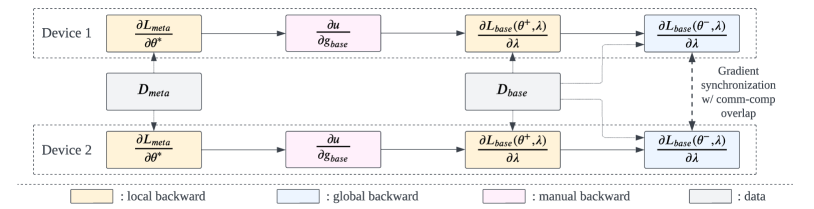
- 여러 GPU 간 자원을 효율적으로 활용하기 위해 새로운 통신-계산 겹침 전략을 구현한다.
- SAMA를 구현하기 위해 JaxOpt 프레임워크를 활용하여 1차 미분 기반 은닉 미분 기법을 적용함으로써 명시적 2차 미분 계산을 피한다.
- 사용자 정의 autograd 확장 기능 없이도 메타 기울기의 역전파 계산을 효율적으로 지원하는 시스템 최적화 파이프라인을 설계한다.
- 기존에 1차 최적화 방법을 위해 설계된 효율적인 분산 훈련 기법을 메타 학습 프레임워크에 통합하여 다중 GPU 환경에서의 확장성을 확보한다.
실험 결과
연구 질문
- RQ1Adam과 같은 적응형 최적화 기법을 사용하는 대규모 모델에 대해 은닉 미분 기반 메타 학습이 확장 가능하고 효율적으로 구현될 수 있는가?
- RQ2기본 자코비안 역행렬의 역행렬 계산으로 인한 계산 및 메모리 오버헤드를 안정성 손실 없이 어떻게 줄일 수 있는가?
- RQ31차 최적화를 위한 분산 훈련 기법이 메타 학습의 확장 가능성을 지원하기 위해 얼마나 잘 적응될 수 있는가?
- RQ4대규모 벤치마크에서 기존 GBML 방법 대비 SAMA가 처리량과 메모리 효율성에서 뚜렷한 향상을 이룰 수 있는가?
- RQ5SAMA는 BERT와 같은 대규모 언어 모델의 데이터 프루닝 및 파인튜닝과 같은 실용적 응용에서 일관된 성능 향상을 제공하는가?
주요 결과
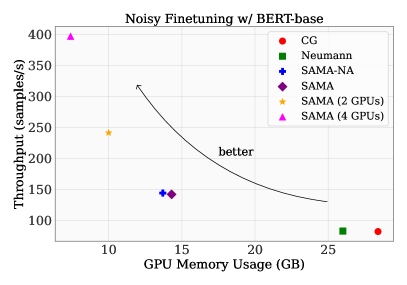
- 단일 GPU 환경에서 SAMA는 기준 메타 학습 알고리즘 대비 최대 1.7배 높은 처리량과 2.0배 낮은 메모리 소비를 달성한다.
- 다중 GPU 환경에서 SAMA는 기준 방법 대비 최대 4.8배 높은 처리량과 3.8배 낮은 메모리 소비를 기록한다.
- SAMA 기반 데이터 최적화 기법은 여러 텍스트 분류 벤치마크에서 BERT 및 RoBERTa 대규모 언어 모델의 파인튜닝 정확도를 향상시킨다.
- SAMA는 ImageNet-1k에서 이미지 분류 작업에 대해 소규모 및 대규모 데이터 프루닝 모두에서 최신 기술 수준의 성능을 달성한다.
- 모델 크기가 커질수록 SAMA와 기준 방법 간의 효율성 격차가 더욱 벌어지며, SAMA는 GPU 메모리 사용량 증가율이 가장 낮다.
- 4개 GPU에서 SAMA를 활용한 효율적 분산 훈련은 분산 훈련을 지원하지 않는 MWN 대비 15–20배의 속도 향상을 달성한다.
더 나은 연구,지금 바로 시작하세요
논문 읽기부터 검토까지, 연구 시간을 획기적으로 줄여보세요.
카드 등록 없음 · 무료 플랜 제공
이 리뷰는 AI가 만들고, 인간 에디터가 검토했습니다.