
[논문 리뷰] Markerless Multi-view 3D Human Pose Estimation: a survey
이 종합 검토는 마커리스 다중 시점 3D 인간 자세 추정에 대한 포괄적인 분석을 제공하며, 방법론, 음영, 데이터 부족 등의 과제, 그리고 다중 모odal 학습 및 시간적 일관성 전략 등을 다룹니다. 현재의 방법이 모든 과제를 완전히 해결하지 못하고 있음을 확인하며, 저감도 감독, 능동 학습, 효율적인 추론 기법에 대한 향후 연구의 필요성을 강조합니다.
3D human pose estimation involves reconstructing the human skeleton by detecting the body joints. Accurate and efficient solutions are required for several real-world applications including animation, human-robot interaction, surveillance, and sports. However, challenges such as occlusions, 2D pose mismatches, random camera perspectives, and limited 3D labelled data have been hampering the models' performance and limiting their deployment in real-world scenarios. The higher availability of cameras has led researchers to explore multi-view solutions to take advantage of the different perspectives to reconstruct the pose. Most existing reviews have mainly focused on monocular 3D human pose estimation, so a comprehensive survey on multi-view approaches has been missing since 2012. According to the reviewed articles, the majority of the existing methods are fully-supervised approaches based on geometric constraints, which are often limited by 2D pose mismatches. To mitigate this, researchers have proposed incorporating temporal consistency or depth information. Alternatively, working directly with 3D features has been shown to completely overcome this issue, albeit at the cost of increased computational complexity. Additionally, models with lower levels of supervision have been identified to help address challenges such as annotated data scarcity and generalisation to new setups. Therefore, no method currently addresses all challenges associated with 3D pose reconstruction, and a trade-off between complexity and performance exists. Further research is needed to develop approaches capable of quickly inferring a highly accurate 3D pose with bearable computation cost. Techniques such as active learning, low-supervision methods, temporal consistency, view selection, depth information estimation, and multi-modal approaches are strategies to consider when developing a new method for this task.
연구 동기 및 목표
- 마커리스 다중 시점 3D 인간 자세 추정 분야의 최신 기법에 대한 체계적인 개요를 제공하기 위해.
- 음영, 시점 할당, 제한된 3D 레이블이 있는 데이터와 같은 핵심 과제를 해결하기 위해 사용되는 전략을 분석하기 위해.
- 다양한 응용 시나리오에서 모델 복잡도, 성능, 계산 비용 간의 상충 관계를 평가하기 위해.
- 열린 연구 과제를 식별하고, 자기지도 학습 및 다중 모달 통합과 같은 유망한 향후 연구 방향을 제안하기 위해.
- 기준 데이터셋 간 성능 비교를 통해 일반화 및 희귀 자세 또는 혼잡한 장면에 대한 저항성에 대한 한계를 강조하기 위해.
제안 방법
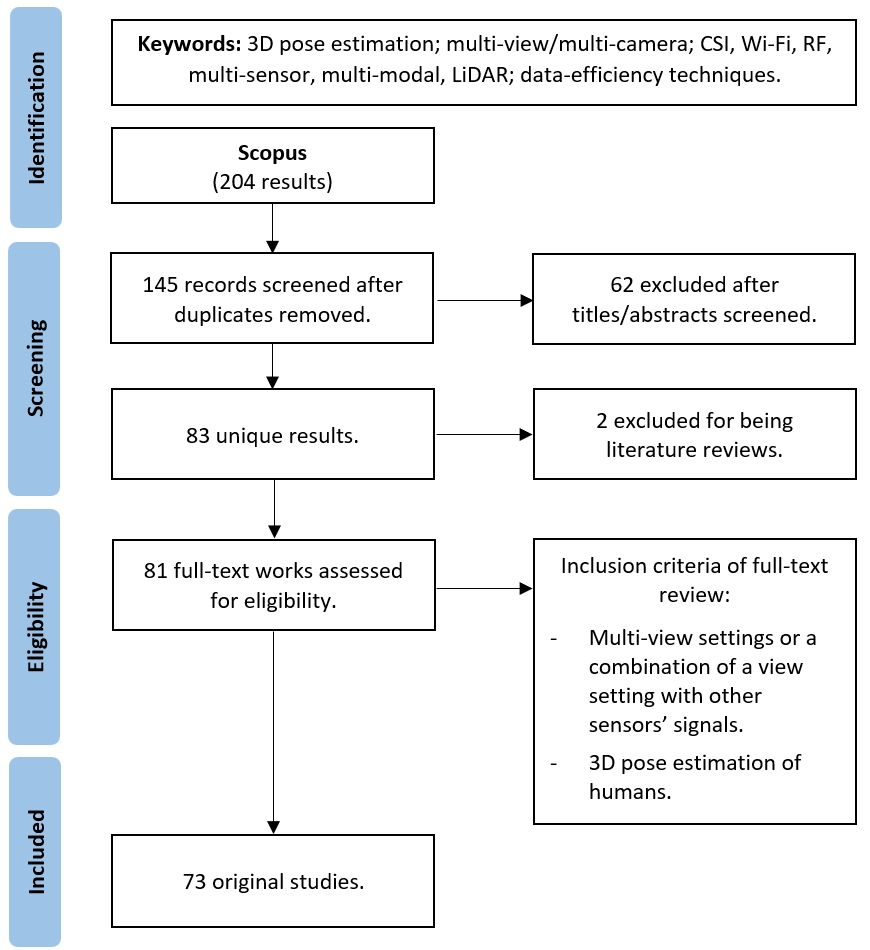
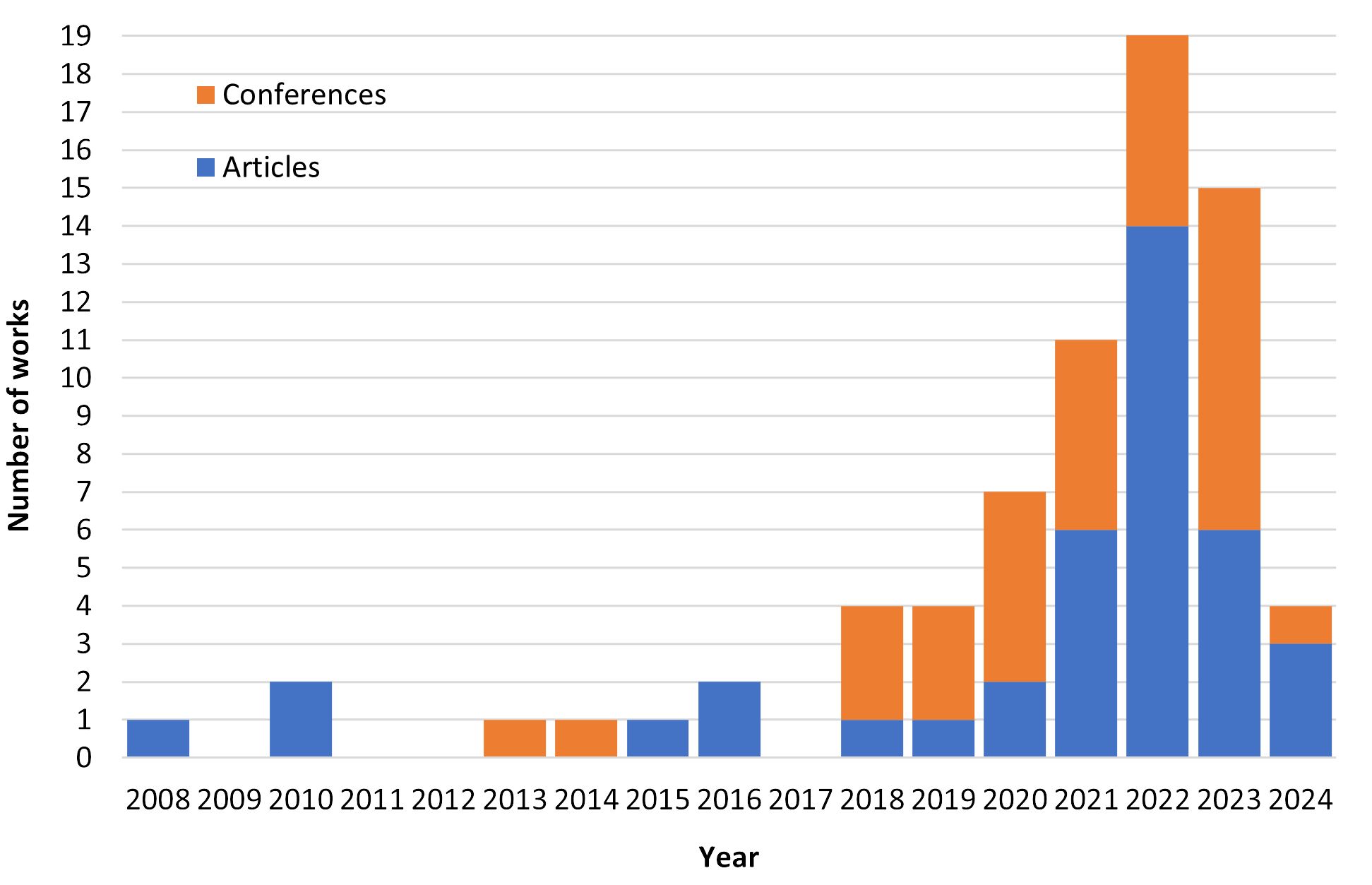
- 2010년부터 2024년까지의 100篇 이상의 논문을 대상으로 한 체계적 문헌 검토로, 단일 RGB 카메라를 사용한 다중 시점 3D 자세 추정에 집중합니다.
- 감독 수준(완전 감독, 약한 감독, 자기지도 학습), 시간 모델링, 시점 선택 전략에 기반한 방법의 분류.
- 기하학적 접근 및 딥 러닝 기반 접근의 분석, 다중 시점 삼각측량, 3D 키포인트 회귀, 그래프 신경망 포함.
- CMU Panoptic, UMPM, Human3.6M 등의 표준 기준 데이터셋을 사용한 성능 평가로, MPJPE (mm) 및 PCKh (%) 등의 지표 활용.
- 비디오 시퀀스에서의 저항성을 향상시키기 위해 시간적 일관성 모델링 통합.
- 깊이 추정 및 다중 모달 데이터(예: IMU, 음성) 통합을 새로운 전략으로 도입하여 정확도 향상과 감독 감소를 도모.
실험 결과
연구 질문
- RQ1다중 시점 3D 인간 자세 추정에서 주로 사용되는 주요 방법론과 아키텍처는 무엇이며, 감독 수준과 설계 측면에서 어떻게 다릅니까?
- RQ2기존 방법들은 실세계의 다중 시점 설정에서 음영, 시점의 모호성, 낮은 카메라 캘리브레이션 문제를 어떻게 해결합니까?
- RQ3현재 접근 방식에서 주요 성능 저하 요인은 무엇이며, 특히 데이터 부족과 제약 없는 환경에서의 일반화 능력에 있어 어떤가요?
- RQ4시간 모델링과 다중 모달 융합은 추정 정확도와 저항성 향상에 얼마나 기여합니까?
- RQ5실시간으로 정확하고 저감독된 3D 자세 추정을 실용적 응용에서 달성하기 위한 가장 유망한 향후 연구 방향은 무엇입니까?
주요 결과
- 현재까지의 방법 중 마커리스 다중 시점 3D 자세 추정에서 음영, 복잡한 상호작용, 제한된 3D 감독 하에서 모든 과제를 완전히 해결하지 못하고 있습니다.
- 5개 이상의 시점을 사용하는 방법은 CMU Panoptic에서 가장 낮은 MPJPE(예: Reddy 등 [64]에서 7.30 mm)와 가장 높은 mAP(92.35% in Zhu 등 [103])를 기록하여, 시점 수 증가로 성능 향상이 가능함을 시사합니다.
- 자기지도 학습 및 약한 감독 방법은 고비용 3D 레이블에 대한 의존도를 줄이는 데 유망하지만, 여전히 완전 감독 모델에 비해 성능이 열등합니다.
- 시간적 일관성 모델링은 성능 향상에 상당한 기여를 하며, Lin과 Lee [50]의 방법은 CMU Panoptic에서 25mm 임계값에서 92.12%의 AP를 달성했습니다.
- RGB와 IMU 또는 깊이 데이터를 융합하는 다중 모달 접근 방식은 도전적인 상황에서 저항성을 향상시키지만, 통합 방법은 아직 탐색이 부족합니다.
- UMPMS에서 가장 뛰어난 성능을 보인 방법들은 평균 96% 이상의 PCKh를 기록하며, Ershadi-Nasab 등 [26]은 p3-chair-11에서 96.65%를 달성하여 제어된 시퀀스에서 뛰어난 성능을 보였습니다.
이 논문 읽기
누빈트 뷰어에서 원문을 열고, 읽으면서 궁금한 곳을 바로 물어보세요.
누빈트에서 이 논문 읽기이 리뷰는 AI가 논문 원문을 바탕으로 만들었습니다. 인용하기 전에 원문을 확인해 주세요.