
[논문 리뷰] MEMTO: Memory-guided Transformer for Multivariate Time Series Anomaly Detection
MEMTO는 게이트형 메모리 모듈과 두 단계 학습 패러다임을 갖춘 기억 주도형 트랜스포머를 통해 다변량 시계열의 이상을 탐지하고, 다섯 개의 실제 데이터셋에서 bi-dimensional deviation-based detection criterion를 사용하여 최첨단 F1 점수를 달성한다.
Detecting anomalies in real-world multivariate time series data is challenging due to complex temporal dependencies and inter-variable correlations. Recently, reconstruction-based deep models have been widely used to solve the problem. However, these methods still suffer from an over-generalization issue and fail to deliver consistently high performance. To address this issue, we propose the MEMTO, a memory-guided Transformer using a reconstruction-based approach. It is designed to incorporate a novel memory module that can learn the degree to which each memory item should be updated in response to the input data. To stabilize the training procedure, we use a two-phase training paradigm which involves using K-means clustering for initializing memory items. Additionally, we introduce a bi-dimensional deviation-based detection criterion that calculates anomaly scores considering both input space and latent space. We evaluate our proposed method on five real-world datasets from diverse domains, and it achieves an average anomaly detection F1-score of 95.74%, significantly outperforming the previous state-of-the-art methods. We also conduct extensive experiments to empirically validate the effectiveness of our proposed model's key components.
연구 동기 및 목표
- 실제 세계의 다변량 시계열에서 재구성 기반 방법의 과도한 일반화 문제를 해결함으로써 강건한 이상 탐지를 촉진한다.
- 이상이 재구성되도록 정규화하는 대표적 정상 패턴을 저장하는 기억 주도형 트랜스포머를 개발한다.
- 메모리 아이템을 K-means 중심으로 초기화하는 두 단계 학습 패러다임을 통해 메모리 업데이트를 안정화한다.
- 잠재공간 및 입력공간 편차를 결합한 이차원 이상 점수를 제안하여 강건한 온라인 탐지를 실현한다.
제안 방법
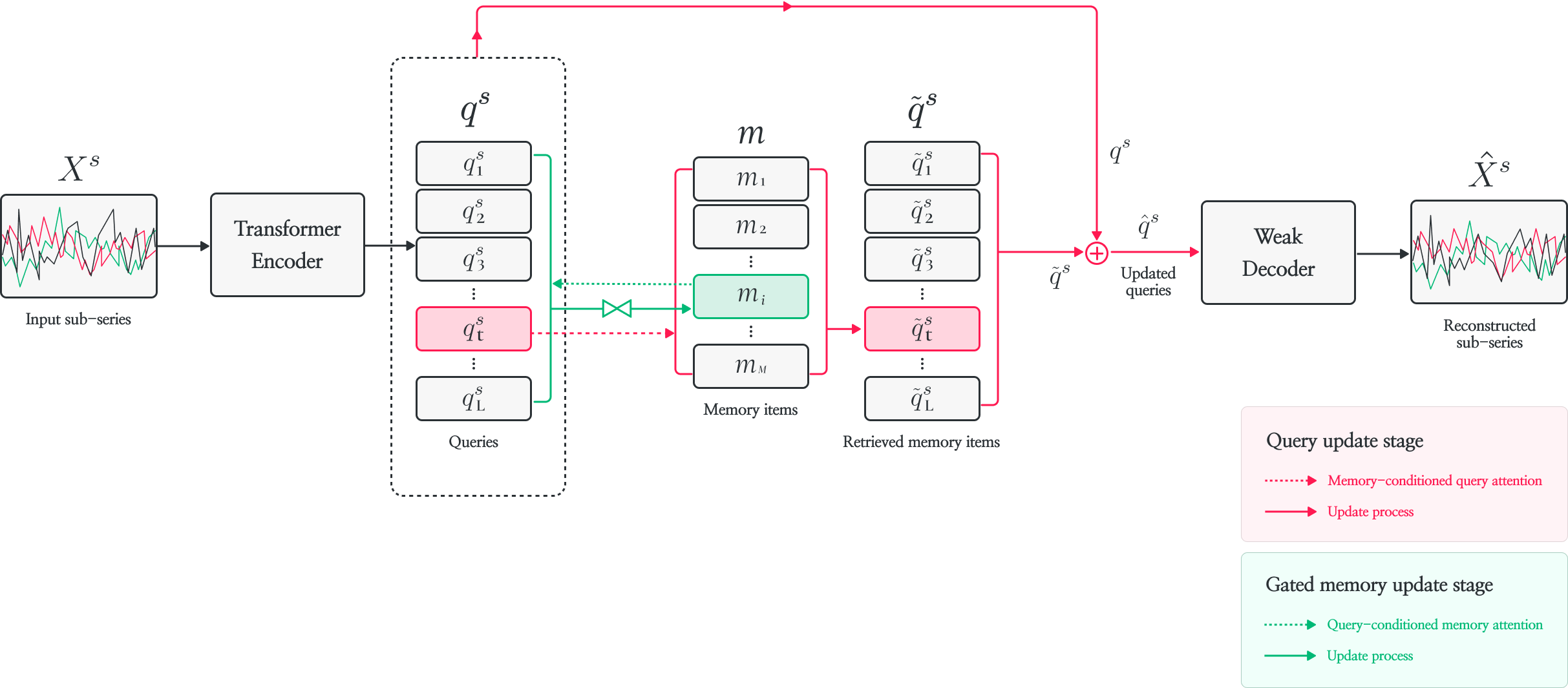
- 입력 부분 시계열을 잠재 공간으로 투영하기 위해 트랜스포머 인코더를 사용한다.
- 입력 데이터에 맞추어 메모리 아이템을 업데이트하는 업데이트 게이트가 있는 게이트형 메모리 모듈을 도입한다.
- 디코딩 전에 쿼리와 함께 메모리 아이템을 검색하고 연결하는 메모리 조건부 쿼리 업데이트 단계를 구현한다.
- 입력을 재구성하기 위한 약한 디코더를 사용하여 자기지도 학습 사전 태스크로 작용한다.
- 재구성 손실과 메모리 주의에 대한 엔트로피 기반 희소 규제화를 통해 새로운 정보 주입을 제어한다.
- 인코더가 생성한 쿼리에 대해 K-means 클러스터링을 사용한 두 단계 학습 패러다임으로 메모리 아이템을 초기화한다.
실험 결과
연구 질문
- RQ1MEMTO가 다양한 실제 데이터셋에 걸쳐 다변량 시계열 이상 탐지에서 기존 방법을 능가할 수 있는가?
- RQ2게이트형 메모리 모듈이 다양한 정상 패턴에 적응함으로써 강건성을 향상시키는가?
- RQ3두 단계 메모리 초기화가 데이터셋 간 학습 안정성과 성능을 향상시키는가?
- RQ4이차원 편차 기반 기준(잠재 공간 및 입력 공간)이 단일 공간 기준보다 더 신뢰할 수 있는 이상 점수를 제공하는가?
- RQ5메모리 아이템 수에 MEMTO가 얼마나 민감하고 계산적 트레이드오프는 무엇인가?
주요 결과
- MEMTO는 다섯 개의 실제 데이터셋에서 평균 F1-점수 95.74%를 달성하여 이전 최첨단을 능가한다.
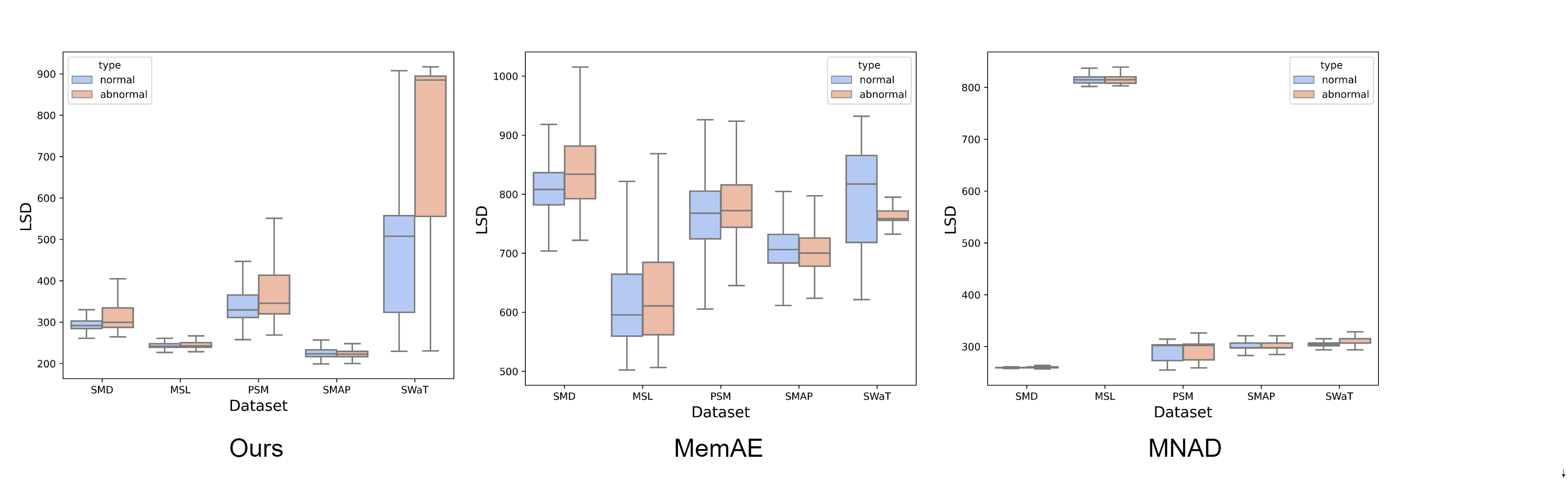
- 이차원 편차 기반 이상 기준(잠재 공간 및 입력 공간)은 단일 공간 기준보다 일관되게 우수하다.
- 게이트형 메모리 모듈을 제거하면 성능이 크게 감소하며, SWaT에서 특히 하락이 두드러진다.
- K-means를 이용한 두 단계 메모리 초기화가 안정성과 평균 F1 점수를 크게 향상시킨다.
- MEMTO는 메모리 아이템 수에 따라 견고하며, 성능과 효율성을 고려했을 때 10개 아이템이 좋은 기본값으로 확인된다.
- MEMTO의 추론 시 계산이 비교 대상 Anomaly Transformer 모델보다 빠르며, 더 간단한 온라인 계산 덕분이다.
이 논문 읽기
누빈트 뷰어에서 원문을 열고, 읽으면서 궁금한 곳을 바로 물어보세요.
누빈트에서 이 논문 읽기이 리뷰는 AI가 논문 원문을 바탕으로 만들었습니다. 인용하기 전에 원문을 확인해 주세요.