
[논문 리뷰] MetaGCD: Learning to Continually Learn in Generalized Category Discovery
MetaGCD는 지속적 일반화된 카테고리 발견(C-GCD)을 위한 메타학습 프레임워크를 제안한다. 이는 기존 카테고리와 새로운 카테고리를 모두 포함한 레이블이 없는 데이터에서 모델이 점진적으로 새로운 클래스를 발견하면서 치명적인 잊음(catastrophic forgetting)을 최소화할 수 있도록 한다. 메타최적화와 소프트 이웃 대비 손실을 활용하여 MetaGCD는 벤치마크 전반에서 최신 기술 성능을 달성하며, 최종 신규 클래스 정확도에서 기존 기준 모델보다 최대 6.25% 향상된다.
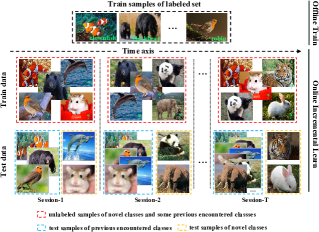
In this paper, we consider a real-world scenario where a model that is trained on pre-defined classes continually encounters unlabeled data that contains both known and novel classes. The goal is to continually discover novel classes while maintaining the performance in known classes. We name the setting Continual Generalized Category Discovery (C-GCD). Existing methods for novel class discovery cannot directly handle the C-GCD setting due to some unrealistic assumptions, such as the unlabeled data only containing novel classes. Furthermore, they fail to discover novel classes in a continual fashion. In this work, we lift all these assumptions and propose an approach, called MetaGCD, to learn how to incrementally discover with less forgetting. Our proposed method uses a meta-learning framework and leverages the offline labeled data to simulate the testing incremental learning process. A meta-objective is defined to revolve around two conflicting learning objectives to achieve novel class discovery without forgetting. Furthermore, a soft neighborhood-based contrastive network is proposed to discriminate uncorrelated images while attracting correlated images. We build strong baselines and conduct extensive experiments on three widely used benchmarks to demonstrate the superiority of our method.
연구 동기 및 목표
- 기존 방법의 한계를 해결하기 위해, 레이블이 없는 데이터에 신규 클래스만 존재한다고 가정하거나 반복적인 재학습이 필요하다는 점을 해결하고자 한다.
- 모델이 시간이 지남에 따라 기존 및 신규 클래스가 혼합된 환경에서 지속적으로 학습하는 현실적인 설정인 지속적 일반화된 카테고리 발견(C-GCD)을 제안하고자 한다.
- 완전히 학습된 엔드 투 엔드 프레임워크를 통해 치명적인 잊음을 최소화하면서도 점진적인 신규 클래스 발견을 가능하게 하고자 한다.
- 미리 훈련 단계에서 오프라인 레이블이 있는 데이터를 활용하여 향후 지속적 학습 작업을 위해 모델를 사전 준비함으로써, 히우리스틱 또는 수작업 전략을 피하고자 한다.
제안 방법
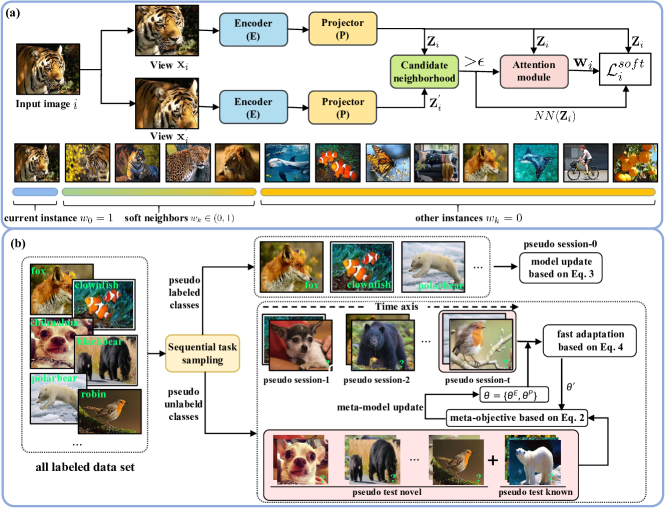
- MetaGCD는 메타학습 프레임워크를 활용하여, 두 가지 상충하는 목표를 조합한 메타목표를 통해 신규 클래스 발견과 지식 유지 간의 균형을 최적화한다.
- 이 방법은 인스턴스와 그 이웃 간의 상관관계 가중치를 계산하여 양의 쌍을 정의하는 소프트 이웃 기반 대비 학습 모듈을 사용한다. 이는 더 견고한 특징 학습을 가능하게 한다.
- 차별 가능한 어텐션 메커니즘이 이웃에 대해 소프트 상관관계 점수를 할당하여, 관련성이 높은 샘플에 집중하고 관련성이 낮은 샘플은 억제한다.
- 모델는 메타최적화 루프를 통해 훈련되며, 각 내부 업데이트는 점진적 학습 세션을 시뮬레이션하고, 메타업데이트는 기존 및 신규 클래스 성능을 종합한 손실을 최소화한다.
- 프레임워크는 향후 점진적 세션을 시뮬레이션하기 위해 오프라인 레이블이 있는 데이터로 훈련되어, 모델이 지속적 환경에서 어떻게 학습할 수 있는지 학습할 수 있도록 한다.
- 유사도 임계값과 메타학습 시 신규 클래스 수와 같은 하이퍼파라미터를 분석하고 최적화하여 성능을 향상시킨다.
실험 결과
연구 질문
- RQ1레이블이 없는 데이터에 기존 및 신규 클래스가 혼합된 현실 환경에서, 오프라인으로 훈련된 모델이 지속적으로 새로운 클래스를 발견할 수 있는가?
- RQ2메타학습을 어떻게 활용하여 지속적 학습에서 신규 클래스 발견과 기억 상실 방지의 이중 목표를 동시에 최적화할 수 있는가?
- RQ3인스턴스와 그 이웃 간의 소프트 상관관계 모델링이 표현 품질과 분류 정확도에 미치는 영향은 무엇인가?
- RQ4메타학습 시 신규 클래스의 수가 모델이 새로운 점진적 작업으로 일반화하는 능력에 미치는 영향은 무엇인가?
- RQ5이진 양의/음의 레이블링 대비 소프트 양의성(Soft positiveness)을 가진 대비 학습 목표가 지속적 발견 성능에 얼마나 기여하는가?
주요 결과
- CIFAR100에서 VanillaGCD 기준 모델보다 최종 신규 클래스 정확도가 6.25% 향상되었으며, 세 가지 벤치마크에서 최종 전체 클래스 정확도는 각각 3.12%와 4.09% 향상되었다.
- 소프트 이웃 대비 학습 구성 요소는 더 세밀한 양의 쌍 선택을 가능하게 하여, 신규 클래스 정확도를 1.66%p 향상시켰다 (62.89% → 64.55%).
- 이웃 선택에 대해 0.85의 임계값이 최적의 성능을 내며, 관련 샘플을 포함하고 오류 양성 샘플을 제거하는 데 균형을 이룬다.
- 메타학습은 일반화 능력을 크게 향상시켜, 명시적으로 발견과 유지 목표를 최적화함으로써 최종 전체 클래스 정확도를 74.56%로 끌어올렸다.
- 메타학습 시 더 많은 수의 신규 클래스(예: 10개)를 사용해 훈련한 모델는 더 뛰어난 강건성과 일반화 능력을 보이며, 적은 수의 클래스를 사용한 경우보다 과적합 위험이 낮아진다.
- 혼동 행렬 분석 결과, MetaGCD는 예측을 대각선에 집중시키며, 기존 및 신규 카테고리 모두에서 기억 상실 감소와 개선된 클래스별 성능을 보였다.
더 나은 연구,지금 바로 시작하세요
논문 읽기부터 검토까지, 연구 시간을 획기적으로 줄여보세요.
카드 등록 없음 · 무료 플랜 제공
이 리뷰는 AI가 만들고, 인간 에디터가 검토했습니다.