
[논문 리뷰] MiAMix: Enhancing Image Classification through a Multi-stage Augmented Mixed Sample Data Augmentation Method
MiAMix 는 AGMix 와 다수의 MSDA 마스크를 결합한 다단계 증강 믹스업 프레임워크를 제안하여 자기 혼합 및 마스크 증강을 가능하게 하여, 정확도와 로버스트성을 향상시키고 학습 오버헤드는 다소 낮습니다. CIFAR-10/100 및 Tiny-ImageNet에서 다른 저비용 MSDA 방법을 능가하면서도 학습 비용은 약 11% 수준을 추가합니다.
Despite substantial progress in the field of deep learning, overfitting persists as a critical challenge, and data augmentation has emerged as a particularly promising approach due to its capacity to enhance model generalization in various computer vision tasks. While various strategies have been proposed, Mixed Sample Data Augmentation (MSDA) has shown great potential for enhancing model performance and generalization. We introduce a novel mixup method called MiAMix, which stands for Multi-stage Augmented Mixup. MiAMix integrates image augmentation into the mixup framework, utilizes multiple diversified mixing methods concurrently, and improves the mixing method by randomly selecting mixing mask augmentation methods. Recent methods utilize saliency information and the MiAMix is designed for computational efficiency as well, reducing additional overhead and offering easy integration into existing training pipelines. We comprehensively evaluate MiaMix using four image benchmarks and pitting it against current state-of-the-art mixed sample data augmentation techniques to demonstrate that MIAMix improves performance without heavy computational overhead.
연구 동기 및 목표
- 오버피팅과 제한된 라벨 데이터 문제를 mixup 기반 데이터 증강으로 해결한다.
- 이미지 증강을 mixup 프레임워크에 다중 동시 혼합 마스크와 통합한다.
- Augmentation 및 회전을 통해 혼합 마스크의 다양성을 높여 일반화 성능을 개선한다.
- 계산 효율성과 기존 학습 파이프라인에의 원활한 통합을 유지한다.
제안 방법
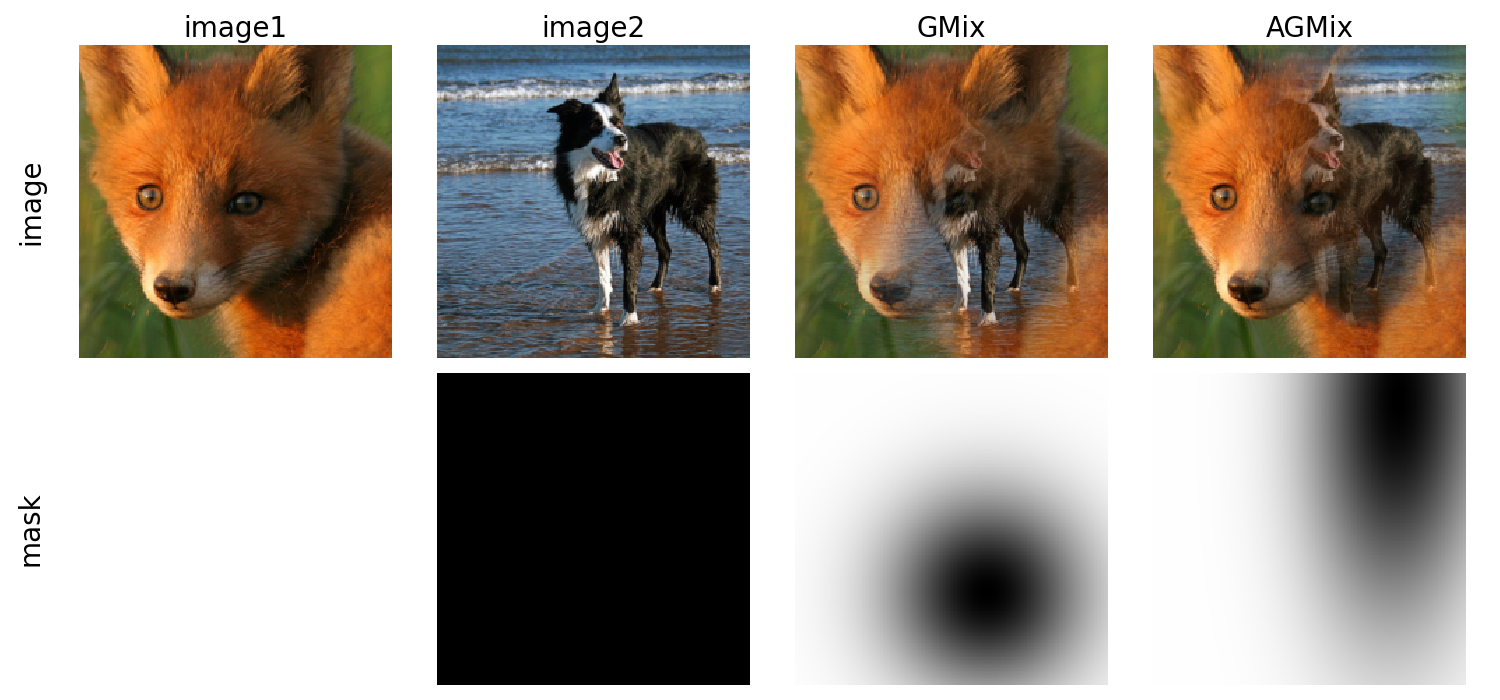
- 다양한 마스크 모양을 위한 무작위 가우시안 혼합 커널로 GMix 를 확장하여 AGMix 를 구성한다.
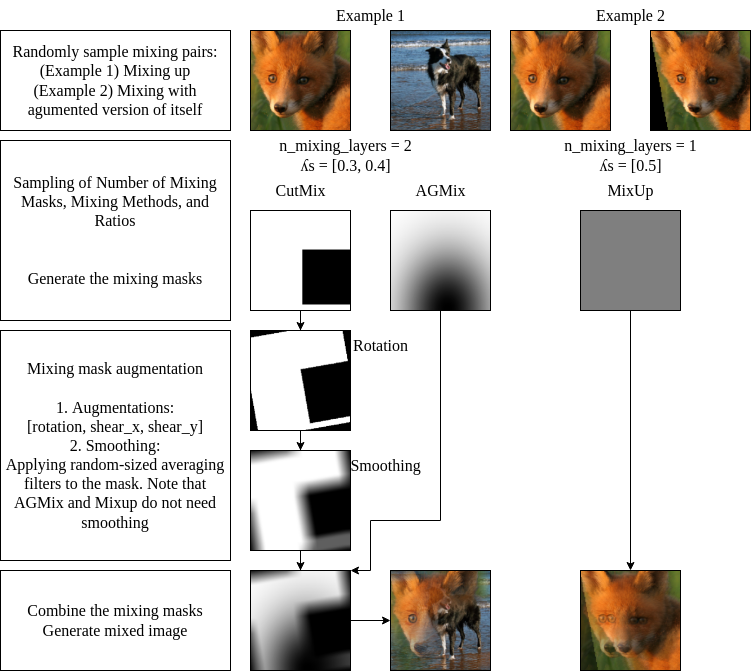
- 네 가지 단계로 MiAMix 를 도입한다: 무작위 샘플 페어링, 혼합 방법 및 비율의 샘플링, 혼합 마스크의 생성 및 증강, 혼합 출력 생성.
- 여러 마스크를 사용할 때 각 마스크의 혼합 비율을 Dirichlet 분포를 사용해 샘플링한다.
- 혼합 비율을 유지하면서 비선형 변형(전단, 회전, 평활화)을 통해 마스크를 증가시키되, (MixUp/AGMix 방법이 아닌 경우에 한함)
- 여러 마스크를 곱셈으로 병합하는 것이 선호되며, 병합 마스크를 얻고 이미지 전체에서 평균 마스크 값을 최종 라벨 혼합 가중치로 계산해 실제 혼합 강도를 반영하도록 한다.
- 자기 혼합(Self-mixing: 확대된 버전의 자기 이미지를 확률적으로 혼합하는 방법)을 포함하여 로버스트성을 향상시킨다.
실험 결과
연구 질문
- RQ1MiAMix 가 표준 이미지 분류 벤치마크에서 기존 MSDA 방법을 능가하는가?
주요 결과
- MiAMix 는 CIFAR-10, CIFAR-100 및 Tiny-ImageNet에서 저비용 MSDA 방법 중 최첨단 성능을 달성하며 학습 오버헤드는 다소 낮다(~11% 대 vanilla).
- MiAMix 는 평가 데이터셋에서 AutoMix 를 능가하지만 계산 비용은 훨씬 적다.
- AGMix(향상된 GMix) 는 더 다양한 혼합 출력들을 제공하여 GMix 대비 성능을 향상시키며 데이터셋 전반에서 이득을 준다.
- 마스크 증가 및 다중 혼합 층은 Top-1 정확도를 크게 향상시키며, 층의 수를 무작위로 조정하면 추가 이득이 발생한다.
- MixUp, CutMix, FMix, GridMix, AGMix 를 포함한 여러 MSDA 방법의 앙상블은 성능에 기여하며, 어떤 방법도 제거하면 정확도가 감소한다.
- Self-mixing(약 10%) 은 특히 잡음 데이터(CIFAR-100-C)에서 로버스트성을 높인다.
이 논문 읽기
누빈트 뷰어에서 원문을 열고, 읽으면서 궁금한 곳을 바로 물어보세요.
누빈트에서 이 논문 읽기이 리뷰는 AI가 논문 원문을 바탕으로 만들었습니다. 인용하기 전에 원문을 확인해 주세요.