
[논문 리뷰] Morphological Prototyping for Unsupervised Slide Representation Learning in Computational Pathology
이 논문은 전자현미경 슬라이드 이미지(WSIs)의 비지도 표현 학습을 위한 프로토타입 기반 프레임워크인 Panther를 제안한다. 이는 조각 임베딩에서 형태학적 프로토타입을 식별하기 위해 혼합 정규분포모형(GMM)을 활용한다. EM 알고리즘을 통해 혼합 성분의 파라미터를 추정함으로써, 압축되고 해석 가능한 슬라이드 표현을 생성하며, 13개 데이터셋에서 종류별 분류 및 생존 예측 과제에서 지도 학습 기반의 MIL 기준을 뛰어넘는 성능을 보이며, 후행 확률 맵을 통한 프로토타입 기반의 설명 가능성도 제공한다.
Representation learning of pathology whole-slide images (WSIs) has been has primarily relied on weak supervision with Multiple Instance Learning (MIL). However, the slide representations resulting from this approach are highly tailored to specific clinical tasks, which limits their expressivity and generalization, particularly in scenarios with limited data. Instead, we hypothesize that morphological redundancy in tissue can be leveraged to build a task-agnostic slide representation in an unsupervised fashion. To this end, we introduce PANTHER, a prototype-based approach rooted in the Gaussian mixture model that summarizes the set of WSI patches into a much smaller set of morphological prototypes. Specifically, each patch is assumed to have been generated from a mixture distribution, where each mixture component represents a morphological exemplar. Utilizing the estimated mixture parameters, we then construct a compact slide representation that can be readily used for a wide range of downstream tasks. By performing an extensive evaluation of PANTHER on subtyping and survival tasks using 13 datasets, we show that 1) PANTHER outperforms or is on par with supervised MIL baselines and 2) the analysis of morphological prototypes brings new qualitative and quantitative insights into model interpretability.
연구 동기 및 목표
- 전체 슬라이드 이미지 표현 학습에서 임의의 작업에 특화된 약한 지도 학습 기반의 MIL 방법의 일반화 능력과 표현력의 한계를 해결하기 위해.
- 조직 내 형태학적 재현성과 혼합 패턴을 포괄하는 비지도, 작업 무관의 프레임워크를 개발하기 위해.
- 형태학적 프로토타입을 식별하고 정량화하여 설명 가능한 슬라이드 표현을 가능하게 하기 위해.
- 13개 데이터셋에서 다양한 하류 과제, 즉 종류별 분류 및 생존 예측 과제에 대해 프레임워크를 평가하기 위해.
- 후행 확률 맵과 형태학적 주석을 통해 프로토타입 기반의 개별 설명 가능성을 제공하기 위해.
제안 방법
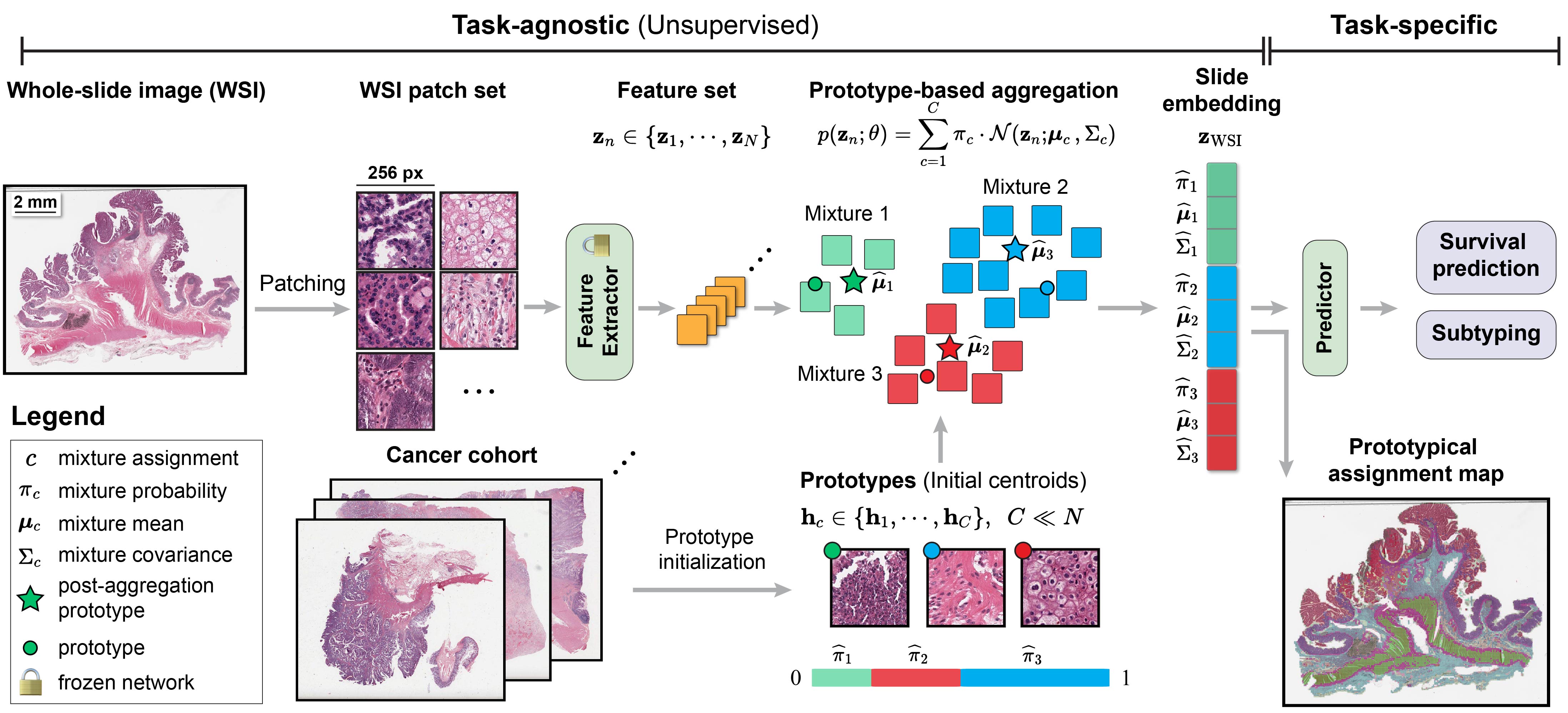
- 각 혼합 성분이 형태학적 프로토타입에 해당하는 혼합 정규분포모형(GMM)으로 WSI 조각 임베딩을 모델링한다.
- 기대값 최대화(EM) 알고리즘을 사용하여 GMM의 파라미터를 추정한다: 혼합 가중치(카디널리티), 평균(프로토타입 표현), 공분산(변동성).
- 모든 프로토타입의 추정된 GMM 파라미터를 연결하여 슬라이드 수준의 표현을 구성한다.
- 후행 확률을 통해 각 조각을 프로토타입에 할당함으로써, 프로토타입 인식 기반의 해석과 히트맵 시각화를 가능하게 한다.
- 사전에 학습된 비전 인코더에서 생성된 조각 임베딩만을 사용하여 비지도 방식으로 프레임워크를 학습한다.
- 학습된 표현을 단순한 선형 헤드 또는 MLP를 사용한 분류 및 생존 예측 과제에 적용한다.
실험 결과
연구 질문
- RQ1전체 슬라이드 이미지 내 형태학적 재현성을 활용하여 작업에 무관한 비지도 슬라이드 표현을 학습할 수 있는가?
- RQ2프로토타입 기반의 GMM 접근법이 하류 진단 및 예후 과제에서 기존의 비지도 및 지도 학습 기반의 MIL 기준을 능가하는가?
- RQ3식별된 형태학적 프로토타입이 슬라이드 수준 표현에 대해 정성적이고 정량적인 설명 가능성을 제공할 수 있는가?
- RQ4프로토타입 분포와 할당이 알려진 조직병리학적 패턴과 임상 결과와 어떻게 관련되어 있는가?
- RQ5이 프레임워크는 다양한 종류의 암과 슬라이드 특성에 걸쳐 얼마나 일반화되는가?
주요 결과
- Panther는 종류별 분류 및 생존 예측 과제에서 13개 데이터셋 전반에서 지도 학습 기반의 MIL 기준을 뛰어넘거나 동등하게 성능을 내며 강력한 일반화 능력을 입증한다.
- 생존 예측(Cox) 과제에서 평균 AUC는 0.671 ± 0.09이며, 종류별 분류 과제에서는 0.651 ± 0.04를 기록하여 OT 및 ProtoCounts와 같은 비지도 기준보다 뛰어난 성능을 보였다.
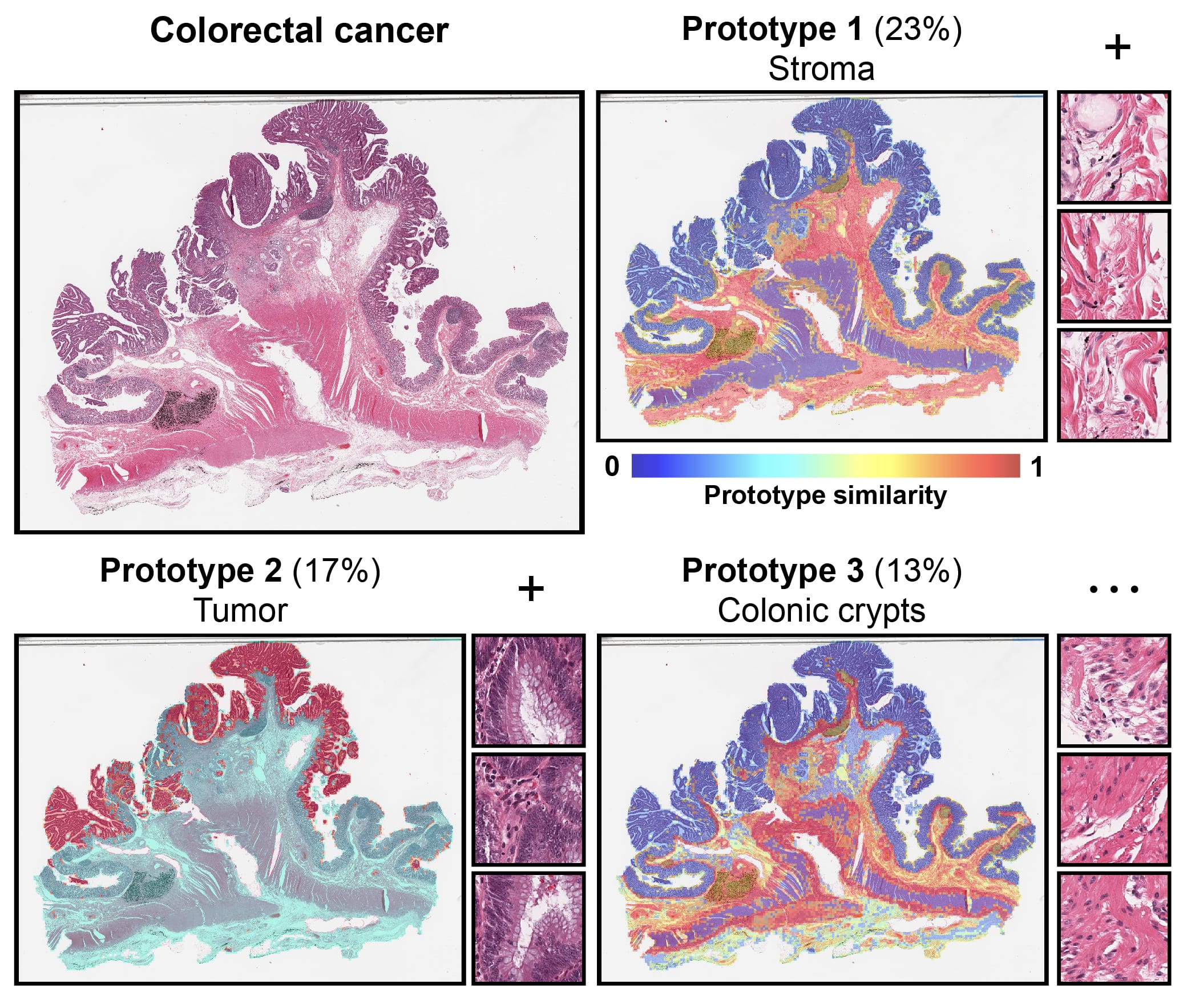
- 프로토타입 기반 히트맵 설명은 BLCA, BRCA, KIRC에서 지도 학습 기반의 조각 수준 분류기와 강한 일치를 보이며 형태학적 관련성을 검증하였다.
- 각 슬라이드의 프로토타입 분포 $π_c$ 는 병리학자 주석을 통해 생물학적으로 의미 있는 조직 비율을 반영하고 있음을 확인하였다.
- 후행 확률의 시각화 결과는 종양 부위, 면역 세포 침윤, 간질 성분과 일치하는 공간 패턴을 드러내었다.
- 이 프레임워크는 프로토타입 기반의 비선형 모델링과 해석을 가능하게 하여 조직 미세환경의 복잡성에 대한 새로운 통찰을 제공한다.
이 논문 읽기
누빈트 뷰어에서 원문을 열고, 읽으면서 궁금한 곳을 바로 물어보세요.
누빈트에서 이 논문 읽기이 리뷰는 AI가 논문 원문을 바탕으로 만들었습니다. 인용하기 전에 원문을 확인해 주세요.