
[논문 리뷰] NeuroGraph: Benchmarks for Graph Machine Learning in Brain Connectomics
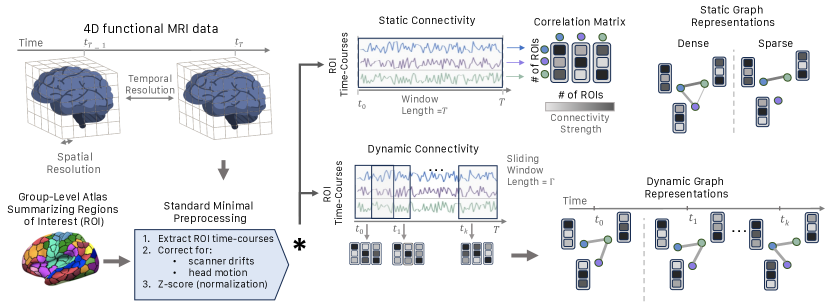
NeuroGraph는 인구통계, 작업 및 인지 특성 예측을 위한 fMRI 유래 커넥톰에서 그래프 신경망을 벤치마킹하기 위해 35개의 데이터셋과 15개의 베이스라인을 탐색하는 정적 및 동적 뇌 그래프 벤치마크를 생성합니다.
Machine learning provides a valuable tool for analyzing high-dimensional functional neuroimaging data, and is proving effective in predicting various neurological conditions, psychiatric disorders, and cognitive patterns. In functional magnetic resonance imaging (MRI) research, interactions between brain regions are commonly modeled using graph-based representations. The potency of graph machine learning methods has been established across myriad domains, marking a transformative step in data interpretation and predictive modeling. Yet, despite their promise, the transposition of these techniques to the neuroimaging domain has been challenging due to the expansive number of potential preprocessing pipelines and the large parameter search space for graph-based dataset construction. In this paper, we introduce NeuroGraph, a collection of graph-based neuroimaging datasets, and demonstrated its utility for predicting multiple categories of behavioral and cognitive traits. We delve deeply into the dataset generation search space by crafting 35 datasets that encompass static and dynamic brain connectivity, running in excess of 15 baseline methods for benchmarking. Additionally, we provide generic frameworks for learning on both static and dynamic graphs. Our extensive experiments lead to several key observations. Notably, using correlation vectors as node features, incorporating larger number of regions of interest, and employing sparser graphs lead to improved performance. To foster further advancements in graph-based data driven neuroimaging analysis, we offer a comprehensive open-source Python package that includes the benchmark datasets, baseline implementations, model training, and standard evaluation.
연구 동기 및 목표
- ML 작업을 위한 fMRI 데이터의 그래프 기반 표현 탐색.
- 정적 및 동적 뇌 그래프의 대형 벤치마크 모음(NeuroGraph) 생성.
- 다양한 GNN과 베이스라인을 평가하여 효과적인 파이프라인 식별.
- 데이터셋, 모델, 평가 프로토콜을 포함하는 오픈 소스 도구 키트를 제공.
제안 방법
- ROI와 상관 기반 간선을 사용하여 fMRI 데이터를 그래프 표현으로 변환.
- 다양한 ROI와 희소성을 가진 정적 및 동적 뇌 그래프를 구성.
- 35개 데이터세트에서 10개의 GNN을 포함한 5개의 비-GNN 베이스라인을 포함한 15개의 베이스라인 모델 평가.
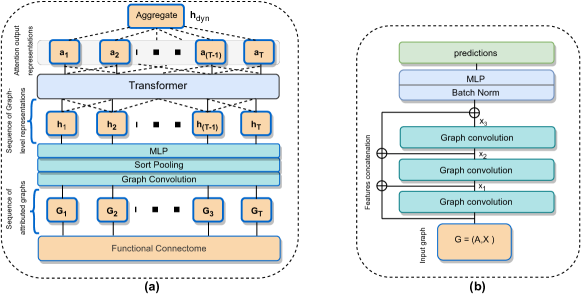
- 잔차 연결과 연결된 다계층 표현을 가진 GNN∗ 아키텍처 제안.
- GNN과 트랜스포머를 결합한 동적 그래프 처리 모듈을 전체 표현에 통합.
실험 결과
연구 질문
- RQ1어느 노드 특성 구성(CORR, BOLD, 또는 둘 다)이 예측 성능을 가장 잘 내는가?
- RQ2ROI 수(100, 400, 1000)가 모델 정확도와 일반화에 어떤 영향을 미치는가?
- RQ3신호와 희소성의 균형을 최적으로 맞추는 엣지 희소화 임계값(top 5/10/20%)은 무엇인가?
- RQ4다양한 작업에 걸쳐 뇌 그래프에 가장 효과적인 그래프 컨볼루션 방법은 무엇인가?
주요 결과
- 상관 기반 노드 특성은 ROI 및 작업 전반에서 일관되게 성능을 향상시킨다.
- 희소 그래프에서 1000 ROI를 사용하는 것이 데이터세트 전반에서 강한 결과를 종종 낳는다.
- 잔차 연결과 MLP 융합이 있는 GNN∗은 정적 데이터세트에서 일반적으로 다른 베이스라인보다 성능이 우수하다.
- 동적 그래프는 데이터세트 제약으로 인해 때로는 낮은 성능이지만 경쟁력 있음; UniMP는 여전히 견고하다.
- 큰 ROI와 상관 특성의 희소성이 벤치마크에서 유리한 설정으로 나타난다.
- 이 연구는 데이터세트, 베이스라인, 학습/평가 파이프라인을 포함한 오픈 소스 NeuroGraph 도구 키트를 제공한다.
더 나은 연구,지금 바로 시작하세요
논문 읽기부터 검토까지, 연구 시간을 획기적으로 줄여보세요.
카드 등록 없음 · 무료 플랜 제공
이 리뷰는 AI가 만들고, 인간 에디터가 검토했습니다.