
[논문 리뷰] Nonlinear Balanced Truncation: Part 2 -- Model Reduction on Manifolds
이 논문은 다항적으로 비선형인 균형 공간에서 모델 축소를 수행하여 비선형 균형 자르기(nonlinear balanced truncation)에 대해 확장 가능한 균형-축소(balanced-and-reduce) 접근법을 개발하고, 비선형 변환의 조건수 악화를 처리하기 위한 전략을 포함한다.
Nonlinear balanced truncation is a model order reduction technique that reduces the dimension of nonlinear systems in a manner that accounts for either open- or closed-loop observability and controllability aspects of the system. Two computational challenges have so far prevented its deployment on large-scale systems: (a) the energy functions required for characterization of controllability and observability are solutions of high-dimensional Hamilton-Jacobi-(Bellman) equations, which have been computationally intractable and (b) the transformations to construct the reduced-order models (ROMs) are potentially ill-conditioned and the resulting ROMs are difficult to simulate on the nonlinear balanced manifolds. Part~1 of this two-part article addressed challenge (a) via a scalable tensor-based method to solve for polynomial approximations of the open- and closed-loop energy functions. This article, (Part~2), addresses challenge (b) by presenting a novel and scalable method to reduce the dimensionality of the full-order model via model reduction on polynomially-nonlinear balanced manifolds. The associated nonlinear state transformation simultaneously 'diagonalizes' relevant energy functions in the new coordinates. Since this nonlinear balancing transformation can be ill-conditioned and expensive to evaluate, inspired by the linear case we develop a computationally efficient balance-and-reduce strategy, resulting in a scalable and better conditioned truncated transformation to produce balanced nonlinear ROMs. The algorithm is demonstrated on a semi-discretized partial differential equation, namely Burgers equation, which illustrates that higher-degree transformations can improve the accuracy of ROM outputs.
연구 동기 및 목표
- 대규모 시스템에 대한 비선형 균형 자르기의 계산적 난제를 해결하기 위해 (i) 에너지 함수를 새로운 좌표에서 대각화하는 확장 가능한 비선형 상태 변환을 도출하고, (ii) 비선형 다양체에서 조건수 악화를 완화하기 위해 균형-축소 절차를 제안한다.
- 오픈 루프 및 폐루프 에너지 함수와 관련 비선형 변환의 확장 가능 계산을 가능하게 하는 다항식 에너지 함수 프레임워크를 제공한다.
- semi-discretized Burgers-type PDE에서 접근법을 시연하여 고차 변환이 ROM 정확도와 특이값 동역학에 어떤 영향을 주는지 보여준다.
제안 방법
- 확장 가능한 테일러 급수 텐서 방법을 통해 오픈 루프 및 폐루프 에너지를 나타내는 비선형 에너지 함수 근사를 계산한다.
- 입력-정규화(input-normal)/출력-대각형 형태를 달성하는 비선형 상태 변환을 도출하고 특이값 함수를 추출한다.
- 에너지 함수와 특이값 함수를 대칭 계수를 갖는 다항식(텐서) 전개로 표현하여 효율적인 계산을 가능하게 한다.
- 전 전체 비선형 변환의 조건수 악화를 완화하기 위해 비선형 다양체에서 직접 균형 ROM을 구성하는 균형-축소 전략을 개발한다.
- 상태별 특이값 함수에 기반한 상태 자르기를 가능하게 하고 에너지 함수를 균형화하기 위해 차수-k 다항 표현을 정의하고 활용한다.
- 변환 차수의 ROM 정확도에 대한 영향을 연구하기 위해 Burgers-type PDE 예제에서 프레임워크를 검증한다.
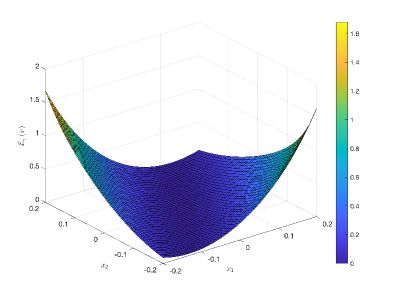
실험 결과
연구 질문
- RQ1대규모 비선형 시스템에서 비선형 에너지 함수를 균형화를 가능하게 하도록 확장 가능하게 계산하려면 어떻게 해야 하는가?
- RQ2지역적 이웃에서 오픈-루프와 폐루프 에너지를 대각선으로 균형화하는 비선형 좌표 변환을 구성할 수 있는가?
- RQ3비선형 변환의 조건수 악화를 다루기 위해 비선형 다양체에서 직접 모델 축소를 어떻게 수행할 수 있는가?
- RQ4편초 PDE 유사 시스템에 대한 차수 높은 비선형 변환이 차수 감소된 모델의 정확도에 어떤 영향을 미치는가?
- RQ5에너지 함수의 다항식(텐서) 표현이 비선형 균형에 대해 확장 가능하고 정확한 구성 요소를 제공하는가?
주요 결과
- 확장 가능한 테일러 급수 기반 전략이 제공되어 비선형 상태 변환 및 특이값 함수를 계산하며, 이 내용은 오픈 액세스 저장소에 있다.
- 새 좌표에서 오픈-루프와 폐루프 에너지 함수를 대각선으로 균형화하는 비선형 상태 변환이 구성되어 비선형 균형 모델을 산출한다.
- 비선형 다양체에서의 균형-축소 접근법이 조건수 악화를 피하고 비선형 ROM 평가를 효율적으로 가능하게 한다.
- 비선형 균형 ROM은 semi-discretized Burgers-type PDE에서 시연되어 고차 변환이 ROM 출력 정확도를 향상시킬 수 있음이 나타난다.
- 본 방법론은 특정 시스템 형태를 가정하지 않으며, 변환이 두 개의 다항식 에너지 함수를 균형화하고 일반적인 비선형 시스템에 재사용 가능한 비선형 매핑을 산출한다۔
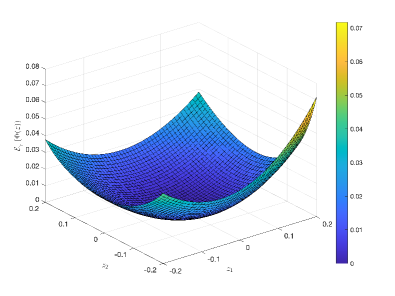
이 논문 읽기
누빈트 뷰어에서 원문을 열고, 읽으면서 궁금한 곳을 바로 물어보세요.
누빈트에서 이 논문 읽기이 리뷰는 AI가 논문 원문을 바탕으로 만들었습니다. 인용하기 전에 원문을 확인해 주세요.