
[논문 리뷰] Octo: An Open-Source Generalist Robot Policy
Octo는 800k 시연으로 사전학습된 대규모 트랜스포머 기반의 오픈소스 범용 로봇 정책으로, 새로운 로봇, 관찰 및 동작 공간에 효율적으로 미세조정될 수 있으며, 언어 또는 목표-이미지 조건화를 지원합니다.
Large policies pretrained on diverse robot datasets have the potential to transform robotic learning: instead of training new policies from scratch, such generalist robot policies may be finetuned with only a little in-domain data, yet generalize broadly. However, to be widely applicable across a range of robotic learning scenarios, environments, and tasks, such policies need to handle diverse sensors and action spaces, accommodate a variety of commonly used robotic platforms, and finetune readily and efficiently to new domains. In this work, we aim to lay the groundwork for developing open-source, widely applicable, generalist policies for robotic manipulation. As a first step, we introduce Octo, a large transformer-based policy trained on 800k trajectories from the Open X-Embodiment dataset, the largest robot manipulation dataset to date. It can be instructed via language commands or goal images and can be effectively finetuned to robot setups with new sensory inputs and action spaces within a few hours on standard consumer GPUs. In experiments across 9 robotic platforms, we demonstrate that Octo serves as a versatile policy initialization that can be effectively finetuned to new observation and action spaces. We also perform detailed ablations of design decisions for the Octo model, from architecture to training data, to guide future research on building generalist robot models.
연구 동기 및 목표
- 구현체와 작업 전반에 걸쳐 일반화하는 일반 로봇 정책의 필요성을 제시한다.
- 새로운 센서, 액추에이터, 도메인에 미세조정될 수 있는 오픈소스 트랜스포머 기반 정책을 개발한다.
- 다양한 로봇 및 언어/목표 조건화 작업에서 제로샷 제어를 시연한다.
- 크고 다양한 데이터셋에서 데이터 효율적인 파인튜닝이 새로운 로봇 설정으로 이전되는 것을 보여준다.
- 아키텍처, 데이터, 목표, 규모 등의 일반 로봇 정책 설계 결정에 대한 지침을 제공한다.
제안 방법
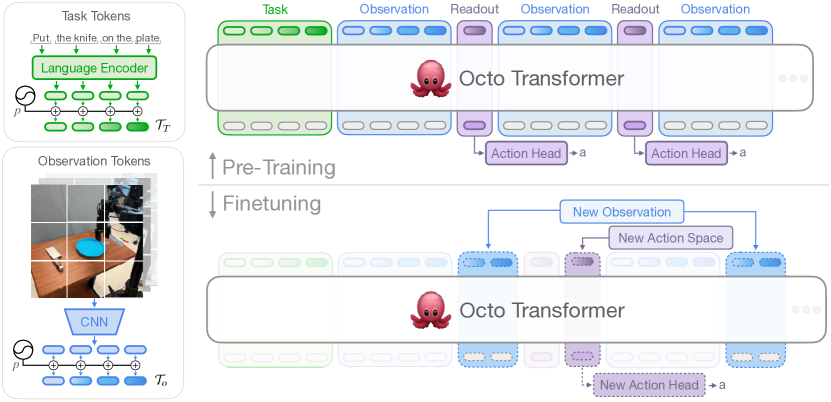
- 언어 목표와 관찰을 공통의 토큰 시퀀스로 토큰화하는 트랜스포머 기반 정책.
- 입력 토크나이저: 언어는 t5-base, 이미지용 경량 CNN 패치, 위치 임베딩 포함.
- 입력의 유연한 추가/제거를 가능하게 하는 읽기 토큰이 있는 블록 단위 마스크드 트랜스포머 백본.
- DDPM 목표를 통해 다수의 연속된 행동 청크를 예측하는 확산 기반 액션 디코딩 헤드.
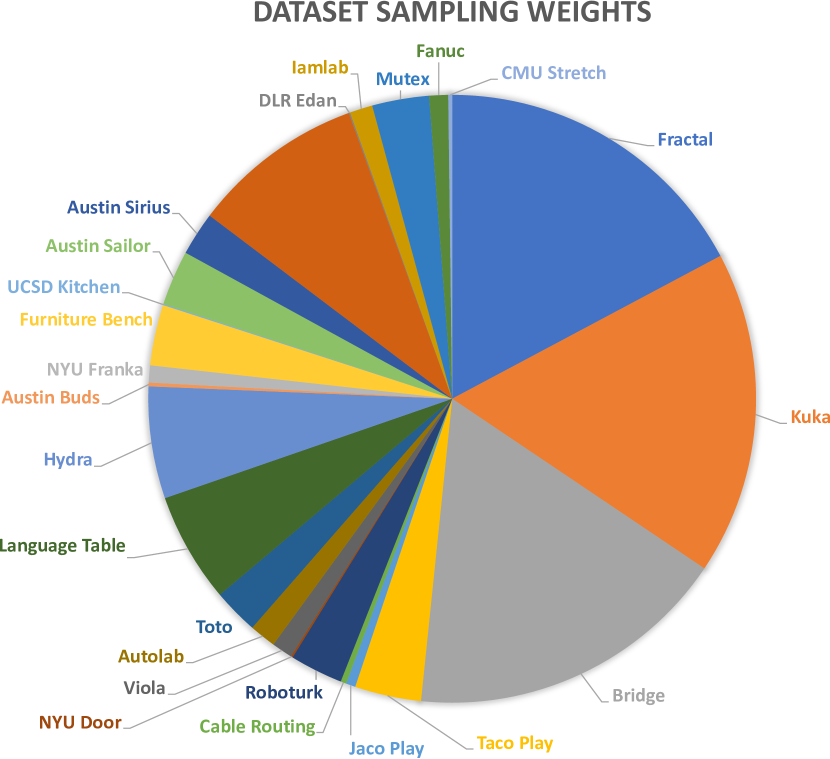
- 누락된 모달리티에 대해 제로 패딩을 사용한 다양한 Open X-Embodiment 데이터 혼합(25개 데이터셋, ~800k 시연)으로 학습.
- 미세조정: 동일한 확산 목표, 대상 도메인당 ~100 트랙션, 일반 소비자 GPU에서 ~50k 스텝; 새로운 입력/출력을 위해 프리트레인 가중치를 재초기화하지 않고 어댑터를 추가.
실험 결과
연구 질문
- RQ1Octo가 언어 및 목표-이미지 조건화로 즉시(제로샷) 다수의 로봇을 제어할 수 있는가?
- RQ2보지 못한 로봇, 관찰, 동작 공간에 데이터 효율적인 파인튜닝에 대한 좋은 초기화가 되는가?
- RQ3어떤 설계 선택(아키텍처, 데이터 혼합, 목표)이 일반 로봇 정책의 성능에 가장 큰 영향을 미치는가?
- RQ4모델 크기와 데이터 다양성의 증가가 제로샷 및 파인튜닝 성능 개선에 어떻게 반영되는가?
주요 결과
- Octo는 9대 로봇과 4개 기관에 걸친 제로샷 제어를 가능하게 하며, 언어 조건화 작업에서 이전에 공개된 일반 로봇 정책보다 우수하게 성능을 발휘한다.
- 도메인당 ~100 시연으로 Octo를 미세조정하면, 처음부터 학습하거나 사전에 학습된 VC-1 비주얼을 사용하는 것에 비해 상당한 차이로 우수한 성능을 보인다.
- 광범위한 데이터 혼합과 트랜스포머 우선 아키텍처를 갖춘 확산 기반 연속 행동 헤드가 강력한 성능을 보이며, 더 큰 모델일수록 제로샷 강건성이 향상된다.
- 트랜스포머 우선 설계, 확산 액션 헤드, 광범위한 데이터 혼합의 아키텍처가 변형 실험에서 최상의 성능을 낸다.
- 모델 확장은 Octo-Base(93M 파라미터)가 더 작은 버전에 비해 일반적으로 제로샷 성능과 견고성을 향상시킨다.
이 논문 읽기
누빈트 뷰어에서 원문을 열고, 읽으면서 궁금한 곳을 바로 물어보세요.
누빈트에서 이 논문 읽기이 리뷰는 AI가 논문 원문을 바탕으로 만들었습니다. 인용하기 전에 원문을 확인해 주세요.