
[논문 리뷰] One-Step Image Translation with Text-to-Image Models
논문은 CycleGAN-Turbo와 pix2pix-Turbo를 제시한다. 한-step 이미지-투-이미지 변환 프레임워크로, 사전 학습된 텍스트-투-이미지 확산 모델을 적대적 학습으로 새로운 작업과 도메인에 적응시키고, 비대응 및 대응 설정에서 빠른 추론과 구조 보존이 강하다.
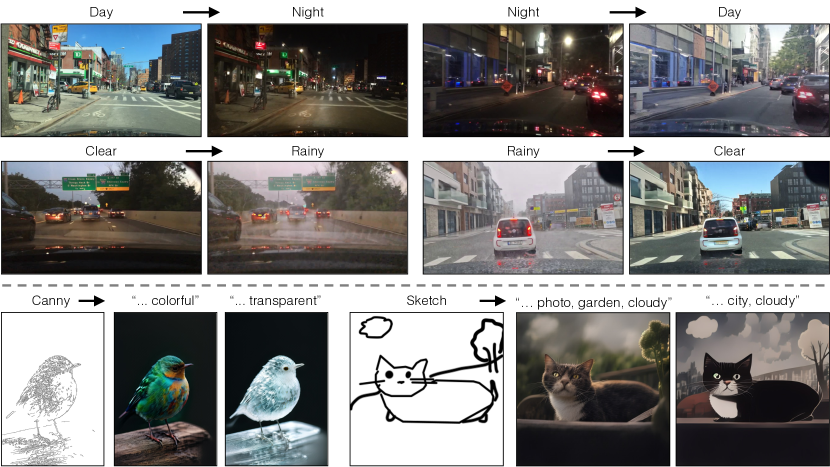
In this work, we address two limitations of existing conditional diffusion models: their slow inference speed due to the iterative denoising process and their reliance on paired data for model fine-tuning. To tackle these issues, we introduce a general method for adapting a single-step diffusion model to new tasks and domains through adversarial learning objectives. Specifically, we consolidate various modules of the vanilla latent diffusion model into a single end-to-end generator network with small trainable weights, enhancing its ability to preserve the input image structure while reducing overfitting. We demonstrate that, for unpaired settings, our model CycleGAN-Turbo outperforms existing GAN-based and diffusion-based methods for various scene translation tasks, such as day-to-night conversion and adding/removing weather effects like fog, snow, and rain. We extend our method to paired settings, where our model pix2pix-Turbo is on par with recent works like Control-Net for Sketch2Photo and Edge2Image, but with a single-step inference. This work suggests that single-step diffusion models can serve as strong backbones for a range of GAN learning objectives. Our code and models are available at https://github.com/GaParmar/img2img-turbo.
연구 동기 및 목표
- 이미지 변환을 위한 조건부 확산(cond. diffusion)에서 추론 시간과 데이터 요구량을 줄이려는 동기를 제시한다.
- 새로운 도메인에 적응하면서 입력 구조를 보존하는 한 단계 번역 프레임워크를 개발한다.
- 최소한의 학습 가능한 매개변수로 단일 엔드-투-엔드 제너레이터를 사용하여 비대응 및 대응 변환을 가능하게 한다.
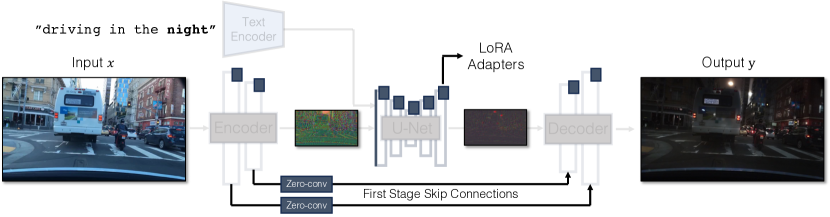
- LoRA 어댑터와 스킵 연결을 활용해 과적합을 방지하고 번역 중 세부 정보를 유지한다.
제안 방법
- Encoder, UNet, Decoder를 하나의 네트워크로 통합하여 사전 학습된 텍스트-투-이미지 확산 모델을 엔드투엔드 한 단계 제너레이터로 변환한다.
- 입력 조건을 노이즈 인코더 분기에 직접 공급하고, LoRA 어댑터를 사용해 백본을 새로운 제어 및 도메인에 적응시킨다.
- encoder와 decoder 사이의 제로-컨브(zero-conv) 계층을 통한 스킵 연결을 도입하여 고주파 입력 세부 정보를 보존한다.
- 비대응 설정(CycleGAN-Turbo)에서 적대적 손실 및 순환 일관성 손실로 학습하고, 대응 설정(pix2pix-Turbo)에서 재구성 손실 및 CLIP 기반 손실로 학습한다.
- 미리 학습된 모델 특징과 학습된 인코더 특징 사이를 보간하고, 어댑터 가중치와 재구성 손실을 조정하는 tunable gamma 매개변수로 다양한 출력과 확률적 특성을 가능하게 한다.
실험 결과
연구 질문
- RQ1한 단계 확산 모델이 비대응 및 대응 설정 모두에서 이미지-투-이미지 번역 작업의 강력한 백본으로 작동할 수 있는가?
- RQ2잠재 노이즈와의 충돌을 피하고 번역 중 입력 구조를 보존하기 위해 조건 입력을 어떻게 통합할 수 있는가?
- RQ3가벼운 학습 가능한 구성요소를 가진 통합 엔드투엔드 제너레이터가 전통적 확산 모델이나 GAN 기반 방법과 비교해 품질과 속도에서 경쟁력을 보이는가?
- RQ4어떤 메커니즘(예: 스킵 연결, LoRA 어댑터)이 한 단계 번역 중에 미세 입력 세부 정보(텍스트, 표지, 질감)를 가장 잘 보존하는가?
- RQ5제어된 한 단계 추론 체계에서 프레임워크가 다양한 출력을 생성할 수 있는가?
주요 결과
- CycleGAN-Turbo는 확산 기반 기준선보다 빠르면서 분포 매칭과 입력 구조 보존이 우수하게 달성된다.
- Pix2pix-Turbo는 단일 순전파 및 한 단계 추론으로 최첨단 대응 번역 방법과 경쟁력 있는 결과를 얻는다.
- 입력 이미지를 백본에 직접 조건부로 주고 LoRA 어댑터를 사용하면 학습 가능한 매개변수를 최소화하면서 새로운 도메인에 효과적으로 적응할 수 있다.
- 제로-컨브 계층을 통한 스킵 연결은 번역 중 고주파 입력 세부 정보를 보존하는 데 도움을 준다.
- 해당 방법은 비대응 작업(예: day↔night, 날씨 변화)에서 강한 성능을 보이고 대응 작업(예: Edge2Image, Sketch2Photo)에서 경쟁력 있는 결과를 보인다.
- 노이즈와 인코더 특징 사이의 보간을 통해 다양한 출력을 지원하고, 다양한 결과를 위해 텍스트 조건을 보간할 수 있다.
이 논문 읽기
누빈트 뷰어에서 원문을 열고, 읽으면서 궁금한 곳을 바로 물어보세요.
누빈트에서 이 논문 읽기이 리뷰는 AI가 논문 원문을 바탕으로 만들었습니다. 인용하기 전에 원문을 확인해 주세요.