
[논문 리뷰] Open-World Pose Transfer via Sequential Test-Time Adaption
이 논문은 추론 중에 분포 외(out-of-distribution, OOD)인 외관 및 스켈레톤 신호에 순차적으로 적응하는 새로운 프레임워크인 SEquential Test-time Adaption (SETA)를 제안한다. 외부 테스트 데이터에 대해 자기지도적 증강을 사용하여 외관 텍스처를 추출하고, 사람 재식별(Re-ID) 모델을 활용해 비유클리드 기반 자세 유사도를 계산함으로써, TikTok 및 SHHQ와 같은 새로운 데이터셋에서 일반화 성능을 향상시킨다. 기존 방법 대비 LPIPS를 최대 76.8%까지 감소시킨다.
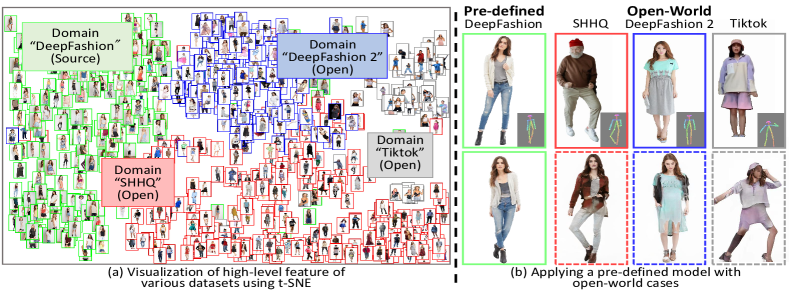
Pose transfer aims to transfer a given person into a specified posture, has recently attracted considerable attention. A typical pose transfer framework usually employs representative datasets to train a discriminative model, which is often violated by out-of-distribution (OOD) instances. Recently, test-time adaption (TTA) offers a feasible solution for OOD data by using a pre-trained model that learns essential features with self-supervision. However, those methods implicitly make an assumption that all test distributions have a unified signal that can be learned directly. In open-world conditions, the pose transfer task raises various independent signals: OOD appearance and skeleton, which need to be extracted and distributed in speciality. To address this point, we develop a SEquential Test-time Adaption (SETA). In the test-time phrase, SETA extracts and distributes external appearance texture by augmenting OOD data for self-supervised training. To make non-Euclidean similarity among different postures explicit, SETA uses the image representations derived from a person re-identification (Re-ID) model for similarity computation. By addressing implicit posture representation in the test-time sequentially, SETA greatly improves the generalization performance of current pose transfer models. In our experiment, we first show that pose transfer can be applied to open-world applications, including Tiktok reenactment and celebrity motion synthesis.
연구 동기 및 목표
- 학습 데이터와 테스트 데이터의 분포가 크게 다를 수 있는 개방형 환경에서 자세 전이의 일반화 문제를 해결하기 위해.
- 기존 테스트 시간 적응(TTA) 방법은 OOD 데이터 전반에 걸쳐 통합된 신호를 가정하지만, 복잡한 다중 신호 분포에서는 실패한다는 한계를 극복하기 위해.
- 외관 및 스켈레톤 신호를 별도로 학습하고 통합함으로써 자세 전이의 안정성과 현실감을 향상시키기 위한 순차적 적응 전략을 개발하기 위해.
- 다양하고 예측할 수 없는 데이터가 흔한 실세계 응용 분야, 예를 들어 TikTok 재연 및 유명인 동작 합성에 있어 자세 전이의 실용적 구현을 가능하게 하기 위해.
제안 방법
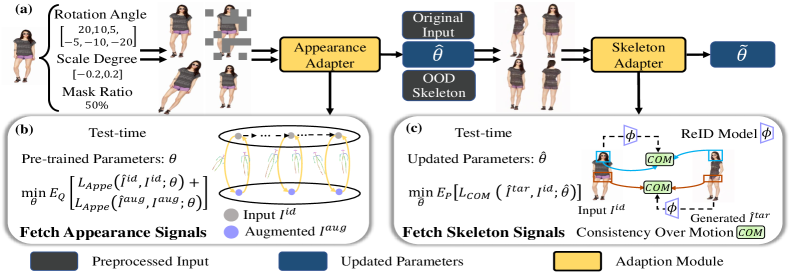
- SETA는 외부 테스트 데이터에 대해 자기지도적 증강을 활용하여 OOD 외관 신호에 먼저 적응하는 순차적 테스트 시간 적응 파이프라인을 사용한다.
- 외부 외관 텍스처를 증강된 OOD 샘플에서 추출하고 분배하기 위해 외관 어댑터를 도입하여 특징 왜곡 과정을 안정화시킨다.
- 이후 스켈레톤 어댑터를 적용하여 사전 훈련된 사람 재식별(Re-ID) 모델의 이미지 특징을 활용해 암묵적인 자세 표현을 학습한다.
- Re-ID 임베딩을 사용해 자세 간 비유클리드 기반 유사도를 모델링함으로써 다양한 OOD 스켈레톤 간 일관된 운동 표현을 가능하게 한다.
- 프레임워크는 외관 및 스켈레톤 적응 단계를 번갈아가며 적용하여 치명적인 기억 상실을 방지하고 안정적인 특징 학습을 보장한다.
- 고정된 반복 횟수로 각 샘플에 대해 반복적인 테스트 시간 학습을 사용하여 성능과 추론 효율성 간 균형을 유지한다.
실험 결과
연구 질문
- RQ1여러 개의 독립적인 OOD 신호(외관 및 스켈레톤)가 동시에 존재하는 개방형 자세 전이 환경에서 테스트 시간 적응을 효과적으로 확장할 수 있는가?
- RQ2먼저 외관에, 그 다음 스켈레톤에 순차적으로 적응하는 전략이 동시에 또는 단일 신호에 대한 적응보다 일반화 성능을 향상시키는가?
- RQ3증강된 OOD 데이터에 대해 자기지도 학습을 통해 지도 학습이 없이도 분리된 외관 텍스처를 효과적으로 추출할 수 있는가?
- RQ4Re-ID 특징의 사용이 극도로 변형되거나 예측 불가능한 스켈레톤에서 비유클리드 자세 일관성을 어떻게 향상시키는가?
- RQ5테스트 시간 설정에서 적응 반복 횟수와 성능 향상 사이의 최적의 트레이드오프는 무엇인가?
주요 결과
- 스켈레톤 어댑터를 사용할 경우 NTED에 대해 LPIPS가 41.66% 감소하고, CASD에 대해 46.84% 감소하여 시각적 품질 향상이 뚜렷하게 나타난다.
- 사람 평가 결과, 스켈레톤 어댑터를 사용했을 때 NTED의 평균 평가 점수(MOS)는 76.13, CASD는 72.17로, 더 높은 시각적 정확도와 낮은 아티팩트를 확인할 수 있다.
- 외관 어댑터는 전반적인 외관 일관성을 향상시켜 스켈레톤 어댑터의 안정적 훈련을 가능하게 하고 생성된 이미지의 왜곡을 줄인다.
- 30회의 테스트 시간 반복을 사용할 경우 최적의 성능을 기록하여 SHHQ에서 NTED의 LPIPS를 0.049로 감소시켰지만, 추론 시간이 증가(28.48초)하는 비용이 수반된다.
- 외관 → 스켈레톤의 순차적 적응 전략이 동시에 또는 반대로 적용하는 것보다 더 효과적이며, 불안정성과 치명적인 기억 상실을 방지한다.
- 이 프레임워크는 TikTok 및 SHHQ와 같은 실세계 개방형 환경 데이터셋에서도 자세 전이를 성공적으로 수행하며, 기준 모델이 심한 비틀림 패턴과 아티팩트를 보이는 것을 방지한다.
이 논문 읽기
누빈트 뷰어에서 원문을 열고, 읽으면서 궁금한 곳을 바로 물어보세요.
누빈트에서 이 논문 읽기이 리뷰는 AI가 논문 원문을 바탕으로 만들었습니다. 인용하기 전에 원문을 확인해 주세요.