
[논문 리뷰] Optimizing Inventory Placement for a Downstream Online Matching Problem
이 논문은 전자상거래에서 온라인 매칭 문제에 대한 재고 배치 최적화를 위해 오프라인 서rogate 함수를 사용하며, 공동 배치 및 이행 문제에 대해 (1−(1−1/d)^d)/2-근사치를 도출한다. 이 방법은 랜덤화된 라운딩을 통해 (1−(1−1/d)^d)-근사치를 달성하며, 실제 JD.com 데이터를 통한 검증을 통해 민첩성과 유동성 배치 절차보다 뛰어난 성능을 보인다.
We study the inventory placement problem of splitting $Q$ units of a single item across warehouses in advance of a downstream online matching problem that represents the dynamic fulfillment decisions of an e-commerce retailer. This is a challenging problem both theoretically, due to the computational complexity of the downstream matching problem, and practically, as the fulfillment team continuously updates its algorithm while the placement team lacks direct evaluation of placement decisions. We compare the performance of three placement procedures based on optimizing surrogate functions that have been studied and applied: Offline, Myopic, and Fluid placement. On the theory side, we show that optimizing inventory placement for the Offline surrogate leads to an $α(1-(1-1/d)^d)$-approximation for the joint placement and fulfillment problem under any demand model that admits an $α$-competitive fulfillment policy. We assume $d$ is an upper bound on how many warehouses can serve any demand location. The crux of our theoretical contribution is to use randomized rounding to derive a tight $(1-(1-1/d)^d)$-approximation for the integer programming problem of optimizing the Offline surrogate. We further show how to extend this result to a multi-SKU setting, improving upon the best known approximation of $1/2$. We use statistical learning to show that rounding after optimizing a sample-average Offline surrogate, which is necessary due to the exponentially-sized support, indeed has vanishing loss. On the experimental side, we evaluate how different combinations of placement and fulfillment procedures perform on a wide array of synthetic instances. When coupled with a good fulfillment procedure, optimizing the Offline surrogate performs best even compared to computationally-intensive simulation procedures, corroborating our theory.
연구 동기 및 목표
- 전자상거래에서 상류 재고 배치를 하류 온라인 이행 결정과 조율하는 과제를 해결하기 위해.
- 공동 배치 및 이행 성능을 평가하고 비교하기 위해 세 가지 서rogate 기반 배치 절차—오프라인, 민첩성, 유동성—를 평가하기 위해.
- 수요의 시간적 또는 공간적 독립성 하에서 오프라인 서rogate 최적화의 근사 보장을 이론적으로 분석하기 위해.
- 실제 주문 시퀀스 데이터를 사용하여 제안된 방법을 경험적으로 검증하기 위해.
- 완전한 하류 이행 정책에 대한 지식이 없더라도 오프라인 서rogate 최적화가 강력하고 높은 성능을 보이는 재고 배치를 이끌어내는지 보여주기 위해.
제안 방법
- 저자들은 정수계획문제의 오프라인 서rogate 함수 최적화를 위해 랜덤화된 라운딩을 사용하여 (1−(1−1/d)^d)-근사치를 도출한다.
- 표본 평균 오프라인 서rogate를 최적화한 후 라운딩을 수행할 경우, 지수 크기의 서포트에도 불구하고 손실이 점차 감소함을 보이기 위해 통계적 학습을 적용한다.
- 이 방법은 어떤 수요 지점도 최대 d개의 창고가 서비스할 수 있도록 가정하며, 수요 도착이 시간적 또는 공간적으로 독립적이라고 가정한다.
- 이 접근법은 세 가지 배치 절차를 비교한다: 오프라인(최적 이행 보상의 서rogate 최적화), 민첩성(시뮬레이션과 국소 탐색 기반), 유동성(정적 유동성 리프레젠테이션 사용).
- 배치 성능을 고립하여 평가하기 위해 고품질의 이행 정책—재해결 기반 S-SP—를 고정한다.
- 실제 주문 데이터를 사용하여 다양한 배치 및 이행 절차 조합의 경쟁 비율을 평가한다.
실험 결과
연구 질문
- RQ1오프라인 서rogate 함수 최적화가 시간적 또는 공간적 독립성 하에서 공동 재고 배치 및 온라인 이행 문제에 대해 증명 가능하게 좋은 근사치를 제공하는가?
- RQ2실제 수요 패턴 하에서 오프라인 배치 성능이 민첩성 및 유동성 배치와 비교해 어떻게 되는가?
- RQ3수요 도착 순서에 대한 지식이 없음에도 불구하고, 오프라인 배치와 같은 서rogate 기반 접근이 시뮬레이션 기반 민첩성 배치를 능가할 수 있는가?
- RQ4다양한 수요 부하와 현지 이행 및 스플로벌 이행 간 보상 비율 변화에 대해 오프라인 배치 절차는 얼마나 견고한가?
- RQ5표본 평균 오프라인 서rogate에 대해 랜덤화된 라운딩을 적용할 경우 실질적으로 최적에 가까운 해를 도출할 수 있는가?
주요 결과
- 시간적 또는 공간적 독립성 하에서 오프라인 서rogate 최적화는 공동 배치 및 이행 문제에 대해 (1−(1−1/d)^d)/2-근사치를 도출한다.
- 랜덤화된 라운딩 기법은 정수계획문제에 대해 (1−(1−1/d)^d)-근사치를 달성하며, 이는 상수 요인까지 이론적으로 최적임을 증명한다.
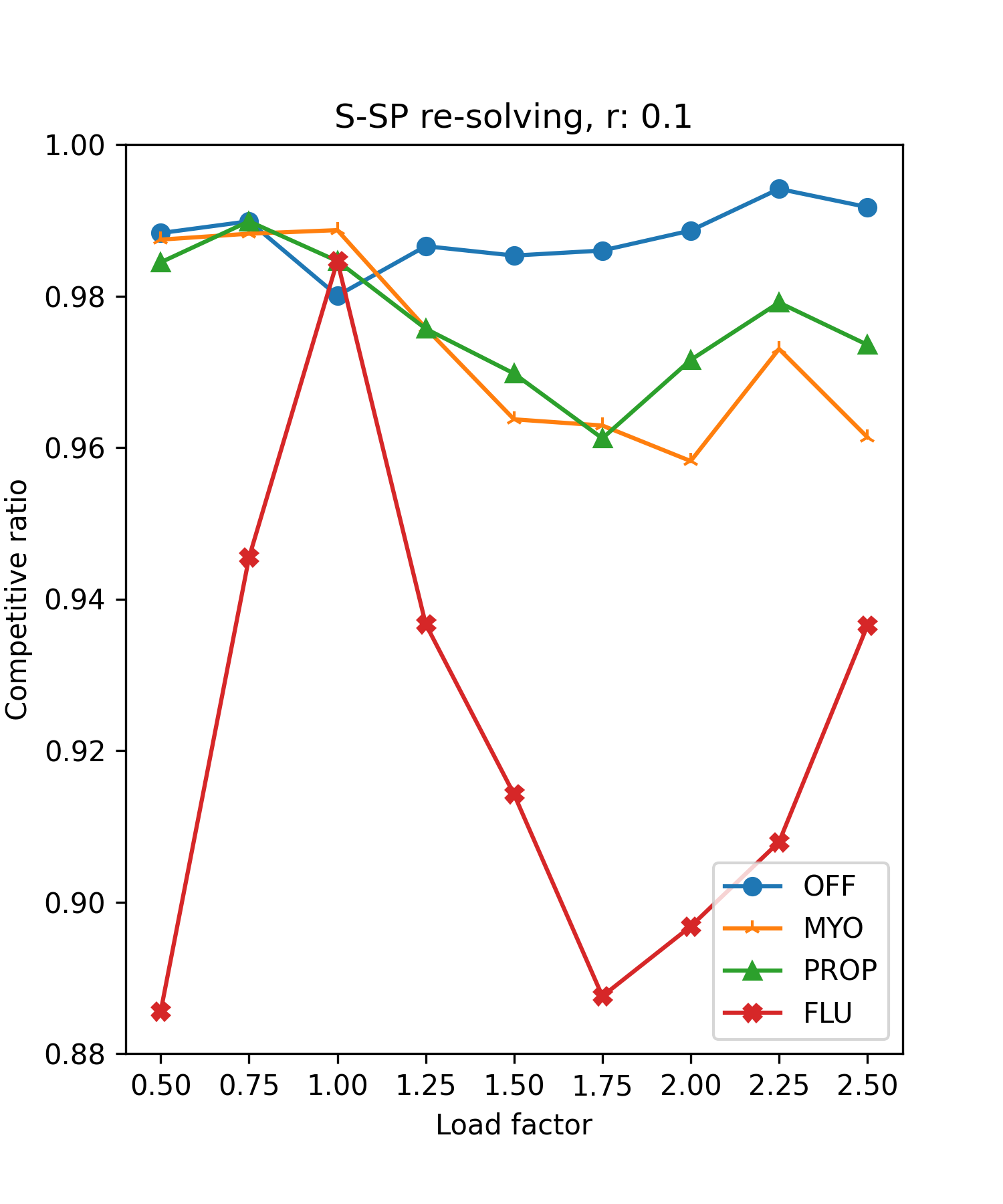
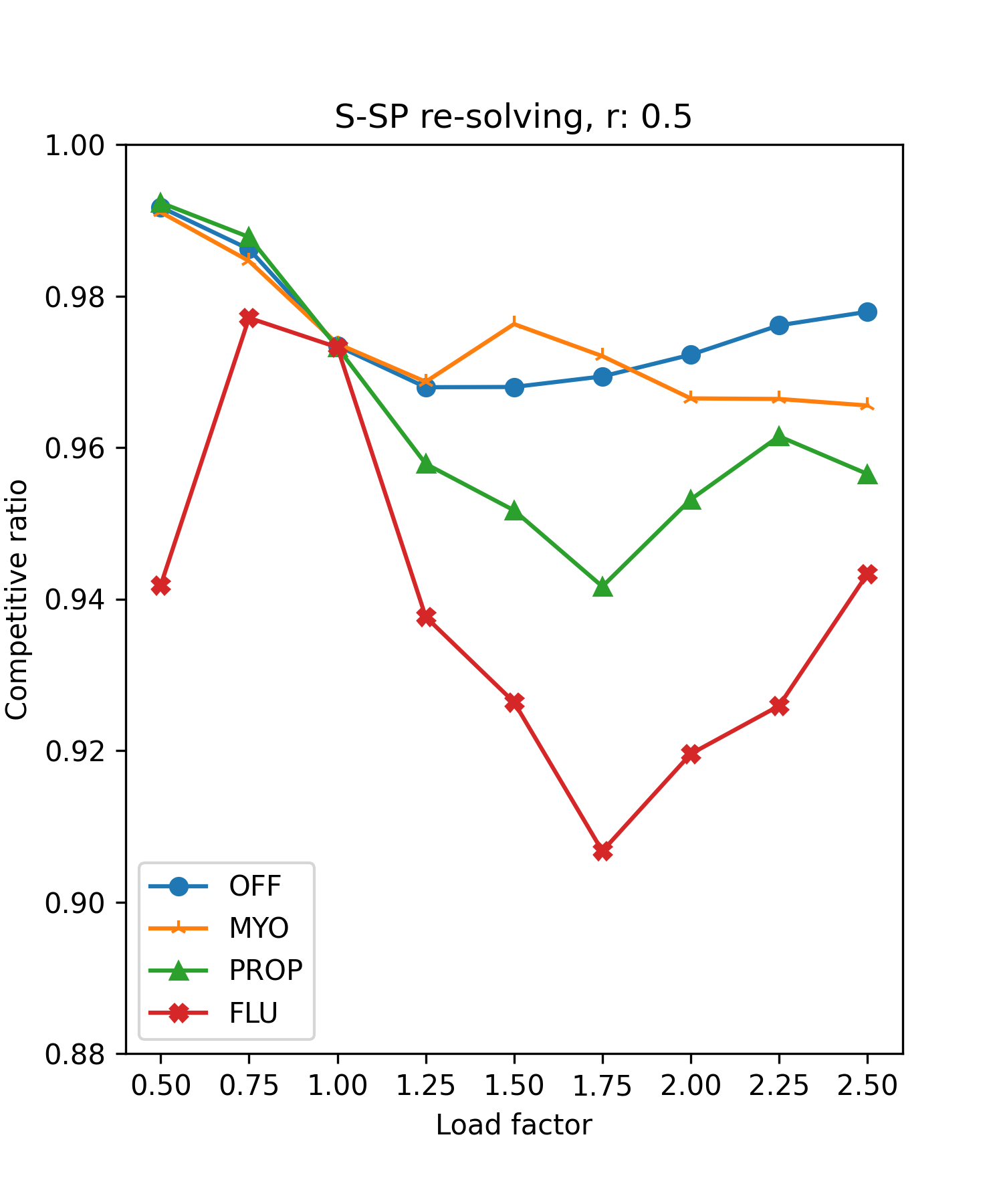
- 도착 순서 정보를 사용하지 않음에도 불구하고, 오프라인 배치가 이론적으로나 실질적으로 민첩성 배치를 능가하며, 특히 r=0.1일 때 부하 계수 ≥1.25인 경우 두드러진 성능 향상을 보인다.
- 모든 설정에서 S-SP(재해결 기반)는 항상 최고 또는 두 번째로 높은 경쟁 비율을 기록하여 가장 견고한 이행 정책임을 입증한다.
- 유동성 배치 절차는 다수의 최적 해로 인한 불안정성과 RDC에 대한 강한 편향으로 인해 성능이 열 劣하다. 특히 타이브레이킹이 RDC를 우선시할 경우 더욱 악화된다.
- 고품질 이행 정책과 조합되었을 때 오프라인 배치 절차는 민첩성 및 유동성 배치 절차를 모두 초월하여 r와 부하 계수의 다양한 값에서 가장 견고한 성능을 보인다.
이 논문 읽기
누빈트 뷰어에서 원문을 열고, 읽으면서 궁금한 곳을 바로 물어보세요.
누빈트에서 이 논문 읽기이 리뷰는 AI가 논문 원문을 바탕으로 만들었습니다. 인용하기 전에 원문을 확인해 주세요.