
[논문 리뷰] Parameter-Efficient Fine-Tuning Design Spaces
이 논문은 매개변수 효율적 미세조정(PEFT)을 위한 설계 공간을 제시하고, 보편적 설계 패턴을 발견하며, 여러 백본 및 NLP 작업에 걸쳐 기존 전략을 능가하는 새로운 PEFT 방법을 보여준다.
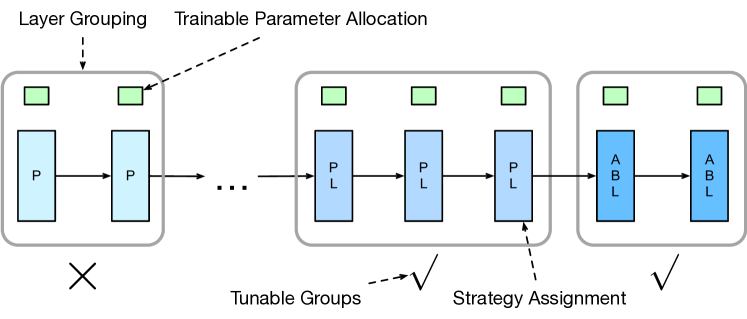
Parameter-efficient fine-tuning aims to achieve performance comparable to fine-tuning, using fewer trainable parameters. Several strategies (e.g., Adapters, prefix tuning, BitFit, and LoRA) have been proposed. However, their designs are hand-crafted separately, and it remains unclear whether certain design patterns exist for parameter-efficient fine-tuning. Thus, we present a parameter-efficient fine-tuning design paradigm and discover design patterns that are applicable to different experimental settings. Instead of focusing on designing another individual tuning strategy, we introduce parameter-efficient fine-tuning design spaces that parameterize tuning structures and tuning strategies. Specifically, any design space is characterized by four components: layer grouping, trainable parameter allocation, tunable groups, and strategy assignment. Starting from an initial design space, we progressively refine the space based on the model quality of each design choice and make greedy selection at each stage over these four components. We discover the following design patterns: (i) group layers in a spindle pattern; (ii) allocate the number of trainable parameters to layers uniformly; (iii) tune all the groups; (iv) assign proper tuning strategies to different groups. These design patterns result in new parameter-efficient fine-tuning methods. We show experimentally that these methods consistently and significantly outperform investigated parameter-efficient fine-tuning strategies across different backbone models and different tasks in natural language processing.
연구 동기 및 목표
- 수동으로 설계된 개별 전략을 넘어 PEFT에 대한 포괄적 설계 패턴이 있는지 이해한다.
- 레이어 그룹핑, 매개변수 할당, 조정 가능한 그룹, 전략 할당을 매개변수화하는 설계 공간 프레임워크를 제안한다.
- 백본(T5, RoBERTa, BART)과 작업(GLUE, generation)에 걸쳐 일반화되는 설계 패턴을 경험적으 로 식별한다.
- 발견된 패턴에서 도출된 새로운 PEFT 방법이 낮은 매개변수 예산에서 기존 PEFT 접근법을 능가하는 것을 시연한다.
제안 방법
- 레이어 그룹핑, 학습 가능한 매개변수 할당, 튜너블 그룹, 전략 배정을 포함하는 네 가지 구성 요소로 구성된 PEFT 설계 공간을 정의한다.
- 제약을 적용하고 GLUE에서 무작위 샘플링과 저에폭 미세조정을 통해 모델 품질을 평가함으로써 제약이 없는 설계 공간을 점진적으로 정교화한다.
- 패턴에 걸쳐 일관되게 성능을 향상시키는 설계 패턴을 식별한다(예: spindle 계층 그룹핑, 균일한 매개변수 할당, 모든 그룹의 조정, 그룹에 다양한 전략 할당).
- 발견된 패턴을 포함하는 새로운 PEFT 방법을 구현하고 여러 백본에서 어댑터, 프리픽스, BitFit, LoRA와 비교한다.
- 다수의 백본(T5-base, T5-3b, RoBERTa-base/large, BART-base/large)과 GLUE 및 generation을 포함한 작업에서 패턴을 검증한다.
실험 결과
연구 질문
- RQ1다양한 백본에서 PEFT에 대해 최상의 성능을 낳는 설계 공간 패턴은 무엇인가?
- RQ2레이어 그룹핑, 매개변수 할당, 조정 가능한 그룹, 전략 할당이 상호 작용해 전이 가능한 설계 원리를 만들어내는가?
- RQ3발견된 설계 패턴이 다양한 NLP 작업에서 기존 전략보다 성능이 우수한 새로운 PEFT 방법으로 이어질 수 있는가?
- RQ4확인된 패턴이 이해 작업(GLUE)과 생성 작업(요약, 번역) 모두에서 견고한가?
주요 결과
- 층 그룹핑의 spindle 패턴이 GLUE에서 T5-base로 실시했을 때 다른 그룹핑보다 일관되게 우수하다.
- 층 간 학습 가능한 매개변수의 균일한 할당은 탐색된 공간에서 GLUE 평균이 가장 높게 나타났다.
- 모든 층 그룹의 튜닝이 성능에 유익하다.
- 다른 그룹에 서로 다른 튜닝 전략을 할당하는 것이 균일한 전략 할당보다 개선된 결과를 낳는다.
- 이 패턴에서 도출된 PEFT 방법들(S4-model, S4-3b-model)은 강력한 베이스라인을 상회하고, 여러 설정에서 낮은 매개변수 예산하에서 전체 미세조정을 능가하기도 한다.
- 패턴에서 파생된 방법은 백본(T5, RoBERTa, BART)과 NLP 작업(분류, 생성)에 걸쳐 일반화된다.

이 논문 읽기
누빈트 뷰어에서 원문을 열고, 읽으면서 궁금한 곳을 바로 물어보세요.
누빈트에서 이 논문 읽기이 리뷰는 AI가 논문 원문을 바탕으로 만들었습니다. 인용하기 전에 원문을 확인해 주세요.