
[논문 리뷰] Paxion: Patching Action Knowledge in Video-Language Foundation Models
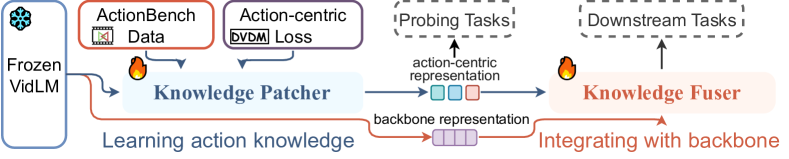
Paxion은 Knowledge Patcher와 Knowledge Fuser를 사용하여 고정된 비디오-언어 모델에 행동 지식을 패치하고, 행동 이해를 개선하는 동시에 객체 수준의 능력을 보존하기 위한 새로운 Discriminative Video Dynamics Modeling 목표를 도입합니다.
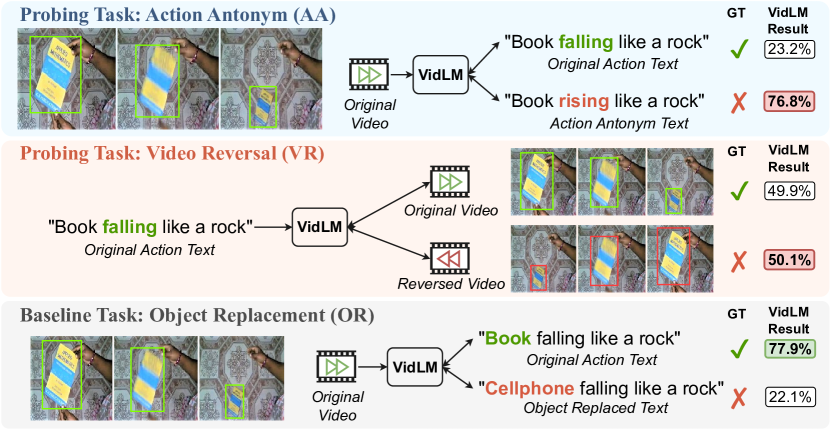
Action knowledge involves the understanding of textual, visual, and temporal aspects of actions. We introduce the Action Dynamics Benchmark (ActionBench) containing two carefully designed probing tasks: Action Antonym and Video Reversal, which targets multimodal alignment capabilities and temporal understanding skills of the model, respectively. Despite recent video-language models' (VidLM) impressive performance on various benchmark tasks, our diagnostic tasks reveal their surprising deficiency (near-random performance) in action knowledge, suggesting that current models rely on object recognition abilities as a shortcut for action understanding. To remedy this, we propose a novel framework, Paxion, along with a new Discriminative Video Dynamics Modeling (DVDM) objective. The Paxion framework utilizes a Knowledge Patcher network to encode new action knowledge and a Knowledge Fuser component to integrate the Patcher into frozen VidLMs without compromising their existing capabilities. Due to limitations of the widely-used Video-Text Contrastive (VTC) loss for learning action knowledge, we introduce the DVDM objective to train the Knowledge Patcher. DVDM forces the model to encode the correlation between the action text and the correct ordering of video frames. Our extensive analyses show that Paxion and DVDM together effectively fill the gap in action knowledge understanding (~50% to 80%), while maintaining or improving performance on a wide spectrum of both object- and action-centric downstream tasks. The code and data will be made publicly available for research purposes at https://github.com/MikeWangWZHL/Paxion.git.
연구 동기 및 목표
- 다중 모달 및 시간적 차원에 걸친 행동 지식을 탐색하기 위한 Action Dynamics Benchmark(ActionBench)을 정의한다.
- 최신 VidLM의 행동 이해가 객체 편향에 비해 어떤 결함을 가지는지 진단한다.
- VL 성능을 해치지 않으면서 고정된 VidLM 백본에 행동 지식을 패치하는 Paxion 프레임워크를 제안한다.
- 행동 텍스트 및 프레임 역학을 더 잘 배우기 위한 Discriminative Video Dynamics Modeling(DVDM) 손실을 도입한다.
- 객체 중심 능력을 유지하면서 행동 중심 다운스트림 작업의 성능 개선을 시연한다.
제안 방법
- Perceiver를 기반으로 한 경량 행동 중심 특징 증강용 Knowledge Patcher(KP)를 도입한다.
- Video-Action Contrastive(VAC) 및 Action-Temporal Matching(ATM) 손실을 사용한 Discriminative Video Dynamics Modeling(DVDM)으로 행동 역학을 학습한다.
- VTC만으로는 행동 지식에 충분하지 않다는 것을 보이고, DVDM이 필요한 차별 신호를 제공한다.
- 교차 주의(attention)를 이용한 Knowledge Fuser(KF)와 KP를 통합하여 다운스트림 작업을 위한 행동 중심 및 객체 중심 표현을 융합한다.
- ActionBench 및 다운스트림 작업(비디오-텍스트 검색, 비디오-동작 검색, NExT-QA)을 제로샷 도메인 전이 고려와 함께 Paxion으로 평가한다.
실험 결과
연구 질문
- RQ1최신 VidLM이 객체 인식 외에 강건한 행동 지식을 시연할 수 있는가?
- RQ2패치 기반의 고정 백본 접근법과 차별적 역학 목표가 VL 성능을 해치지 않으면서 행동 이해를 향상시키는가?
- RQ3행동 중심 패치를 백본 표현과 융합하는 것이 객체 중심, 행동 중심 및 시간 중심의 다양한 다운스트림 작업에 어떤 영향을 주는가?
주요 결과
- ActionBench는 Action Antonym 및 Video Reversal에서 선도적인 VidLM의 성능이 거의 무작위에 가까움을 보여주며, 강한 행동 지식의 부재와 객체에 대한 편향을 시사한다.
- DVDM을 포함한 Paxion은 객체 기반 작업의 성능을 유지하거나 향상시키면서 행동 이해(AA 및 VR)를 크게 개선한다.
- VTC+DVDM이 KP와 함께 작동하면 AA/VR 점수가 크게 향상되며(InternVideo 변형에서 58.8/46.2에서 90.1/75.5로 증가), 전반적인 평균 이득이 강력하게 나타난다.
- 지식 융합자(KF)가 행동 중심과 객체 중심 표현의 균형을 통해 다운스트림 작업 성능을 향상시키며, 특히 Temporal-SSv2 및 NExT-QA와 같은 시계열 중심 작업을 크게 개선한다.
- KF를 사용할 때 Paxion은 제로샷 설정에서 도메인 이동에 대한 강건성과 양의 전이가 나타나 일반화가 향상된다.
이 논문 읽기
누빈트 뷰어에서 원문을 열고, 읽으면서 궁금한 곳을 바로 물어보세요.
누빈트에서 이 논문 읽기이 리뷰는 AI가 논문 원문을 바탕으로 만들었습니다. 인용하기 전에 원문을 확인해 주세요.