
[논문 리뷰] Predicting Drivers' Route Trajectories in Last-Mile Delivery Using A Pair-wise Attention-based Pointer Neural Network
이 논문은 역내 배송 경로의 실제 운전사 경로를 예측하기 위해 역사적 운전사 데이터를 사용하는 쌍별 어텐션 기반 포인터 신경망을 제안한다. 국지적인 쌍별 정류소 관계와 반복적 경로 생성 알고리즘을 통합함으로써, 기준 모델 대비 첫 네 정류소의 예측 정확도를 31.2% 향상시키고 경로 이질성을 15% 감소시킨다.
In last-mile delivery, drivers frequently deviate from planned delivery routes because of their tacit knowledge of the road and curbside infrastructure, customer availability, and other characteristics of the respective service areas. Hence, the actual stop sequences chosen by an experienced human driver may be potentially preferable to the theoretical shortest-distance routing under real-life operational conditions. Thus, being able to predict the actual stop sequence that a human driver would follow can help to improve route planning in last-mile delivery. This paper proposes a pair-wise attention-based pointer neural network for this prediction task using drivers' historical delivery trajectory data. In addition to the commonly used encoder-decoder architecture for sequence-to-sequence prediction, we propose a new attention mechanism based on an alternative specific neural network to capture the local pair-wise information for each pair of stops. To further capture the global efficiency of the route, we propose a new iterative sequence generation algorithm that is used after model training to identify the first stop of a route that yields the lowest operational cost. Results from an extensive case study on real operational data from Amazon's last-mile delivery operations in the US show that our proposed method can significantly outperform traditional optimization-based approaches and other machine learning methods (such as the Long Short-Term Memory encoder-decoder and the original pointer network) in finding stop sequences that are closer to high-quality routes executed by experienced drivers in the field. Compared to benchmark models, the proposed model can increase the average prediction accuracy of the first four stops from around 0.229 to 0.312, and reduce the disparity between the predicted route and the actual route by around 15%.
연구 동기 및 목표
- 기존 최적화 방법이 포착하지 못하는 암묵적인 지식을 반영한 실제 운전사 경로 궤적을 도로 내 마지막 마일 배송에서 예측하기 위해.
- 더 나은 순서 예측을 위해 쌍별 어텐션 메커니즘을 사용해 국지적인 정류소 간 의존성을 모델링하기 위해.
- 최적의 경로 시작점을 선택함으로써 운영 비용을 최소화하는 반복적 경로 생성 알고리즘을 개발하기 위해.
- 전통적인 TSP/VRP 솔버와 표준 딥러닝 모델에 비해 고품질의 인간이 수행하는 배송 순서를 더 잘 예측하기 위해.
제안 방법
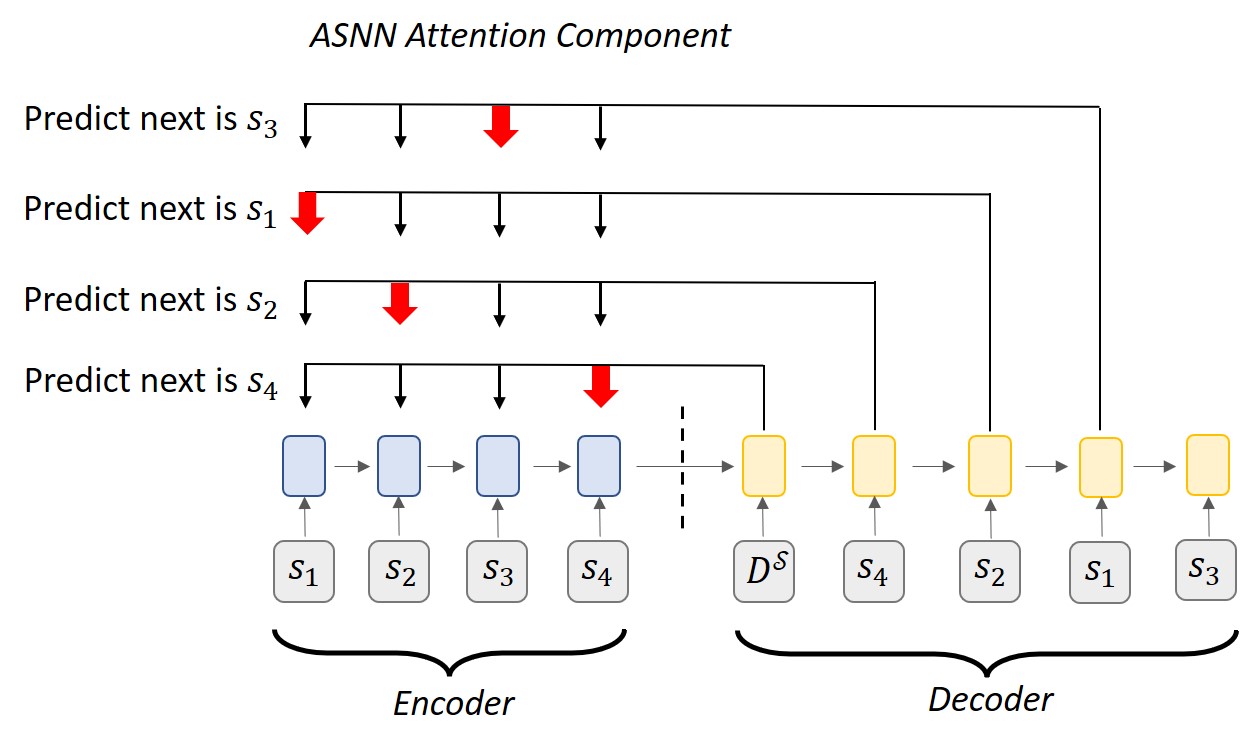
- 기존 경로 데이터를 기반으로 한 시퀀스-투-시퀀스 모델로, 인코더-디코더 아키텍처를 사용하여 정류소 순서를 처리한다.
- 새로운 쌍별 어텐션 메커니즘이 정류소 쌍 간의 국지적 의존성을 캡처하여 순차적 선택의 모델링을 향상시킨다.
- 특정 정류소에 기반한 신경망(ASNN)이 정류소 쌍 특징에 기반해 어텐션 점수를 계산함으로써 국지적 경로 결정 정확도를 향상시킨다.
- 반복적 경로 생성 알고리즘이 총 이동 비용을 최소화하는 첫 번째 정류지를 선택함으로써 전역 경로 효율성을 확보한다.
- 지역 내 경로 및 투어 TSP 문제를 해결하여 정류소 순서를 완전히 생성하며, 가장 가까운 정류소를 각 영역의 입구/출구 후보로 사용한다.
- 영역 순서를 각 영역의 후보 첫 번째 및 마지막 정류소 간 TSP 부분 문제를 해결함으로써 전체 정류소 순서로 변환한다.
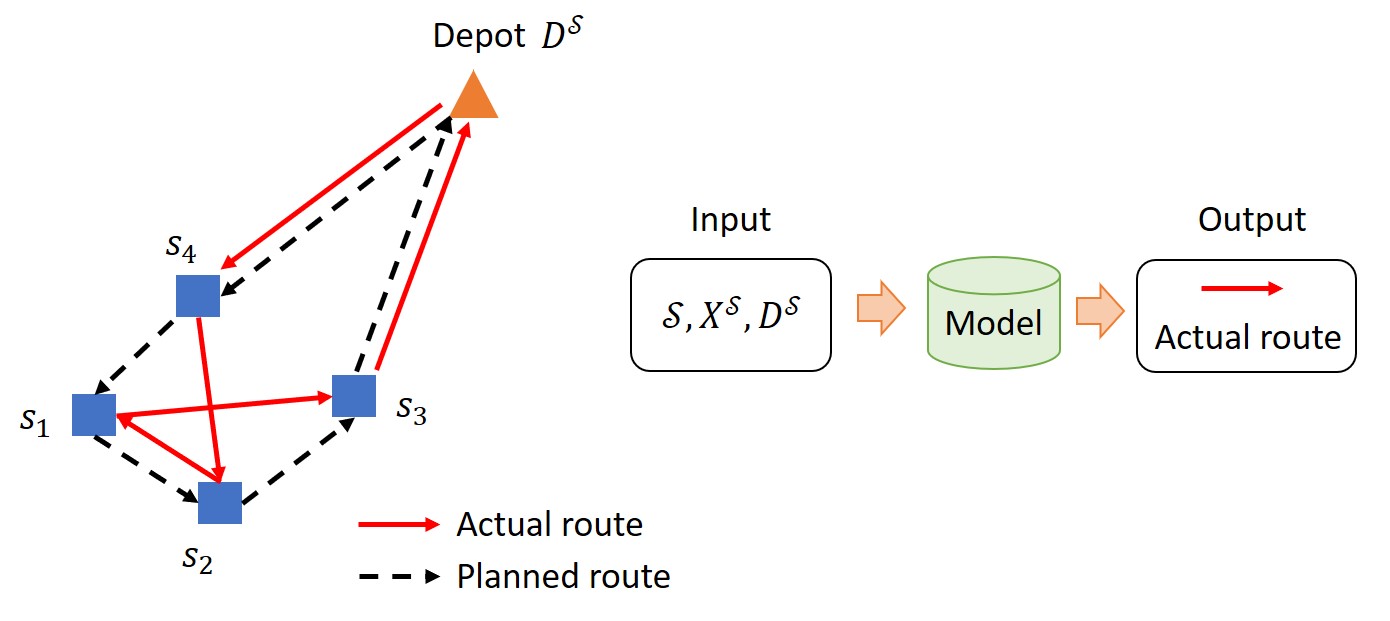
실험 결과
연구 질문
- RQ1역사적 운전사 궤적 데이터로 훈련된 딥러닝 모델이 기존 최적화 방법보다 실제 정류소 순서를 더 정확하게 예측할 수 있는가?
- RQ2정류소 간 쌍별 어텐션을 통합함으로써 표준 포인터 네트워크에 비해 궤적 예측 성능이 어떻게 향상되는가?
- RQ3운영 비용 기반의 반복적 생성 전략이 숙련된 운전사 행동에서의 경로 이질성을 어느 정도 최소화할 수 있는가?
- RQ4모델의 성능이 LSTM-인코더-디코더 및 표준 포인터 네트워크에 비해 배송 경로의 첫 네 정류소를 예측할 때 어떻게 비교되는가?
주요 결과
- 제안된 모델은 첫 네 정류소의 평균 예측 정확도를 약 0.2에서 0.312로 높여 기준 모델에 비해 뚜렷한 향상을 이룬다.
- 기준 접근 방식에 비해 예측된 경로와 실제 경로 간 이질성을 약 15% 감소시켰다.
- 쌍별 어텐션 메커니즘이 국지적 정류소 의존성을 효과적으로 캡처하여 표준 어텐션 메커니즘보다 더 나은 순서 모델링에 기여한다.
- 반복적 경로 생성 알고리즘이 저비용의 시작 정류지를 성공적으로 식별하여 예측된 경로의 전역 효율성을 향상시켰다.
- 실제 도로 내 마지막 마일 배송 시나리오에서 기존 최적화 기반 방법과 딥러닝 기반 베이스라인 모델(예: LSTM-인코더-디코더 및 원본 포인터 네트워크)을 모두 능가하는 성능을 보였다.
- 영역 수준의 라우팅과 영역 내 TSP 최적화의 통합은 예측된 순서에서 스케일링 가능하고 정확한 전체 경로 재구성 가능하게 한다.
이 논문 읽기
누빈트 뷰어에서 원문을 열고, 읽으면서 궁금한 곳을 바로 물어보세요.
누빈트에서 이 논문 읽기이 리뷰는 AI가 논문 원문을 바탕으로 만들었습니다. 인용하기 전에 원문을 확인해 주세요.