
[논문 리뷰] Probabilistically Correct Language-based Multi-Robot Planning using Conformal Prediction
이 논문은 사용자가 지정한 임무 성공률을 보장하면서 불확실성을 정량화하는 분산형, LLM 기반 다중 로봇 계획자인 방법을 제안한다. 자신감이 있을 땐 결정을 내리고 불확실할 땐 도움을 요청함으로써, 이 방법은 95% 신뢰수준에서 96.57%의 성공률을 달성하면서 도움 요청 횟수를 최소화하였으며, 복잡한 시나리오에서 이전의 중심집중형 및 분산형 LLM 기반 계획자들보다 뛰어난 성능을 보였다.
This paper addresses task planning problems for language-instructed robot teams. Tasks are expressed in natural language (NL), requiring the robots to apply their capabilities at various locations and semantic objects. Several recent works have addressed similar planning problems by leveraging pre-trained Large Language Models (LLMs) to design effective multi-robot plans. However, these approaches lack performance guarantees. To address this challenge, we introduce a new distributed LLM-based planner, called S-ATLAS for Safe plAnning for Teams of Language-instructed AgentS, that is capable of achieving user-defined mission success rates. This is accomplished by leveraging conformal prediction (CP), a distribution-free uncertainty quantification tool in black-box models. CP allows the proposed multi-robot planner to reason about its inherent uncertainty in a distributed fashion, enabling robots to make individual decisions when they are sufficiently certain and seek help otherwise. We show, both theoretically and empirically, that the proposed planner can achieve user-specified task success rates, assuming successful plan execution, while minimizing the overall number of help requests. We provide comparative experiments against related works showing that our method is significantly more computational efficient and achieves lower help rates. The advantage of our algorithm over baselines becomes more pronounced with increasing robot team size.
연구 동기 및 목표
- 기존의 LLM 기반 다중 로봇 계획자들이 불확실성 하에서 환영을 일으키거나 실패하는 등 안전성과 성능 보장이 부족한 문제를 해결하기 위해.
- 불확실성 정량화를 통해 이론적으로 입증된 임무 성공률을 보장하는 분산형, 언어 지시 기반 다중 로봇 계획을 가능하게 하기 위해.
- 로봇이 자신감이 낮을 때만 자율적으로 도움을 요청함으로써 인간 간섭에 대한 의존도를 최소화하기 위해.
- 임무 복잡도와 로봇 팀 규모가 증가함에 따라 높은 계획 정확도를 유지할 수 있는 계획자를 설계하기 위해.
- 다중 에이전트 환경에서 LLM과 확률적 예측을 통합하여 신뢰할 수 있고 타당한 행동 예측 집합을 생성하기 위해.
제안 방법
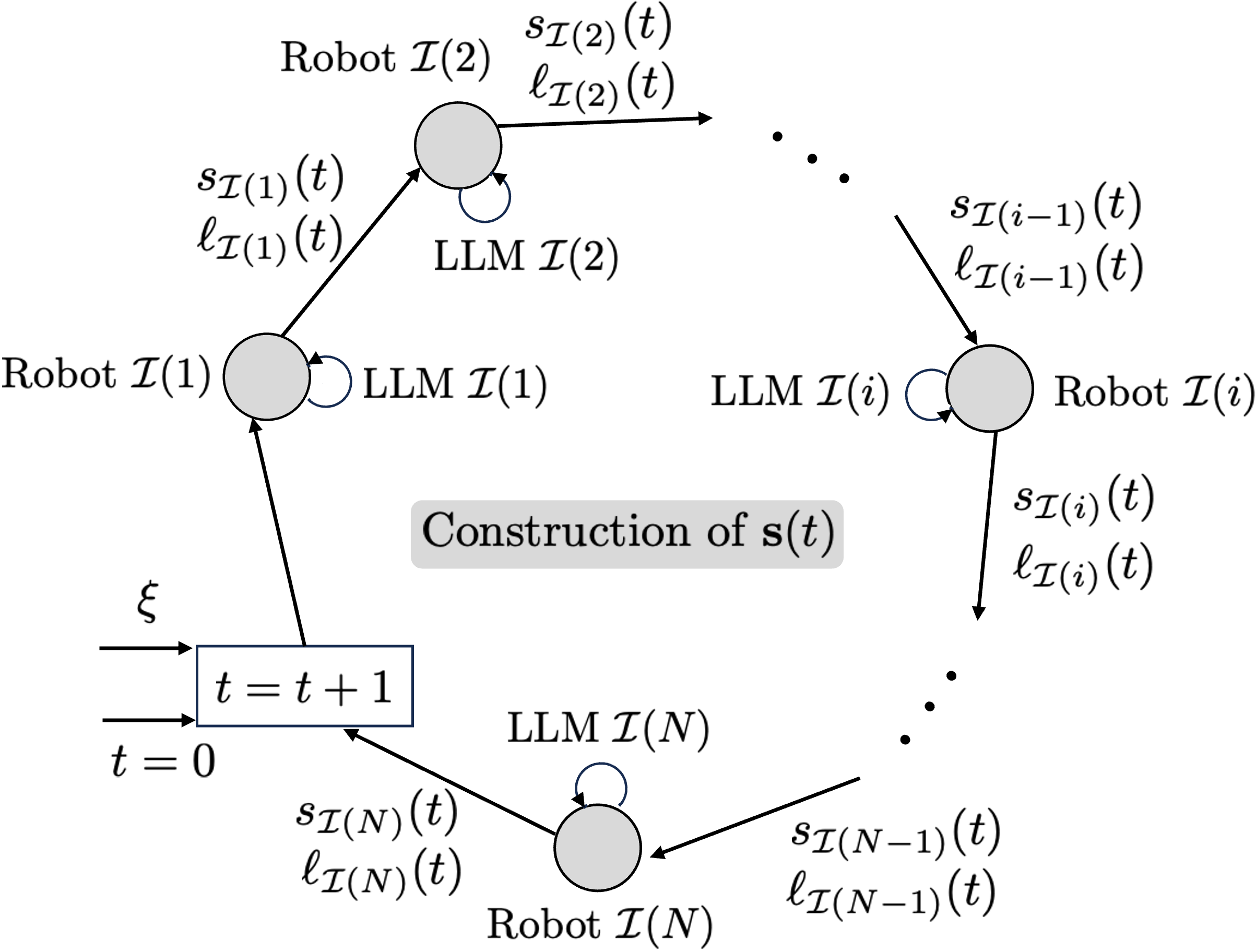
- 각 로봇은 사전 학습된 LLM 에이전트를 할당받으며, 이 에이전트는 다중 선택 질문-답변(MCQA) 프레임워크를 통해 행동을 선택함으로써 유효한 행동로 제한하고 환영을 줄인다.
- LLM의 출력에 대해 확률적 예측을 적용하여 각 로봇의 다음 행동에 대한 예측 집합을 생성함으로써, 분포에 종속되지 않는 방식으로 불확실성을 정량화한다.
- 계획자는 좌표 강하 접근법을 사용하며, 로봇들이 다른 이들의 결정력에 기반해 순차적으로 행동을 선택함으로써 조율을 보장한다.
- 예측 집합이 단일 원소가 아닐 경우, 로봇은 도움을 요청할 수 있다. 이때 시스템은 다른 로봇 순서 집합(I)을 사용하여 계획을 재계산함으로써 불확실성을 줄일 수 있다.
- W번의 尝시에 단일 원소 집합을 얻을 수 없다면, 시스템은 인간 사용자로부터 도움을 요청하여 정확성을 보장한다.
- 이 방법은 확률적 예측에 이론적으로 기반하여, 진짜 행동이 최소 1−α 확률로 예측 집합 내에 포함됨을 보장한다.

실험 결과
연구 질문
- RQ1중앙 집중적 감시에 의존하지 않고도 분산형 LLM 기반 계획자가 사용자가 지정한 임무 성공률을 달성할 수 있는가?
- RQ2확률적 예측을 다중 로봇 계획에 효과적으로 통합하여, 분산형, 블랙박스 LLM 환경에서 불확실성을 정량화할 수 있는가?
- RQ3제안된 방법은 계획 정확도를 유지하거나 향상시키면서 기존의 LLM 기반 계획자들보다 도움 요청 횟수를 줄일 수 있는가?
- RQ4임무 복잡도와 로봇 팀 규모가 증가함에 따라 계획자의 성능는 어떻게 변화하는가?
- RQ5로봇 선택 순서를 재정렬함으로써(예: I), 예측 집합 크기를 줄일 수 있고, 따라서 인간 간섭의 필요성을 줄일 수 있는가?
주요 결과
- 제안된 계획자는 도움 요청 없이도 87.9%의 임무 성공률을 달성하여 기준 성능를 검증하였다.
- 90% 성공률(1−α=0.90)을 목표로 할 경우, 도움 요청을 允허함으로써 94.59%의 성공률을 달성하여 이론적 보장을 확인하였다.
- 95% 성공률(1−α=0.95)을 목표로 할 경우, 계획자는 96.57%의 성공률을 달성하여 이론적 경계와 강한 경험적 일치를 보였다.
- 90% 및 95% 신뢰수준에서 각각 4.44%와 8.1%의 결정에서 도움이 요청되었으며, 간섭에 따른 부담이 낮음을 보여주었다.
- 로봇 선택 순서 집합(I)을 재정렬함으로써, 테스트된 5개 시나리오 중 2개에서 비단일 원소 예측 집합을 단일 원소 집합으로 줄이는 데 성공하여 인간 도움 의존도를 감소시켰다.
- 제안된 방법은 임무 복잡도와 팀 규모가 증가함에 따라 기존의 중심집중형 및 분산형 LLM 기반 계획자들보다 계획 정확도에서 뛰어난 성능을 보였다.
이 논문 읽기
누빈트 뷰어에서 원문을 열고, 읽으면서 궁금한 곳을 바로 물어보세요.
누빈트에서 이 논문 읽기이 리뷰는 AI가 논문 원문을 바탕으로 만들었습니다. 인용하기 전에 원문을 확인해 주세요.