
[논문 리뷰] Re-ReST: Reflection-Reinforced Self-Training for Language Agents
이 논문은 언어 에이전트의 자기학습을 향상시키기 위해 외부 피드백(예: 단위 테스트 결과)을 사용하여 저품질 출력을 보완하는 반사 모델을 활용하는 반사 강화 자기학습(Re-ReST)을 제안한다. 개선된 샘플은 이후 에이전트의 성능 향상에 사용되며, 추론 오버헤드 없이 다양한 작업에서 일관된 성능 향상을 이룬다.
Finetuning language agents with reasoning-action trajectories is effective, but obtaining these trajectories from human annotations or stronger models is costly and sometimes impractical. In this paper, we investigate the use of self-training in language agents, which can generate supervision from the agent itself, offering a promising alternative without relying on human or stronger model demonstrations. Self-training, however, requires high-quality model-generated samples, which are hard to obtain for challenging language agent tasks. To address this, we present Reflection-Reinforced Self-Training (Re-ReST), which uses a extit{reflector} to refine low-quality generated samples during self-training. The reflector takes the agent's output and feedback from an external environment (e.g., unit test results in code generation) to produce improved samples. This technique enhances the quality of inferior samples and efficiently enriches the self-training dataset with higher-quality samples. We conduct extensive experiments on open-source language agents across tasks, including multi-hop question answering, sequential decision-making, code generation, visual question answering, and text-to-image generation. The results demonstrate the effectiveness of self-training and Re-ReST in language agent tasks, with self-training improving baselines by 7.6\% on HotpotQA and 28.4\% on AlfWorld, and Re-ReST further boosting performance by 2.0\% and 14.1\%, respectively. Our studies also confirm the efficiency of using a reflector to generate high-quality samples for self-training. Moreover, we demonstrate a method to employ reflection during inference without ground-truth feedback, addressing the limitation of previous reflection work. Our code is released at https://github.com/PlusLabNLP/Re-ReST.
연구 동기 및 목표
- 복잡한 작업에 특히 어려움을 겪는 자기학습에서 고품질 샘플 확보의 비효율성을 해결한다.
- 저품질 샘플을 기각하는 한계를 극복하기 위해 반사 모델을 통해 그들을 개선할 수 있도록 한다.
- 자기 판단에 의존하는 것 대신, 추론 시에 신뢰할 수 없는 판단에 의존하지 않도록 외부 피드백(예: 테스트 결과)을 학습 중에 활용하여 정확한 수정을 유도한다.
- 반사 기반 데이터 증강 후 바로 정확한 출력을 생성하도록 에이전트를 훈련시켜 추론 시 비용이 전혀 발생하지 않도록 보장한다.
- 기존 자기일致성 디코딩과의 호환성과 다양한 언어 에이전트 작업에 대한 확장성을 입증한다.
제안 방법
- 모델이 생성한 출력과 외부 피드백(예: 실행 결과, 테스트 결과)을 입력으로 받는 반사 모델을 도입한다.
- 반사 모델을 사용해 잘못되거나 저품질의 출력을 수정하고 고품질 버전으로 변환한다.
- 이러한 개선된 샘플을 자기학습 데이터셋에 추가하여 피팅 훈련 중 에이전트의 성능 향상에 기여한다.
- 원본 샘플과 반사된 샘플의 병합된 데이터셋을 사용해 표준 자기학습 목표함수에 따라 에이전트를 훈련시킨다.
- 반사 과정을 추론와 분리한다: 테스트 시에는 오직 에이전트 모델만 사용되며 런타임 오버헤드가 발생하지 않는다.
- 다중 생성물을 처리하고 개선된 변형을 생성할 수 있도록 반사 모델을 설계해 자기일치성 디코딩과의 호환성을 확보한다.

실험 결과
연구 질문
- RQ1저품질 모델 출력에 대한 반사 기반 보정이 자기학습의 효율성과 성능 향상에 상당한 기여를 할 수 있는가?
- RQ2반사 과정에서 외부 피드백(예: 단위 테스트)을 사용할 경우, 자기 판단만으로 보정하는 것보다 더 신뢰성 있고 고품질의 샘플 개선이 가능한가?
- RQ3반사 보강 자기학습이 코드 생성 및 다단계 질문 응답과 같은 다양한 언어 에이전트 작업에 얼마나 일반화 가능한가?
- RQ4샘플 품질과 최종 성능 측면에서 Re-ReST는 일반 자기학습 및 기타 자기 향상 기법과 비교해 어떤가?
- RQ5반사 메커니즘은 자기일치성과 같은 기존 추론 시 디코딩 전략과 호환되는가?
주요 결과
- Re-ReST는 다단계 질문 응답, 순차적 의사결정, 코드 생성, 시각 질문 응답, 텍스트 기반 이미지 생성 등 다섯 가지 다양한 작업에서 일반 자기학습 대비 일관된 성능 향상을 달성한다.
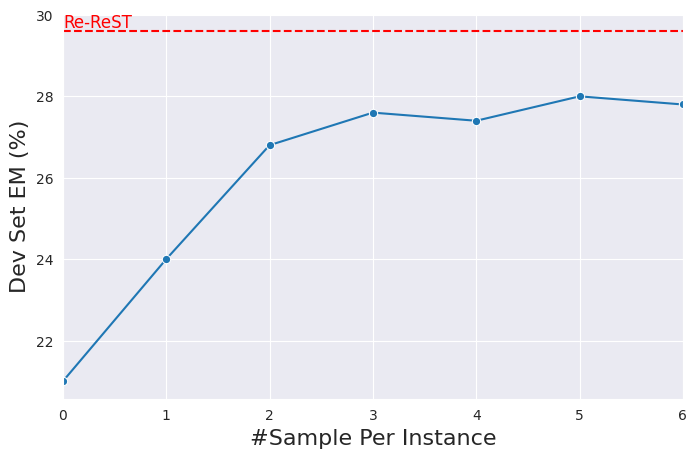
- 절단 실험을 통해 반사 모델이 자기학습 샘플의 품질과 유용성을 크게 향상시킴을 확인하였으며, 단지 모델 샘플링에 의존하는 방법보다 뛰어난 성능을 보였다.
- 자기일치성 디코딩과의 호환성이 확인되어, 기존 강력한 추론 파이프라인에 수정 없이 통합 가능함을 시사한다.
- 학습 중 외부 피드백(예: 테스트 결과)을 활용함으로써 반사 모델이 정확한 수정을 생성할 수 있었으며, 자기 판단에 의존하는 방법에 비해 성능 저하가 발생하지 않았다.
- 최종 에이전트 모델은 추론 시 반사 과정을 거치지 않아도 되므로, 테스트 시 어떤 추론 오버헤드도 발생하지 않으며, 더 나은 성능을 달성한다.
- 이 방법은 강력한 일반화 능력을 보이며, 저샷 및 복잡한 추론 환경에서도 성능 향상이 관찰되었다.
이 논문 읽기
누빈트 뷰어에서 원문을 열고, 읽으면서 궁금한 곳을 바로 물어보세요.
누빈트에서 이 논문 읽기이 리뷰는 AI가 논문 원문을 바탕으로 만들었습니다. 인용하기 전에 원문을 확인해 주세요.