
[논문 리뷰] Rethinking Depth Estimation for Multi-View Stereo: A Unified Representation
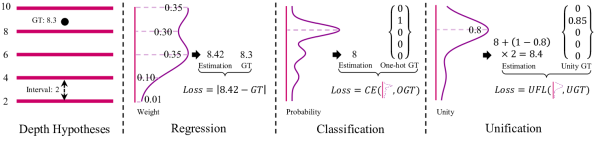
이 논문은 회귀의 서브픽셀 정확도와 분류 기반 비용 볼륨 감독의 강건성의 장점을 결합한 새로운 통합된 깊이 표현인 UniMVSNet을 제안한다. 이를 위해 샘플 불균형 문제를 해결하기 위해 새로운 통합 포인트 손실(UFL)을 사용한다. 이 방법은 DTU 및 Tanks and Temples 벤치마크에서 최신 기술 성능을 달성하며, 뛰어난 일반화성과 강건성을 보인다.
Depth estimation is solved as a regression or classification problem in existing learning-based multi-view stereo methods. Although these two representations have recently demonstrated their excellent performance, they still have apparent shortcomings, e.g., regression methods tend to overfit due to the indirect learning cost volume, and classification methods cannot directly infer the exact depth due to its discrete prediction. In this paper, we propose a novel representation, termed Unification, to unify the advantages of regression and classification. It can directly constrain the cost volume like classification methods, but also realize the sub-pixel depth prediction like regression methods. To excavate the potential of unification, we design a new loss function named Unified Focal Loss, which is more uniform and reasonable to combat the challenge of sample imbalance. Combining these two unburdened modules, we present a coarse-to-fine framework, that we call UniMVSNet. The results of ranking first on both DTU and Tanks and Temples benchmarks verify that our model not only performs the best but also has the best generalization ability.
연구 동기 및 목표
- 기반 다중 시야 스테레오(MVS)에서 회귀와 분류의 한계를 해결하기 위해 그 장점을 통합하고자 한다.
- 회귀의 간접적 감독과 분류의 이산적 성격으로 인한 깊이 추정 문제를 해결하고자 한다.
- 직접적인 비용 볼륨 감독과 서브픽셀 깊이 예측을 가능하게 하는 통합 표현을 설계하고자 한다.
- 연속된 레이블에서 샘플 불균형을 더 잘 다룰 수 있는 보다 효과적인 손실 함수인 통합 포인트 손실(UFL)을 개발하고자 한다.
- 플러그 앤 플레인지 프레임워크인 UniMVSNet을 통해 제안된 모듈의 효과성과 일반화 능력을 입증하고자 한다.
제안 방법
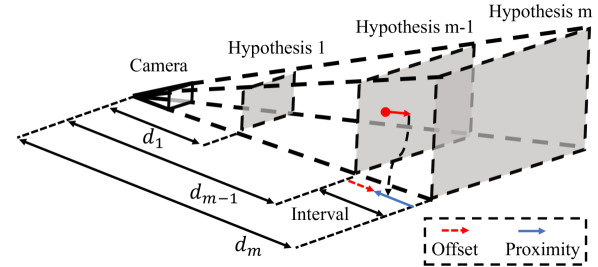
- 최적의 깊이 가설과 진짜 깊이에 대한 오프셋을 동시에 표현할 수 있는 연속적이고 거리 기반의 레이블(유니티)을 사용하는 통합 깊이 표현 'Unification'을 제안한다.
- 유니티 레이블을 연속 구간 내에서 단일 비영 값으로 정의하며, 근접도(1 - 오프셋)가 진짜 깊이의 신뢰도와 위치를 표현한다.
- 진짜 깊이 크기를 고려하여 어려운 샘플과 쉬운 샘플을 더 잘 구분하는 Focal Loss와 GFL의 일반화된 형태인 통합 포인트 손실(UFL)을 도입한다.
- 통합 표현에 직접 UFL을 적용하여 샘플 균형을 개선하고 강건한 엔드 투 엔드 학습을 가능하게 한다.
- 추가 계산 비용이나 메모리 비용 없이 표준 MVS 파이프라인에 Unification과 UFL을 통합한 코arse-투-파인 프레임워크인 UniMVSNet을 설계한다.
- 공정한 비교를 위해 적응형 집계와 더 세밀한 진짜 레이블 감독을 활용하며, 아블레이션 스터디를 통해 방법의 독립적 우수성을 확인한다.
실험 결과
연구 질문
- RQ1통합된 깊이 표현은 회귀의 서브픽셀 정밀도와 분류 기반 감독의 강건성을 효과적으로 통합할 수 있는가?
- RQ2특히 진짜 깊이 크기가 변할 경우 연속된 깊이 레이블에서 클래스 불균형 문제를 더 잘 다룰 수 있는 손실 함수는 어떻게 설계할 수 있는가?
- RQ3깊이 가설 범위가 진짜 값을 포함하지 않을 경우, 제안된 통합 표현은 강건성을 유지하는가?
- RQ4기존의 포인트 손실 변종에 비해 통합 포인트 손실(UFL)은 정확도와 완전성 측면에서 얼마나 향상되는가?
- RQ5제안된 모듈은 계산 비용을 증가시키지 않고 기존 MVS 프레임워크에 효과적으로 통합될 수 있는가?
주요 결과
- UniMVSNet은 DTU 벤치마크에서 최신 기술 성능을 달성하여 총 오차 0.324 mm로 1위를 기록하였으며, 기준 모델의 0.333 mm보다 향상되었다.
- Tanks and Temples 벤치마크에서는 이전문제 모델 대비 중간 세트에서 2.68점, 고급 세트에서 3.24점 향상되었다.
- 가설 범위가 진짜 값을 포함하지 않더라도 통합 표현은 정확한 감독을 유지한다. 모든 유니티 레이블이 0이 되므로 모델 오염을 방지한다.
- 통합 포인트 손실(UFL)은 GFL 및 표준 포인트 손실보다 정확도와 완전성 측면에서 뚜렷한 향상을 보이며, 특히 어려운 샘플 처리에 유리하다.
- 아블레이션 결과, 훈련 데이터의 50%만으로도 기준 모델의 전체 데이터를 사용한 성능을 초월하며 강력한 일반화 능력을 입증하였다.
- 제안된 모듈은 플러그 앤 플레이 방식으로 구현되어 계산 비용이나 메모리 오버헤드 없이 기존 MVS 프레임워크에 원활하게 통합될 수 있다.
이 논문 읽기
누빈트 뷰어에서 원문을 열고, 읽으면서 궁금한 곳을 바로 물어보세요.
누빈트에서 이 논문 읽기이 리뷰는 AI가 논문 원문을 바탕으로 만들었습니다. 인용하기 전에 원문을 확인해 주세요.