
[논문 리뷰] RoboCodeX: Multimodal Code Generation for Robotic Behavior Synthesis
RoboCodeX는 물리적 제약 조건과 선호도를 고려한 객체 중심의 조작 단위로 작업을 분해함으로써 고수준의 인간 지시를 실행 가능한 로봇 제어 코드로 변환하는 트리 구조의 다중모달 코드 생성 프레임워크를 제안한다. 이 프레임워크는 다중모달 추론과 플랫폼 간 일반화된 코드 기반 실행을 통해 다양한 조작 및 주행 작업에서 시뮬레이터와 실제 로봇 모두에서 최신 기술 수준(SOTA) 성능을 달성한다.
Robotic behavior synthesis, the problem of understanding multimodal inputs and generating precise physical control for robots, is an important part of Embodied AI. Despite successes in applying multimodal large language models for high-level understanding, it remains challenging to translate these conceptual understandings into detailed robotic actions while achieving generalization across various scenarios. In this paper, we propose a tree-structured multimodal code generation framework for generalized robotic behavior synthesis, termed RoboCodeX. RoboCodeX decomposes high-level human instructions into multiple object-centric manipulation units consisting of physical preferences such as affordance and safety constraints, and applies code generation to introduce generalization ability across various robotics platforms. To further enhance the capability to map conceptual and perceptual understanding into control commands, a specialized multimodal reasoning dataset is collected for pre-training and an iterative self-updating methodology is introduced for supervised fine-tuning. Extensive experiments demonstrate that RoboCodeX achieves state-of-the-art performance in both simulators and real robots on four different kinds of manipulation tasks and one navigation task.
연구 동기 및 목표
- embodiment AI에서 고수준 의미 이해와 저수준 로봇 제어 사이의 격차를 메우기 위해.
- 다양한 물체, 형태, 로봇 플랫폼 간 로봇 정책의 일반화 문제를 해결하기 위해.
- 실행 가능한 코드에 물리적 선호도와 제약 조건을 통합하여 정밀하고 이식 가능한 로봇 행동 합성 가능하게 하기 위해.
- 다중모달 대규모 언어 모델을 활용해 구체적이고 맥락 인식 가능한 로봇 계획 및 동작 생성을 가능하게 하기 위해.
- 시각, 언어, 공간 추론을 플랫폼 독립적 로봇 코드로 통합하는 통합 프레임워크를 개발하기 위해.
제안 방법
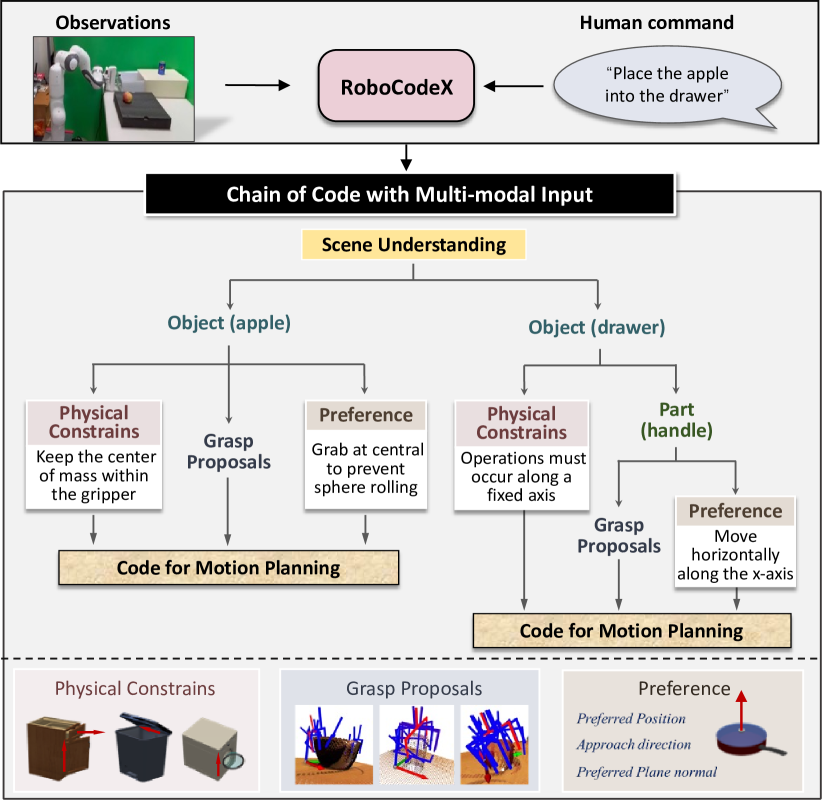
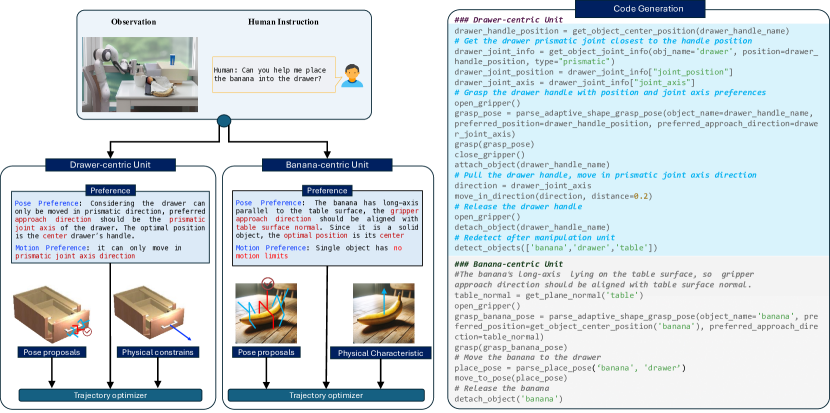
- RoboCodeX는 고수준 지시를 객체 중심의 조작 단위로 분해하기 위해 트리 오브 씽크팅 추론 구조를 사용한다.
- 목표 자세 제안, 물리적 제약 조건(예: 관절 축, 쟁반 영역) 예측, 3D 공간 및 시각 입력을 기반으로 선호하는 쟁반 자세를 추론한다.
- 프리트레인을 위해 전용 다중모달 추론 데이터셋을 활용하고, 지도 미세조정을 위한 반복적 자기 업데이트 방법을 적용한다.
- 이동_to_자세, 경로 따라 이동, 쟁반 등의 동작 계획 기능을 포함한 파이썬 기반 API를 통합하여 실행 가능한 로봇 코드를 생성한다.
- 그립퍼 접근 방향, 평면 법선, 쟁반 유형 등의 물리적 선호도는 코드 생성 과정에서 설정 가능한 매개변수로 인코딩된다.
- 상징적 코드 표현을 통해 개념적 이해를 저수준 제어 시퀀스로 변환하며, 이는 다양한 로봇 플랫폼 간 이식 가능성을 보장한다.
실험 결과
연구 질문
- RQ1코드를 상징적 다리로 삼아, 다중모달 추론 프레임워크가 다양한 물체와 로봇 플랫폼 간 로봇 행동 합성의 일반화를 얼마나 잘 달성할 수 있는가?
- RQ2트리 오브 씽크팅 구조를 가진 모델이 고수준 지시를 실행 가능하고 물리적으로 타당한 조작 단위로 얼마나 효과적으로 분해할 수 있는가?
- RQ3자기 지도 미세조정 전략이 실제 로봇 작업에서 코드 생성 품질과 제로샷 일반화 능력을 얼마나 향상시키는가?
- RQ4다중모달 대규모 언어 모델이 3D 공간 및 물리적 제약 조건에 효과적으로 뿌리를 내리며 신뢰할 수 있는 로봇 제어 코드를 생성할 수 있는가?
- RQ5물리적 선호도 모델링(예: 쟁반 영역, 관절 제약 조건)의 통합이 생성된 로봇 행동의 강건성과 적응 가능성에 얼마나 기여하는가?
주요 결과
- RoboCodeX는 시뮬레이션 및 실제 환경에서 네 가지 조작 작업과 한 가지 주행 작업에서 최신 기술 수준(SOTA) 성능을 달성한다.
- 코드 기반의 플랫폼 독립적 실행 인터페이스 덕분에 새로운 물체와 로봇 플랫폼에 대해 강력한 제로샷 일반화 성능를 보여준다.
- 반복적 자기 업데이트 미세조정 전략은 기준 방법 대비 코드 생성 정확도와 작업 성공률을 크게 향상시킨다.
- 물리적 제약 조건과 선호도 모델링의 통합은 더 신뢰할 수 있고 안전한 쟁반 및 조작 행동을 이끈다.
- 프리트레인 단계에서 전용 다중모달 추론 데이터셋을 사용함으로써 모델이 물체의 기능과 공간 관계를 더 잘 추론할 수 있는 능력이 향상된다.
- 시스템은 실제 로봇 배포를 통해 검증된 실행 가능한 파이썬 코드를 성공적으로 생성하여 고수준 지시를 정밀한 로봇 동작으로 매핑한다.
이 논문 읽기
누빈트 뷰어에서 원문을 열고, 읽으면서 궁금한 곳을 바로 물어보세요.
누빈트에서 이 논문 읽기이 리뷰는 AI가 논문 원문을 바탕으로 만들었습니다. 인용하기 전에 원문을 확인해 주세요.