
[논문 리뷰] Sentiment Analysis through LLM Negotiations
이 논문은 추론이 강화된 생성기와 설명을 유도하는 판별기가 반복적으로 협상하는 다중-LLM 협상 프레임워크를 제안하여 단일 LLM ICL 기반의 벤치마크 대비 더 높은 정확도를 달성한다.
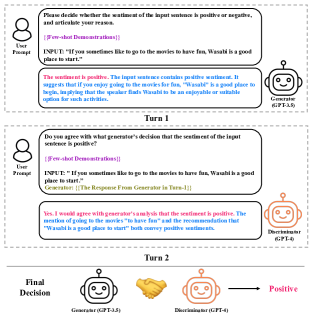
A standard paradigm for sentiment analysis is to rely on a singular LLM and makes the decision in a single round under the framework of in-context learning. This framework suffers the key disadvantage that the single-turn output generated by a single LLM might not deliver the perfect decision, just as humans sometimes need multiple attempts to get things right. This is especially true for the task of sentiment analysis where deep reasoning is required to address the complex linguistic phenomenon (e.g., clause composition, irony, etc) in the input. To address this issue, this paper introduces a multi-LLM negotiation framework for sentiment analysis. The framework consists of a reasoning-infused generator to provide decision along with rationale, a explanation-deriving discriminator to evaluate the credibility of the generator. The generator and the discriminator iterate until a consensus is reached. The proposed framework naturally addressed the aforementioned challenge, as we are able to take the complementary abilities of two LLMs, have them use rationale to persuade each other for correction. Experiments on a wide range of sentiment analysis benchmarks (SST-2, Movie Review, Twitter, yelp, amazon, IMDB) demonstrate the effectiveness of proposed approach: it consistently yields better performances than the ICL baseline across all benchmarks, and even superior performances to supervised baselines on the Twitter and movie review datasets.
연구 동기 및 목표
- 복합적 언어 현상(예: 아이러니, 부정)을 위한 맥락 학습(ICL) 방식의 단일 LLM 감정 분석 한계 제시.
- 정확도와 강건성을 개선하기 위한 제너레이터-디스크리미네이터 다중-LLM 협상 프레임워크를 제안.
- 두 LLM의 협력, 필요 시 제3의 LLM까지 활용하면 감독 학습 벤치마크보다 다양한 데이터셋에서 더 나은 성능을 얻을 수 있음을 보여준다.
- 역할 전환 협상과 합리성 기반 설명이 의사결정의 질과 해석 가능성을 높임을 보여준다.
제안 방법
- 추론이 강화된 제너레이터(G)와 설명을 도출하는 판별기(D)를 갖춘 2-LLM 설정을 도입한다.
- G는 회수된 시演시( demonstrations)에 조건화된 구조화된 추론 체인과 함께 감정 판단을 생성한다.
- D는 G의 출력을 평가하고 근거를 제시하며 합의에 도달할 때까지 반복 협상을 촉발할 수 있다.
- 역할을 바꾼 협상은 의사 결정을 더 세밀하게 다듬기 위해 G와 D의 역할을 교환한다.
- 의견 불일치가 지속되면 세 명의 LLM을 도입해 여섯 개의 협상 결과를 집계하고 투표한다.
- 실험은 백본으로 GPT-3.5, GPT-4 및 InstructGPT-3.5를 사용하고, KNN 기반 시演시 검색에는 RoBERTa-Large를 사용한다.
실험 결과
연구 질문
- RQ1두 LLM 간 제너레이터-디스크리미네이터 협상이 단일 LLM의 ICL보다 감정 분석에서 성능을 더 낼 수 있는가?
- RQ2역할 교체(및 선택적 제3-LLM 투표)가 다양한 감정 벤치마크에서 정확도와 강건성을 더 향상시키는가?
- RQ3협상 과정에서 명시적 추론 체인의 포함이 성능에 미치는 영향은 무엇인가?
- RQ4SST-2, MR, Twitter, Yelp, Amazon, IMDB 같은 표준 데이터셋에서 제안된 접근법이 감독 학습 벤치마크와 비교해 어떤 차이가 있는가?
주요 결과
- 두 LLM 협상 프레임워크가 여러 데이터셋에서 일반적인 ICL 벤치마크보다 일관되게 정확도를 향상시킨다.
- 두 개의 서로 다른 LLM과의 협상은 MR, Twitter, IMDB에서 자가 협상(한 LLM) 설정에 비해 통계적으로 유의한 차이로 성능을 상회한다.
- 역할 교환 협상과 세 번째 LLM의 추가로 성능이 더 향상되어 합의 기반 의사결정을 가능하게 한다.
- 이 방법은 Twitter 및 Movie Review 데이터셋에서 일부 감독 학습 벤치마크를 능가할 수 있으며 여러 벤치마크에서 RoBERTa-Large와의 격차를 좁힌다.
- 합리성 포함 프롬프트는 결정 품질에 결정적이며, 협상 설정에서 합리성 단계를 제거하면 단일 LLM 벤치마크보다 성능 손실이 더 커진다.
이 논문 읽기
누빈트 뷰어에서 원문을 열고, 읽으면서 궁금한 곳을 바로 물어보세요.
누빈트에서 이 논문 읽기이 리뷰는 AI가 논문 원문을 바탕으로 만들었습니다. 인용하기 전에 원문을 확인해 주세요.