
[논문 리뷰] Stochastic Approximation with Delayed Updates: Finite-Time Rates under Markovian Sampling
이 논문은 마르코프 샘플링 하에서 지연 업데이트를 갖는 확률적 근사(SA)에 대한 최초의 유한시간 수렴 분석을 제공하며, 고정점 주변의 노이즈 볼로의 지수 수렴을 확립한다. 반복값의 균일 유계성을 보장하는 새로운 귀납적 증명 기법을 도입하였고, 최대 지연 τ_max 대신 평균 지연 τ_avg에 따라 지수를 조정하는 지연 적응형 SA 방식을 제안하여, 지연에 대한 사전 지식 없이 단계 크기 조정이 가능하도록 한다.
Motivated by applications in large-scale and multi-agent reinforcement learning, we study the non-asymptotic performance of stochastic approximation (SA) schemes with delayed updates under Markovian sampling. While the effect of delays has been extensively studied for optimization, the manner in which they interact with the underlying Markov process to shape the finite-time performance of SA remains poorly understood. In this context, our first main contribution is to show that under time-varying bounded delays, the delayed SA update rule guarantees exponentially fast convergence of the \emph{last iterate} to a ball around the SA operator's fixed point. Notably, our bound is \emph{tight} in its dependence on both the maximum delay $τ_{max}$, and the mixing time $τ_{mix}$. To achieve this tight bound, we develop a novel inductive proof technique that, unlike various existing delayed-optimization analyses, relies on establishing uniform boundedness of the iterates. As such, our proof may be of independent interest. Next, to mitigate the impact of the maximum delay on the convergence rate, we provide the first finite-time analysis of a delay-adaptive SA scheme under Markovian sampling. In particular, we show that the exponent of convergence of this scheme gets scaled down by $τ_{avg}$, as opposed to $τ_{max}$ for the vanilla delayed SA rule; here, $τ_{avg}$ denotes the average delay across all iterations. Moreover, the adaptive scheme requires no prior knowledge of the delay sequence for step-size tuning. Our theoretical findings shed light on the finite-time effects of delays for a broad class of algorithms, including TD learning, Q-learning, and stochastic gradient descent under Markovian sampling.
연구 동기 및 목표
- 마르코프 샘플링 하에서 지연된 업데이트를 갖는 확률적 근사(SA)에 대한 유한시간 이론적 분석 부족 문제를 해결하기 위해.
- 비동기 및 다중 에이전트 강화학습 환경에서 지연된 SA의 경험적 성공성과 시간적으로 상관된(Markovian) 샘플링 하에서의 이론적 정당성 부족 간 격차를 메우기 위해.
- 시간에 따라 변하는 지연과 기저 마르코프 과정의 혼합 시간을 모두 고려한 수렴 분석을 개발하기 위해.
- 최대 지연 τ_max 가 아닌 평균 지연 τ_avg 에 따라 의존하는 지연 적응형 SA 방식을 제안하고 분석하기 위해.
- 지연 수열에 대한 사전 지식이 필요 없는 단계 크기 조정을 제공하여 실용적 적용성을 높이기 위해.
제안 방법
- 반복값의 균일 유계성을 보장하는 새로운 귀납적 증명 기법을 개발하여, 시간에 따라 변하는 유계 지연 하에서도 날카운 유한시간 경계를 확보한다.
- 마르코프 샘플링 하에서 원래의 지연된 SA 업데이트 규칙을 분석하여, max{τ_max, τ_mix}에 비례하는 수렴 속도를 도출한다. 여기서 τ_mix 는 마르코프 과정의 혼합 시간이다.
- 관측된 지연에 따라 업데이트 규칙을 동적으로 조정하는 지연 적응형 SA 방식을 도입하여, 수렴 지수의 τ_max 의 의존도를 감소시킨다.
- 재귀적 오차 경계 분석을 통해 기대 제곱 오차가 τ_avg 에 따라 의존하는 비율로 지수적으로 감소함을 보인다.
- 수렴 속도를 최적화할 수 있는 명시적 단계 크기 조건을 유도하며, T 번의 반복에 대해 경계가 exp(−αμT/(4τ_avg + 4)) 의 형태로 스케일링됨을 보인다.
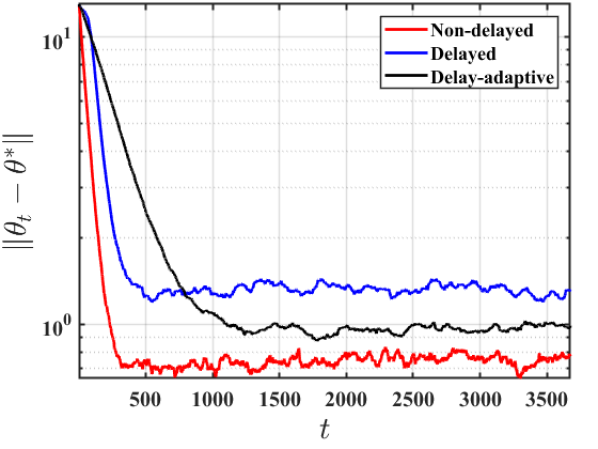
- 마르코프 샘플링과 임의의 지연 하에서 TD(0) 학습에 대한 시뮬레이션을 통해 이론적 결과를 검증하였으며, 지연 없음, 원래 지연, 지연 적응형 알고리즘 간의 비교를 수행하였다.
실험 결과
연구 질문
- RQ1시간에 따라 변하는 지연과 마르코프 과정의 혼합 시간 간의 상호작용이 지연된 업데이트를 갖는 확률적 근사의 유한시간 수렴에 어떤 영향을 미치는가?
- RQ2반복값의 균일 유계성을 보장하는 새로운 귀납적 증명 기법이 지연과 마르코프 샘플링 하에서 기존 방법보다 날카운 수렴 경계를 도출할 수 있는가?
- RQ3최대 지연 τ_max 에 의존하는 수렴 속도를 줄이고 평균 지연 τ_avg 에 따라 스케일링하는 지연 적응형 SA 방식이 존재하는가?
- RQ4지연 수열에 대한 사전 지식 없이도 단계 크기 조정이 가능한 지연 적응형 방식을 설계할 수 있는가?
- RQ5실제로 비틀린 지연된 SA와 제안된 지연 적응형 방식 간의 이론적 수렴 속도와 노이즈 볼 크기의 비교는 어떠한가?
주요 결과
- 원래의 지연된 SA 업데이트 규칙은 고정점 주변의 노이즈 볼로 지수 수렴을 달성하며, 이 수렴 지수는 기저 마르코프 과정의 혼합 시간 τ_mix 와 함께 max{τ_max, τ_mix} 에 비례한다.
- 제안된 귀납적 증명 기법은 반복값의 균일 유계성을 보장하며, τ_max 와 τ_mix 양쪽에 대한 최적의 의존성으로 날카운 경계를 도출한다.
- 지연 적응형 SA 방식의 경우, 수렴 지수는 τ_max 가 아닌 τ_avg 에 따라 스케일링되며, 희귀한 큰 지연에 대한 저감도가 크게 향상된다.
- 동일한 단계 크기 하에서, 지연 적응형 방식은 τ_max 에 대한 민감도가 감소하여 원래 지연된 방법보다 더 작은 수렴 노이즈 볼을 달성한다.
- TD(0) 학습에 대한 시뮬레이션을 통해 이론적 분석을 검증하였으며, 지연 적응형 알고리즘이 원래 지연된 버전보다 더 작은 노이즈 볼로 수렴하는 것으로 나타났다. 다만 이론적 상충 관계에 따라 수렴 속도는 느리게 나타났다.
- 지연 적응형 방식은 τ_max 와 반비례하는 조정이 필요 없기 때문에, 더 보수적인 단계 크기 선택이 가능하여 실세계 응용에 더 실용적이다.
이 논문 읽기
누빈트 뷰어에서 원문을 열고, 읽으면서 궁금한 곳을 바로 물어보세요.
누빈트에서 이 논문 읽기이 리뷰는 AI가 논문 원문을 바탕으로 만들었습니다. 인용하기 전에 원문을 확인해 주세요.