
[논문 리뷰] Stop Regressing: Training Value Functions via Classification for Scalable Deep RL
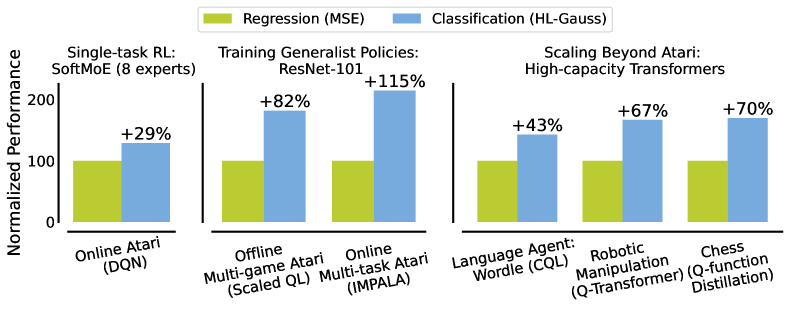
이 논문은 딥 강화학습에서 가치 함수 학습에 평균 제곱 오차(MSE) 회귀 대신 분류 문제로 가치 예측을 재정의함으로써 성능 향상을 제안한다. 히스토그램 기반 이산화(예: HL-Gauss)를 사용해 연속적인 가치 타겟을 이산 분류 범주로 변환함으로써, 다중 작업 Atari에서 최대 2.1배 향상, 체스에서 70% 향상, 로봇 조작에서 67% 향상되는 등 뚜렷한 성능 향상을 이룬다. 이는 노이즈가 많고 비정상적인 타겟에 대한 강건성도 향상시키며, Transformer 및 MoE와 같은 대규모 모델을 활용한 확장 가능한 학습을 가능하게 한다.
Value functions are a central component of deep reinforcement learning (RL). These functions, parameterized by neural networks, are trained using a mean squared error regression objective to match bootstrapped target values. However, scaling value-based RL methods that use regression to large networks, such as high-capacity Transformers, has proven challenging. This difficulty is in stark contrast to supervised learning: by leveraging a cross-entropy classification loss, supervised methods have scaled reliably to massive networks. Observing this discrepancy, in this paper, we investigate whether the scalability of deep RL can also be improved simply by using classification in place of regression for training value functions. We demonstrate that value functions trained with categorical cross-entropy significantly improves performance and scalability in a variety of domains. These include: single-task RL on Atari 2600 games with SoftMoEs, multi-task RL on Atari with large-scale ResNets, robotic manipulation with Q-transformers, playing Chess without search, and a language-agent Wordle task with high-capacity Transformers, achieving state-of-the-art results on these domains. Through careful analysis, we show that the benefits of categorical cross-entropy primarily stem from its ability to mitigate issues inherent to value-based RL, such as noisy targets and non-stationarity. Overall, we argue that a simple shift to training value functions with categorical cross-entropy can yield substantial improvements in the scalability of deep RL at little-to-no cost.
연구 동기 및 목표
- Transformer 및 MoE와 같은 대규모 신경망을 사용할 때 평균 제곱 오차(MSE) 회귀를 사용하는 가치 기반 딥 RL 방법의 낮은 확장성 문제를 해결한다.
- 가치 함수 학습을 분류 문제로 재정의함으로써 분류 기반 교차 엔트로피 손실를 사용할 경우 성능 및 확장성 향상 여부를 조사한다. 이는 지도학습 분야에서의 성공 사례를 모방한다.
- 분류 기반 학습이 단일 작업 및 다중 작업 Atari, 로봇 조작, 체스, 언어 에이전트 작업 등 다양한 RL 도메인에서 안정적이고 효과적인 학습을 가능하게 함을 보여준다.
- 노이즈가 많은 타겟, 비정상성, 표현 품질에 대한 강건성 분석을 통해 관찰된 성능 향상의 근본 원인을 이해한다.
- 분류 기반 교차 엔트로피를 가치 기반 RL에서 MSE 회귀의 단순하고 효과적이며 확장 가능한 대체 수단으로 정립하며, 기존 알고리즘에 쉽게 통합할 수 있도록 한다.
제안 방법
- 히스토그램 기반 이산화 방법(예: HL-Gauss)을 사용해 연속적인 가치 타겟을 이산 범주로 변환함으로써 분류 기반 학습을 가능하게 한다.
- 가치 네트워크를 평균 제곱 오차(MSE) 대신 분류 기반 교차 엔트로피 손실로 학습시켜 더 안정적이고 표현력 있는 최적화를 가능하게 한다.
- 다양한 아키텍처(예: ResNet, Mixture-of-Experts(MoE), Transformer)에 분류 기반 가치 함수 학습을 적용하여 여러 RL 벤치마크에서 검증한다.
- 특히 오프라인 및 자가 대전 환경에서 학습을 안정화시키기 위해 타겟 분포 스무딩 및 가치 분포 정련 기법을 적용한다.
- 선형 프로빙을 포함한 아블레이션 및 진단 실험을 수행하여 MSE와 교차 엔트로피로 학습된 표현 간의 비교 분석 및 최적화 동역학 분석을 수행한다.
- 다양한 환경에 이 방법을 적용한다: 단일 및 다중 작업 Atari, 로봇 조작(Q-Transformer), 체스(검색 없이 자가 대전), 대용량 Transformer 기반 언어 에이전트 작업(Wordle).
실험 결과
연구 질문
- RQ1MSE 회귀를 분류 기반 교차 엔트로피 분류로 대체할 경우, 대규모 모델을 사용하는 가치 기반 딥 RL의 확장성과 성능 향상이 뚜렷하게 향상되는가?
- RQ2교차 엔트로피 손실이 노이즈가 많거나 비정상적인 타겟 하에서 가치 기반 RL의 학습 안정성과 성능 향상에 기여하는 주요 메커니즘은 무엇인가?
- RQ3특히 대용량 아키텍처에서 MSE로 학습된 가치 네트워크와 비교했을 때, 교차 엔트로피로 학습된 네트워크의 표현 품질은 어떻게 되는가?
- RQ4분류 기반 가치 학습이 복잡하고 고차원적인 제어 및 의사결정 작업에서 더 나은 일반화 및 샘플 효율성을 제공하는가?
- RQ5교차 엔트로피의 이점이 다양한 아키텍처(예: ResNet, MoE, Transformer)와 RL 패러다임(온라인, 오프라인, 자가 대전) 간에 얼마나 전이되는가?
주요 결과
- HL-Gauss 이산화를 사용한 분류 기반 교차 엔트로피로 학습할 경우, 단일 작업 Atari RL에서 Mixture-of-Experts(MoE)를 확장할 때 성능이 30% 향상된다.
- ResNet-101를 사용한 다중 작업 Atari RL에서, 이 방법은 MSE 회귀 대비 1.8–2.1배 높은 성능을 기록하며 대규모 모델과의 강력한 확장성을 입증한다.
- 270M 파라미터의 Transformer를 사용해 검색 없이 체스를 플레이할 경우, 교차 엔트로피 방법은 지도인 Stockfish 엔진 대비 성능 격차를 70% 향상시킨다.
- 대용량 Transformer 기반 언어 에이전트 작업(Wordle)에서, 이 방법은 MSE 기반 학습 대비 40% 성능 향상을 기록하며 최신 기술 성능을 달성한다.
- Q-Transformer 기반 로봇 조작 작업에서, 교차 엔트로피로 가치 함수를 학습할 경우 MSE 대비 성능이 67% 향상된다.
- 진단 분석 결과, 교차 엔트로피 손실은 노이즈가 많고 비정상적인 타겟에 대한 강건성을 향상시키며, 네트워크 용량을 더 효과적으로 활용함으로써 선형 프로빙을 통해 더 표현력 있는 표현을 도출함을 확인했다.

이 논문 읽기
누빈트 뷰어에서 원문을 열고, 읽으면서 궁금한 곳을 바로 물어보세요.
누빈트에서 이 논문 읽기이 리뷰는 AI가 논문 원문을 바탕으로 만들었습니다. 인용하기 전에 원문을 확인해 주세요.