
[논문 리뷰] Strong lensing selection effects
이 논문은 강한 렌즈 설계 효과를 정량화하여 렌즈 조사가 은하 및 소스 집단에 미치는 편향을 모델링하며, 렌즈 은하는 일반 집단보다 체계적으로 더 질량이 크고, 더 조밀하며, 더 많은 암흑물질을 포함하고 있음을 보여준다. 0.5" 에인슈타인 반경까지 완전한 유클리드 유사 조사의 경우, 별질량 대광도 비율의 편향은 약 10%에 불과하여, 보정 없이도 렌즈 데이터를 직접적으로 별질량을 보정하는 데 사용할 수 있다.
Context. Strong lenses are a biased subset of the general population of galaxies. Aims. The goal of this work is to quantify how lens galaxies and lensed sources differ from their parent distribution, namely the strong lensing bias. Methods. We first studied how the strong lensing cross-section varies as a function of lens and source properties. Then, we simulated strong lensing surveys with data similar to that expected for Euclid and measured the strong lensing bias in different scenarios. We focused particularly on two quantities: the stellar population synthesis mismatch parameter, $α_{sps}$, defined as the ratio between the true stellar mass of a galaxy and the stellar mass obtained from photometry, and the central dark matter mass at fixed stellar mass and size. Results. Strong lens galaxies are biased towards larger stellar masses, smaller half-mass radii and larger dark matter masses. The amplitude of the bias depends on the intrinsic scatter in the mass-related parameters of the galaxy population and on the completeness in Einstein radius of the lens sample. For values of the scatter that are consistent with observed scaling relations and a minimum detectable Einstein radius of $0.5''$, the strong lensing bias in $α_{sps}$ is $10\%$, while that in the central dark matter mass is $5\%$. The bias has little dependence on the properties of the source population: samples of galaxy-galaxy lenses and galaxy-quasar lenses that probe the same Einstein radius distribution are biased in a very similar way. Conclusions. Given current uncertainties, strong lensing observations can be used directly to improve our current knowledge of the inner structure of galaxies, without the need to correct for selection effects. Time-delay measurements of $H_0$ from lensed quasars can take advantage of prior information obtained from galaxy-galaxy lenses with similar Einstein radii.
연구 동기 및 목표
- 강한 렌즈 조사가 은하 및 배경 소스의 편향된 부분집단을 어떻게 선별하는지 정량화하는 것.
- 조사항 설계 함수가 렌즈 은하의 성질(예: 별질량, 크기, 암흑물질 함량)에 미치는 영향을 모델링하는 것.
- 현재 별집단 합성 매개변수에 대한 불확실성이 강한 렌즈 데이터로 제약을 받을 수 있는지 평가하는 것.
- 시간지연 H₀ 측정에서 은하-은하 렌즈에서의 사전 정보를 은하-활성은하핵 렌즈로의 이식 가능성 평가.
- 선택 편향이 에인슈타인 반경에서의 내재 산란과 조사 완전성에 어떻게 의존하는지 규명하는 것.
제안 방법
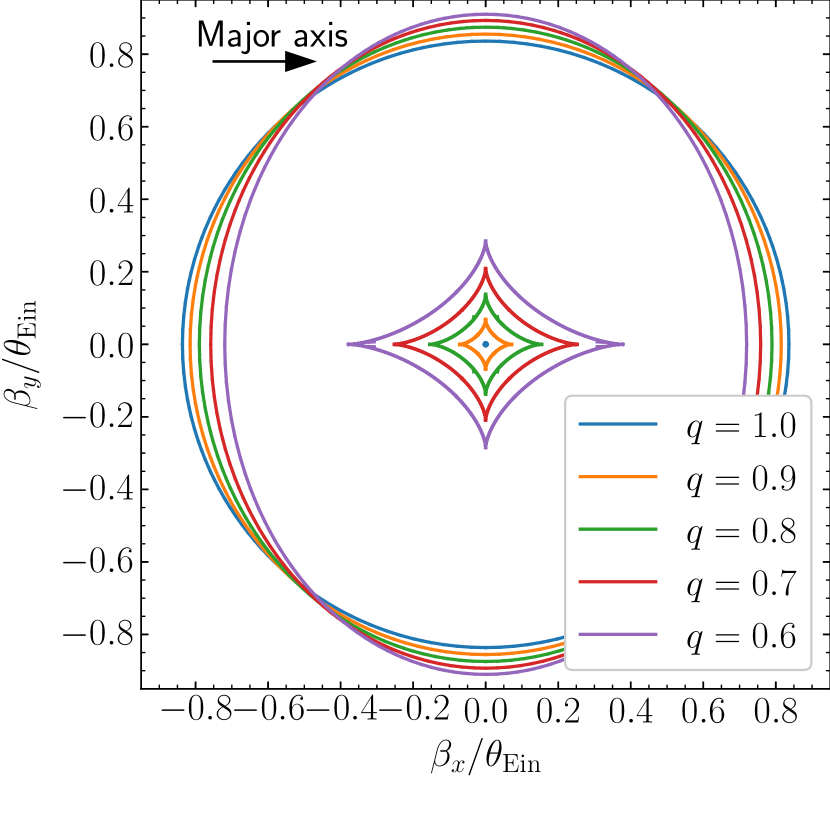
- 저자들은 분석적 및 반분석적 모델을 사용하여 렌즈 및 소스 성질에 따라 강한 렌즈 단면적을 계산한다.
- 감지 한계 및 이미지 간격 임계값을 포함한 현실적인 조사 특성을 가진 유클리드 유사 렌즈 조사를 시뮬레이션한다.
- 선택 함수는 P_SL(ψ_g, ψ_s|S) ∝ P_g(ψ_g) P_s(ψ_s) P_sel(ψ_g, ψ_s|S)로 모델링되며, 렌즈 기하학과 감지 완전성을 통합한다.
- 별집단 합성 불일치 매개변수 α_sps는 진정한 별질량 대 비포지트릭 별질량의 비율로 정의되며, 질량 측정 편향을 정량화하는 데 사용된다.
- 고정된 별질량과 크기에서 중심 암흑물질 질량을 측정하여 구조적 편향을 분리한다.
- 은하-은하 렌즈와 은하-활성은하핵 렌즈를 비교하는 시뮬레이션을 통해 선택 효과의 소스 집단 의존성을 평가한다.

실험 결과
연구 질문
- RQ1강한 렌즈 선택 함수는 별질량, 크기, 암흑물질 함량과 같은 관측된 렌즈 은하 성질의 분포를 어떻게 편향시키는가?
- RQ2별집단 합성 매개변수의 내재 산란이 선택 편향의 크기에 어느 정도의 영향을 미치는가?
- RQ3작은 에인슈타인 반경을 가진 렌즈를 감지하는 데서의 완전성이 선택 편향의 크기에 어떤 영향을 미치는가?
- RQ4은하-은하 렌즈에서의 정보를 시간지연 H₀ 측정에서 은하-활성은하핵 렌즈 시스템의 사전 정보로 신뢰성 있게 사용할 수 있는가?
- RQ5선택 함수는 배경 소스의 크기 분포에 편향을 주는가, 아니면 그들 위상 분포에만 편향을 주는가?
주요 결과
- 유클리드 유사 조사에서 0.5" 에인슈타인 반경까지 완전한 경우, 별집단 합성 불일치 매개변수 α_sps의 강한 렌즈 편향은 10% 또는 0.04 dex이다.
- 같은 조건에서 고정된 별질량과 크기에서 중심 암흑물질 질량의 편향은 5%, 또는 0.02 dex이다.
- 고정된 별질량에서 평균 허브 질량의 편향은 0.07 dex이며, 이는 중간 정도이지만 측정 가능한 선택 효과임을 시사한다.
- 강한 렌즈 편향은 소스 집단에 거의 의존하지 않으며, 에인슈타인 반경이 동일한 경우 은하-은하 렌즈와 은하-활성은하핵 렌즈는 유사한 편향 크기를 보인다.
- 선택 함수는 배경 소스의 위상 분포를 넓히지만, 고정된 위상에서 크기 분포에 유의미한 편향을 주지 않는다.
- 은하-은하 렌즈 사전 정보를 활용해 활성은하핵 렌즈에 대해 H₀ 추론을 할 경우, 약 1%의 편향이 추정되며, 이는 제약 조건의 이식 가능성에 대한 지원을 제공한다.
이 논문 읽기
누빈트 뷰어에서 원문을 열고, 읽으면서 궁금한 곳을 바로 물어보세요.
누빈트에서 이 논문 읽기이 리뷰는 AI가 논문 원문을 바탕으로 만들었습니다. 인용하기 전에 원문을 확인해 주세요.