
[논문 리뷰] TCAN: Text-oriented Cross Attention Network for Multimodal Sentiment Analysis
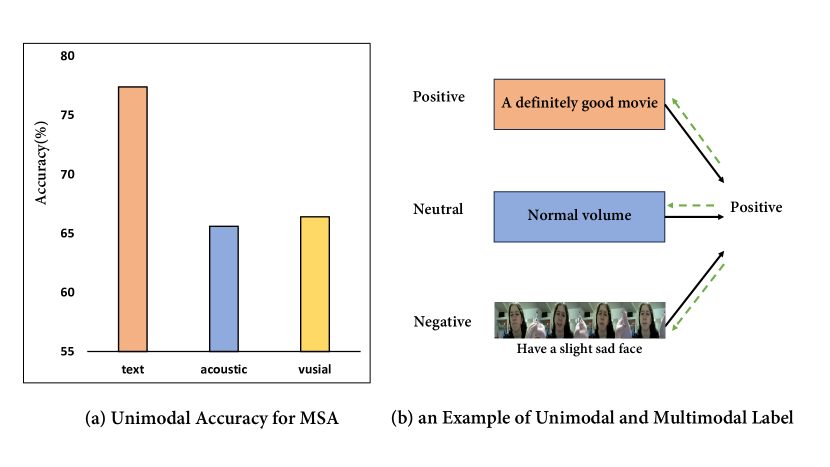
TCAN은 시각적 및 청각적 모odal의 융합을 위한 주도적 가이드로 텍스트 모달을 활용하는 텍스트 중심의 교차 attention 네트워크를 제안한다. 텍스트 쿼리 기반 교차 attention과 게이팅 메커니즘, 단모달 공동 학습을 통해 TCAN은 CMU-MOSI 및 CMU-MOSEI에서 최신 기술 수준(SOTA) 성능을 달성하며, 모달 기여도를 효과적으로 균형 잡고 노이즈 영향을 줄이는 데 성공한다.
Multimodal Sentiment Analysis (MSA) endeavors to understand human sentiment by leveraging language, visual, and acoustic modalities. Despite the remarkable performance exhibited by previous MSA approaches, the presence of inherent multimodal heterogeneities poses a challenge, with the contribution of different modalities varying considerably. Past research predominantly focused on improving representation learning techniques and feature fusion strategies. However, many of these efforts overlooked the variation in semantic richness among different modalities, treating each modality uniformly. This approach may lead to underestimating the significance of strong modalities while overemphasizing the importance of weak ones. Motivated by these insights, we introduce a Text-oriented Cross-Attention Network (TCAN), emphasizing the predominant role of the text modality in MSA. Specifically, for each multimodal sample, by taking unaligned sequences of the three modalities as inputs, we initially allocate the extracted unimodal features into a visual-text and an acoustic-text pair. Subsequently, we implement self-attention on the text modality and apply text-queried cross-attention to the visual and acoustic modalities. To mitigate the influence of noise signals and redundant features, we incorporate a gated control mechanism into the framework. Additionally, we introduce unimodal joint learning to gain a deeper understanding of homogeneous emotional tendencies across diverse modalities through backpropagation. Experimental results demonstrate that TCAN consistently outperforms state-of-the-art MSA methods on two datasets (CMU-MOSI and CMU-MOSEI).
연구 동기 및 목표
- 다모달 감성 분석에서 강력한 모달(예: 텍스트)이 자주 과소평가되는 모달 기여도의 불균형 문제를 해결하기 위해.
- 다른 모달 간에 시간적으로 정렬되지 않은 시각적 및 청각적 시퀀스에서 발생하는 노이즈와 중복을 줄이기 위해.
- 텍스트와 다른 모달 간의 상호작용 가능한 이중 방향 학습을 통해 표현 학습을 향상시키기 위해.
- 다양한 모달의 기여도를 의미적 풍부도에 따라 동적으로 균형 잡는 유연한 프레임워크를 개발하기 위해.
- 기존 최신 기술 수준의 방법들을 초월하여 벤치마크 다모달 감성 분석 데이터셋에서 성능을 높이기 위해.
제안 방법
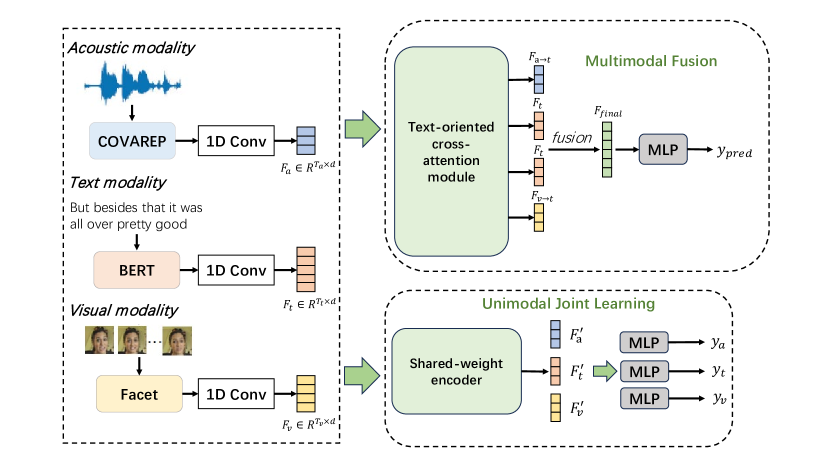
- 모델은 텍스트-시각(TV) 및 텍스트-청각(TA) 두 가지 이모달 융합 모듈을 사용하며, 여기서 텍스트 모달이 다른 모달에 대한 교차 attention의 쿼리로 기능한다.
- 교차 attention 이전에 텍스트 모달에 대해 자기 attention을 적용하여 내부 표현을 향상시킨다.
- 시각적 및 청각적 모달에서 노이즈가 많고 중복된 특징을 억제하기 위해 게이팅 제어 메커니즘을 도입한다.
- 공유된 감성 신호를 역전파하여 모달 간 표현을 정렬하기 위해 단모달 공동 학습을 적용한다.
- 텍스트 중심의 교차 attention 메커니즘을 갖춘 스택드 트랜스포머 아키텍처를 구축하여 다모달 표현의 반복적 정련을 가능하게 한다.
- 텍스트 중심 교차 attention 모듈의 수(N)는 튜닝되며, CMU-MOSI에서 최적 성능은 N=5에서 달성된다.
실험 결과
연구 질문
- RQ1어떻게 하면 더 높은 의미적 풍부도와 낮은 노이즈를 갖는 텍스트 모달을 효과적으로 우선시할 수 있는가?
- RQ2비대칭적인 삼모달 융합 대비 텍스트 쿼리 기반 교차 attention이 시간적으로 정렬되지 않은 다모달 시퀀스에서 융합 성능을 얼마나 향상시킬 수 있는가?
- RQ3게이팅 메커니즘의 포함이 다모달 융합에서 노이즈 억제 및 성능 안정성에 어떤 영향을 미치는가?
- RQ4TCAN에서 표현 깊이와 모달 가이드 기능을 균형 잡는 데 최적의 교차 attention 레이어 수(N)는 얼마인가?
- RQ5단모달 및 다모달 학습을 동시에 수행하면 다양한 모달 간 일관성과 일반화 능력이 향상되는가?
주요 결과
- TCAN은 CMU-MOSI 및 CMU-MOSEI 데이터셋에서 모두 최신 기술 수준 성능을 달성하며, 기존 SOTA 방법보다 F1 점수에서 뛰어난 성능을 보였다.
- 제거 실험 결과, 게이팅 메커니즘 또는 단모달 공동 학습을 제거할 경우 성능 저하가 심각하게 발생함을 확인하여 이들의 효과성을 입증했다.
- 텍스트 모달을 주도 모달로 대체할 경우 성능이 크게 저하됨을 통해 텍스트의 의미적 우월성을 확인했다.
- CMU-MOSI에서 텍스트 중심 교차 attention 모듈의 최적 수는 N=5이며, 이 이상의 N을 늘릴 경우 과적합 또는 가이드 품질 저하로 인해 성능이 떨어졌다.
- 시각화 결과는 TCAN이 강력한 모달(예: 텍스트)에 더 높은 가중치를 할당하고, 약한 또는 충돌하는 신호를 보완함을 보여주었다.
- 단모달 예측 간 갈등이 발생하는 모호한 케이스에서도 모델은 다모달 진짜값에 가까운 예측을 성공적으로 도출했다.
이 논문 읽기
누빈트 뷰어에서 원문을 열고, 읽으면서 궁금한 곳을 바로 물어보세요.
누빈트에서 이 논문 읽기이 리뷰는 AI가 논문 원문을 바탕으로 만들었습니다. 인용하기 전에 원문을 확인해 주세요.