
[논문 리뷰] Testing the General Deductive Reasoning Capacity of Large Language Models Using OOD Examples
이 논문은 규칙 다양성, 증명 깊이, 폭, 구성 가능성을 다루는 프로그래머블 합성 데이터셋 PrOntoQA-OOD를 도입하여 LLM의 일반적 연역 추론을 평가하고, 맥락 내 시演을 넘어선 OOD 일반화를 측정합니다.
Given the intractably large size of the space of proofs, any model that is capable of general deductive reasoning must generalize to proofs of greater complexity. Recent studies have shown that large language models (LLMs) possess some abstract deductive reasoning ability given chain-of-thought prompts. However, they have primarily been tested on proofs using modus ponens or of a specific size, and from the same distribution as the in-context examples. To measure the general deductive reasoning ability of LLMs, we test on a broad set of deduction rules and measure their ability to generalize to more complex proofs from simpler demonstrations from multiple angles: depth-, width-, and compositional generalization. To facilitate systematic exploration, we construct a new synthetic and programmable reasoning dataset that enables control over deduction rules and proof complexity. Our experiments on four LLMs of various sizes and training objectives show that they are able to generalize to compositional proofs. However, they have difficulty generalizing to longer proofs, and they require explicit demonstrations to produce hypothetical subproofs, specifically in proof by cases and proof by contradiction.
연구 동기 및 목표
- LLMs가 Demonstrations를 넘어 더 복잡한 증명으로 일반화하는지 여부를 평가합니다.
- 모듈 폰스(modus ponens) beyond multiple deduction rules 일반화 평가.
- 합성 세계 모델에서 생성된 증명에서 깊이, 폭, 구성 일반화를 Examine합니다.
- 유도적 과제에서 맥락 학습(in-context learning)과 감독(supervision)의 일반화 영향을 결정합니다.
제안 방법
- PrOntoQA-OOD를 프로그래머블 합성 데이터셋으로 확장하여 PrOntoQA에 여러 유도 규칙과 제어 가능한 증명 깊이와 폭을 추가합니다.
- 트리 구조로 증명을 표현하여 깊이(증명 체인의 길이)와 폭(한 단계의 선행 조건 수)을 정량화합니다.
- 다른 유도 규칙을 하위 증명으로 결합하는 재귀적 절차를 통해 구성적 증명을 생성합니다.
- 속임수를 방지하고 추론 단계의 강건한 평가를 가능하게 하기 위해 산만한 요소를 포함합니다.
- CoT 출력물을 일차 논리로 의미적으로 파싱하여 각 유도 단계를 검증하고 전제에 대한 타당성 및 근접성을 확보합니다.
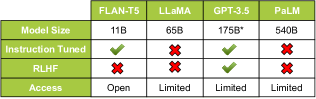
- ID(distribution) 및 OOD 조건에서 GPT-3.5, PaLM, LLaMA, FLAN-T5를 대상으로 8-shot Chain-of-Thought 프롬프트를 평가합니다.
실험 결과
연구 질문
- RQ1LLMs가 CoT 시演으로 제시된 Demonstration을 넘어서 모든 deduction 규칙의 완전한 집합을 학습할 수 있는가?
- RQ2LLMs가 Demonstrations에서 본 것보다 더 깊고 넓은 증명(깊이/폭 일반화) 및 하나의 증명에 여러 규칙을 결합한 구성적 증명으로 일반화하는가?
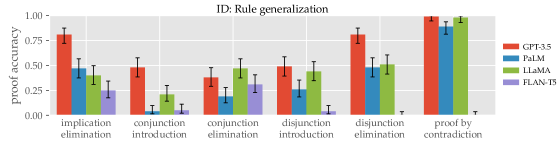
- RQ3LLMs가 보이지 않는 deduction 규칙에 대해 Explicit Demonstrations 없이 어느 정도까지 일반화할 수 있는가(OOD 규칙 일반화)?
- RQ4맥락 학습과 감독 학습이 일반적 연역 추론을 가능하게 하는 데 어떤 차이가 있는가?
- RQ5산만한 요소가 OOD 일반화 및 단축 솔루션 회피에 미치는 영향은 무엇인가?
주요 결과
- LLMs는 구성적 증명에서 CoT 프롬프팅을 사용하여 일반화할 수 있지만 더 긴 증명은 여전히 도전적입니다.
- 모델의 성능이 크기와 강한 상관이 없으며, 지시 조정(instruction tuning)이 적용된 작은 모델이 더 큰 모델과 비견될 수 있습니다.
- 일부 규칙(예: OR-분배법칙 제거와 모순에 의한 증명)에서는 명시적 시演 없이도 여러 규칙을 사용할 수 있지만, 경우에 따라서는 시演이 필요합니다.
- 일부 시나리오에서 테스트 예제와 다른 분포의 맥락 내 시演은 ID 시演보다 구성적 일반화를 더 잘 이끌 수 있습니다.
- 산만한 요소는 일부 모델에서 복사 휴리스틱을 완화시킬 수 있지만 규칙과 모델에 따라 효과가 다릅니다.
이 논문 읽기
누빈트 뷰어에서 원문을 열고, 읽으면서 궁금한 곳을 바로 물어보세요.
누빈트에서 이 논문 읽기이 리뷰는 AI가 논문 원문을 바탕으로 만들었습니다. 인용하기 전에 원문을 확인해 주세요.