
[논문 리뷰] The quantum geometric origin of capacitance in insulators
이 논문은 밴드 절연체에서 縦방향 전도도가 양자 기하(tensor)에서 기인하는 내재된 커패시턴스, 특히 이에 해당하는 양자 거리(metric)에 기인한 것으로 규명한다. 이는 가상의 다이아몬드 간 전이를 지배한다. 핵심 결과는 이 커패시턴스가 양자 거리와 밴드 갭의 비율에 비례하며, hBN가 정렬된 비틀린 이중층 그래핀, 다이아몬드, 기타 차단된 원자 절연체와 같은 절연체에서 측정 가능한, 위상적으로 영향을 받는 유전율 반응 기여를 제공한다는 것이다.
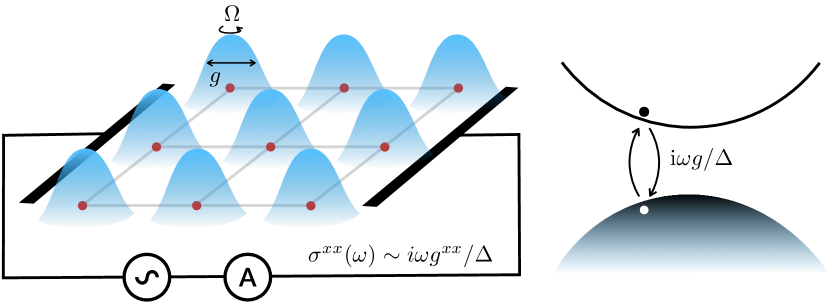
In band insulators, where the Fermi surface is absent, adiabatic transport is allowed only due to the geometry of the Hilbert space. By driving the system at a small but finite frequency $ω$, transport is still expected to depend sensitively on the quantum geometry. Here we show that this expectation is correct and can be made precise by expressing the Kubo formula for conductivity as the variation of the \emph{time-dependent polarization} with respect to the applied field. In particular, a little appreciated effect is that at linear order in frequency, the longitudinal conductivity results from an intrinsic capacitance, determined by the ratio of the quantum metric and the spectral gap. We demonstrate that this intrinsic capacitance has a measurable effect in a wide range of insulators with non-negligible metric, including the electron gas in a quantizing magnetic field, the gapped bands of hBN-aligned twisted bilayer graphene, and obstructed atomic insulators such as diamond whose large refractive index has a topological origin. We also discuss the influence of quantum geometry on the dielectric constant.
연구 동기 및 목표
- 전통적인 운반 메커니즘을 초월하여 밴드 절연체에서의 종방향 전도도 기원을 규명하기 위해.
- 특히 양자 거리가 절연체에서 저주파 응답에 어떻게 기여하는지 조사하기 위해.
- 양자 기하 텐서와 청결한 절연체의 내재 커패시턴스 사이의 직접적인 연결을 수립하기 위해.
- 이 커패시턴스가 비제로인 양자 거리를 가진 실제 물질에서 측정 가능하고 비섭동적인 효과임을 입증하기 위해.
- 특히 광학 유전율 상수 $\epsilon_\infty$를 결정하는 데 있어 양자 기하의 역할을 명확히 하기 위해.
제안 방법
- 쿠보 공식을 사용하여 선형 응답 전도도를 유도하고, 이를 외부 전기장에 대한 시간에 따라 변화하는 분극의 기능적 도함수로 표현하기 위해.
- 주파수에 대한 정적 근사 전개를 적용하여 전도도의 주요 종방향 기여가 내재 커패시턴스 $c = \varepsilon_0 \chi$ 에 의해 지배됨을 보여주기 위해.
- 정적 순화도 $\chi$ 를 양자 거리와 연결하기 위해 $\chi \propto \sum_{m \neq n} \frac{g^{xx}_{mn}}{\omega_{mn}}$ 를 사용하며, 여기서 $g^{xx}_{mn}$ 는 양자 거리의 면내 성분이다.
- 유전율 상수와 양자 기하 사이의 연결을 위해 선형 응답 표현식 $\epsilon = 1 + \frac{2e^2}{\hbar \varepsilon_0} \sum_{m \neq n} \int_{\text{BZ}} f_n(1 - f_m) \frac{g^{xx}_{mn}}{\omega_{mn}}$ 을 사용하기 위해.
- ab initio 및 tight-binding 모델을 사용하여 hBN, 그래핀, 다이아몬드, 산화물 등 다양한 물질의 이론적 $\epsilon_\infty$ 및 $\left<\bar{g}\right>_z$ 값을 계산하기 위해.
- 기존의 $\epsilon_\infty \Delta$ 와 비교하여 $\left<\bar{g}\right>_z \propto a_z \Delta \chi$ 의 행동을 분석하여, 양자 기하와의 더 우수한 상관관계를 강조하기 위해.
실험 결과
연구 질문
- RQ1저주파수에서 양자 기하 텐서는 절연체의 종방향 전도도에 어떻게 영향을 미치는가?
- RQ2내재 커패시턴스는 양자 거리와 밴드 갭으로부터 유도될 수 있으며, 측정 가능한가?
- RQ3왜 기존의 분석 방식인 $\epsilon_\infty \Delta$ 는 다양한 물질 간에 강한 변동을 보이는 데 반해, $\left<\bar{g}\right>_z$ 는 더 보편적인 경향을 보이는가?
- RQ4비트리비얼한 밴드 위상 구조를 가진 물질에서 양자 거리가 유전율 반응을 얼마나 지배하는가?
- RQ5클래식하거나 효과 매질 기여와 비교해 볼 때, 커패시턴스의 양자 기하 기원은 어떻게 다를까?
주요 결과
- 저주파수에서 절연체의 종방향 전도도는 양자 거리에서 기인하는 내재 커패시턴스 $c$ 에 의해 지배되며, 이는 $g^{xx}_{mn}/\Delta$ 에 비례한다.
- 이 내재 커패시턴스는 비제로인 양자 거리가 없는 시스템에서는 존재하지 않는, 공명 가상의 다이아몬드 간 전이에 의해 유도되는 순수한 양자 효과이다.
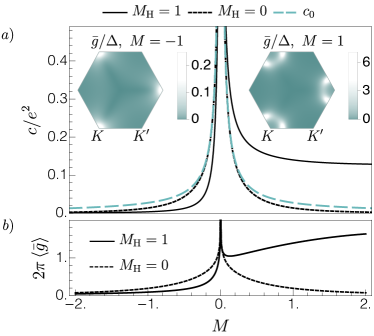
- hBN가 정렬된 비틀린 이중층 그래핀과 다이아몬드와 같은 물질에서는 양자 거리가 역전이 밴드 갭의 역수에 비례하는 측정 가능한 커패시턴스 기여를 유도한다.
- 유전율 상수 $\epsilon_\infty$ 는 항상 $\Delta^{-1}$ 에 비례하는 것은 아니지만, 그 변동은 양자 거리 기여 $\left<\bar{g}\right>_z$ 에 의해 더 잘 설명된다.
- 보조 표 1은 SiO₂, ZnO, MgO 와 같은 물질에서 양자 기하 텐서로부터 계산된 이론적 $\epsilon_\infty$ 값이 실험 데이터와 잘 일치함을 보여준다.
- 다양한 갭을 가진 물질들 사이에서 $\left<\bar{g}\right>_z$ 의 비율은 2.5 배 이내로 변동하며, 이는 기존의 $\epsilon_\infty \Delta$ 스케일링보다 더 강력한 기하학적 제어를 나타낸다.
더 나은 연구,지금 바로 시작하세요
논문 읽기부터 검토까지, 연구 시간을 획기적으로 줄여보세요.
카드 등록 없음 · 무료 플랜 제공
이 리뷰는 AI가 만들고, 인간 에디터가 검토했습니다.