
[논문 리뷰] The Surprising Effectiveness of Diffusion Models for Optical Flow and Monocular Depth Estimation
이 논문은 일반적인 잡음 제거 확산 모델이 특정 작업 아키텍처 없이도 광류(optical flow) 및 단안 깊이 추정에서 최첨단 또는 경쟁력 있는 성능을 달성하고, 불확실성 추정과 다중 모달 예측을 가능하게 한다는 것을 보여준다.
Denoising diffusion probabilistic models have transformed image generation with their impressive fidelity and diversity. We show that they also excel in estimating optical flow and monocular depth, surprisingly, without task-specific architectures and loss functions that are predominant for these tasks. Compared to the point estimates of conventional regression-based methods, diffusion models also enable Monte Carlo inference, e.g., capturing uncertainty and ambiguity in flow and depth. With self-supervised pre-training, the combined use of synthetic and real data for supervised training, and technical innovations (infilling and step-unrolled denoising diffusion training) to handle noisy-incomplete training data, and a simple form of coarse-to-fine refinement, one can train state-of-the-art diffusion models for depth and optical flow estimation. Extensive experiments focus on quantitative performance against benchmarks, ablations, and the model's ability to capture uncertainty and multimodality, and impute missing values. Our model, DDVM (Denoising Diffusion Vision Model), obtains a state-of-the-art relative depth error of 0.074 on the indoor NYU benchmark and an Fl-all outlier rate of 3.26\% on the KITTI optical flow benchmark, about 25\% better than the best published method. For an overview see https://diffusion-vision.github.io.
연구 동기 및 목표
- 전문 아키텍처나 손실 없이 일반 디퓨전 모델이 광류와 단안 깊이 추정을 해결할 수 있음을 입증한다.
- 노이즈가 많거나 불완전한 ground truth로 인한 데이터 문제를 infilling(인필링), 스텝 언롤링 디노이즈, 그리고 L1 디노이저 손실로 다룬다.
- 깊이 및 흐름 작업에 대한 pre-training과 일반화 향상을 위한 합성-실세계 데이터 혼합을 보여준다.
- 모델이 불확실성과 다모드를 포착하고, 거친-to-세밀한 정제 및 보충을 가능하게 하는 능력을 보여준다.]
- method:
- method.append("")
- Research Questions are translated as below:
- research_questions: ["일반적인 확산 모델이 작업 특화 아키텍처 없이도 광류와 단안 깊이 추정에서 최첨단 결과를 달성할 수 있는가?","노이즈가 많거나 불완전한 ground truth로 학습될 때 확산 기반의 밀집 예측 작업이 어떻게 안정화될 수 있는가?","다중 작업 자기지도 및 합성-실제 프리트레이닝이 깊이 및 흐름의 성능과 일반화를 향상시키는가?","이 작업들에서 모델이 불확실성과 다모달리티를 포착하는 능력은 어떠한가?","확산 모델이 밀집 예측에서 거친-to-세밀한 정제와 누락 값 보충을 지원할 수 있는가?"]
- key_findings: ["DDVM은 NYU 실내 깊이 추정에서 상대 깊이 오차 0.074의 최첨단 성능을 달성한다.","KITTI 광류에 대해 모델은 Fl-all 이상치율 3.26%를 달성했으며, 최고 공개 방법보다 약 25% 더 우수하다."," Sintel과 KITTI에서 제로샷 광류 결과는 합성 데이터 혼합(AutoFlow, FlyingThings, Kubric, TartanAir)으로 사전학습한 후 강력한 베이스라인을 능가한다.","확산 모델은 다모달리티와 불확실성을 여러 샘플을 통해 포착하며, 특히 반사, 투명 또는 애매한 영역에서 그렇다.","거친-to-세밀한 정제 및 인필링 전략은 흐름 및 깊이 정확도를 크게 향상시켜 AEPE를 감소시키고 KITTI/Sintel 지표를 개선한다.","모델은 KITTI 광류에서 제로샷 및 미세조정 설정에서 FlowFormer를 능가하며 Sintel의 많은 경우에서도 우수하며, 일부 예외는 논의된다."]
- table_headers: []
- table_rows: []}]} </GeneratedReview>
- table_headers_for_output: [],
제안 방법
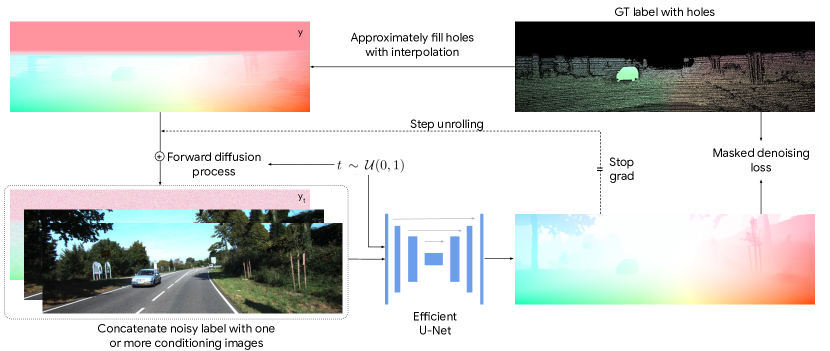
- Formulate depth and flow estimation as image-to-image translation with a conditional denoising diffusion model.
- Use infilling of missing ground truth values during training to mitigate data noise.
- Apply step-unrolled denoising during fine-tuning to reduce training-inference distribution shift.
- Incorporate an L1 denoiser loss for robustness to noisy ground truth.
- Employ coarse-to-fine refinement during inference to achieve high-resolution outputs.
- Pre-train on synthetic datasets and real data mixtures to improve generalization.
실험 결과
연구 질문
- RQ1Can a generic diffusion model achieve state-of-the-art results on optical flow and monocular depth estimation without task-specific architectures?
- RQ2How can training with noisy/incomplete ground truth be stabilized for diffusion-based dense prediction tasks?
- RQ3Does multi-task self-supervised and synthetic-real pre-training enhance performance and generalization for depth and flow?
- RQ4What is the model’s capacity to capture uncertainty and multimodality in these tasks?
- RQ5Can diffusion models support coarse-to-fine refinement and missing value imputation in dense predictions?
주요 결과
- DDVM achieves state-of-the-art relative depth error of 0.074 on NYU indoor depth estimation.
- For KITTI optical flow, the model attains an Fl-all outlier rate of 3.26%, about 25% better than the best published method.
- Zero-shot optical flow results on Sintel and KITTI surpass strong baselines after pre-training on a synthetic data mixture (AutoFlow, FlyingThings, Kubric, TartanAir).
- Diffusion models capture multi-modality and uncertainty via multiple samples, especially in reflective, translucent, or ambiguous regions.
- Coarse-to-fine refinement and infilling strategies significantly improve flow and depth accuracy, reducing AEPE and improving KITTI/Sintel metrics.
- The model outperforms FlowFormer on KITTI optical flow in zero-shot and fine-tuning settings, and many cases on Sintel, with some exceptions discussed.
이 논문 읽기
누빈트 뷰어에서 원문을 열고, 읽으면서 궁금한 곳을 바로 물어보세요.
누빈트에서 이 논문 읽기이 리뷰는 AI가 논문 원문을 바탕으로 만들었습니다. 인용하기 전에 원문을 확인해 주세요.