
[논문 리뷰] Thermal Conductivity Predictions with Foundation Atomistic Models
논문은 기초 머신러닝 포텐셜 foundation 모델과 Wigner 형식의 열전달을 결합한 프레임워크를 도입하여 다양한 고체에서 퍼스트 프린시플 원리의 정확도로 비조화 진동 및 열전도도를 예측하고, 정확도를 위해 미세 조정도 포함한다. mp-fMLPs를 DFT 데이터와 벤치마크 테스트하고, WTE가 정확한 전도도 예측에 언제 어떻게 필수적인지 보여준다.
Advances in machine learning have led to the development of foundation models for atomistic materials chemistry, enabling quantum-accurate descriptions of interatomic forces across chemically diverse compounds at reduced computational cost. Hitherto, the accuracy and utility of these models have been assessed relying on descriptors based on formation energies or idealized harmonic atomic vibrations. Yet, the rigorous and physically interpretable quantification of their capability to describe both realistic anharmonic atomic dynamics and technologically relevant observables remains a pressing problem. Here, we address this problem, leveraging the Wigner formulation of heat transport and the Grüneisen approach to thermal expansion to connect the atomic-physics awareness of foundation models to their utility in predicting experimentally observable thermomechanical properties, presenting standards and fine-tuning protocols needed to achieve first-principles accuracy. We apply our framework to a database of 103 solids with diverse compositions and structures, demonstrating that it overcomes the major bottlenecks of current methods for designing heat-management materials -- high cost, limited transferability, or lack of physics awareness -- and its potential to discover materials for next-gen technologies ranging from thermal insulation to neuromorphic computing.
연구 동기 및 목표
- 퍼스트 프린시플 정확도 향상을 위한 foundation ML potentials (fMLPs)를 이용한 비조화 진동 및 열적 특성 예측의 가능성 제시 및 촉진.
- 전도도 예측의 정밀도와 비용 간 트레이드오프를 평가하기 위한 벤치마크와 지표 개발.
- 제로샷(fMLP) 예측의 정확도가 떨어질 때 더 높은 정확도를 달성하기 위한 미세 조정 프로토콜 제공.
- 다양한 고체 데이터베이스에서 프레임워크를 시연하여 열 관리 재료의 발견 가능성 제시
제안 방법
- 거의 보편적인 화학 공간에서 학습된 fMLP를 사용해 조화 진동특성 및 3차 조화 진동특성을 얻는다.
- 입자형 및 파동형 기여를 결합하는 Wigner 전이방정식(WTE)을 통해 열전도도를 계산한다.
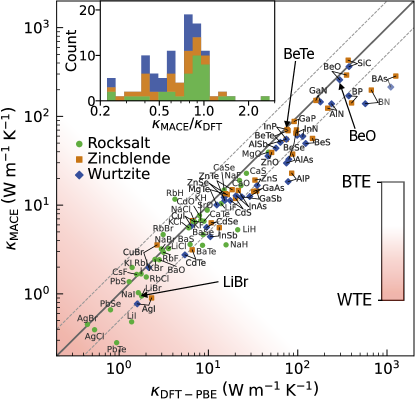
- phononDB-PBE 데이터베이스의 103화합물에 대해 제로샷 fMLP 예측을 DFT-PBE 참조 데이터와 벤치마크한다.
- 미세한 수준의 정확도 지표로 대칭 상대 오차(SRE) 및 대칭 상대 평균 오차(SRME)와 같은 지표를 도입해 미시적 및 거시적 정확도를 정량화한다.
- LiBr에 대해 DFT-PBE 프레임 세트를 소수의 표본으로 미세 조정하는 프로토콜을 적용하여 300 K에서 fMLP 예측을 퍼스트 프린시스 수준의 정확도로 계량하고 진동특성 및 선폭 예측을 개선한다.
실험 결과
연구 질문
- RQ1기초 ML 포텐셜이 다양한 재료에서 양자 정확한 비조화 진동 특성과 열전도도 예측을 제공할 수 있는가?
- RQ2fMLPs로부터의 물리학 기반 정확도를 반영하는 전도도 예측의 벤치마크와 지표는 무엇인가?
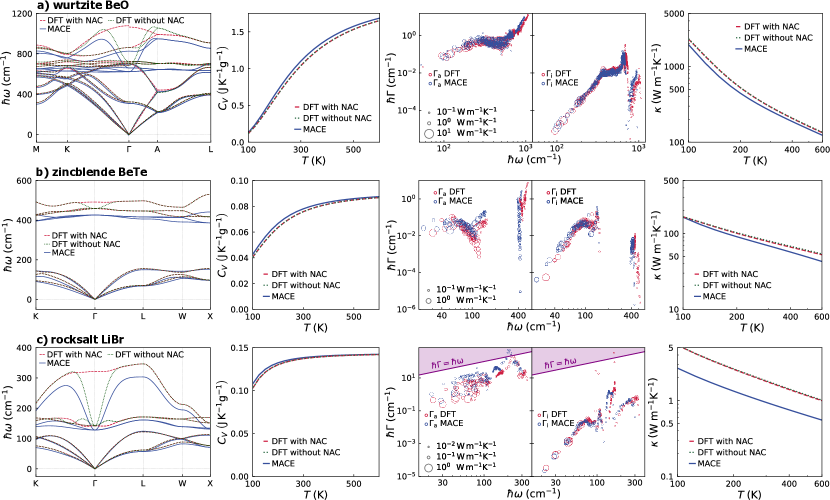
- RQ3웨이브 성분이 중요한 재료에서 Wigner 열전달 프레임워크가 보손성 트랜스포트에 비해 어떤 차이를 보이는가?
- RQ4적은 추가 데이터와 비용으로 mp-fMLPs를 미세 조정해 퍼스트 프린시플스 정확도를 달성할 수 있는가?
- RQ5Semiclassical BTE의 실패를 보이고 WTE 프레임워크가 더 적합한 재료는 어떤 것인가?
주요 결과
- 제로샷 mp-fMLPs(MACE-MP-0, SevenNet, CHGNet, M3GNet)는 phononDB-PBE의 103개 화합물 중 약 69%에 대해 300 K 전도도를 DFT-PBE의 대략 두 배의 오차 범위 내로 예측한다.
- 전도도 차이는 고주파 phonons의 저평가에서 비롯될 수 있으며 재료에 따라 오차의 상쇄 또는 보완으로 완화될 수 있다.
- WTE 프레임워크는 입자형 및 파동형 전도 모두를 포착하여, 특히 전도도가 낮고 BTE가 열전달을 제대로 설명하지 못하는 재료에서 중요하다.
- LiBr를 대상로 한 소량의 표적 DFT-PBE 프레임 세트(3 프레임)로 미세 조정하면 300 K에서 DFT-PBE의 2% 이내의 전도도 예측과 향상된 진동특성 및 선폭 예측을 달성할 수 있다.
- 미세 조정된 모델을 이용한 100–800 K 범위의 예측은 실험적 경향을 재현하고 aiMD 벤치마크와 일치하여 물리학 인식 접근법의 타당성을 검증한다.
이 논문 읽기
누빈트 뷰어에서 원문을 열고, 읽으면서 궁금한 곳을 바로 물어보세요.
누빈트에서 이 논문 읽기이 리뷰는 AI가 논문 원문을 바탕으로 만들었습니다. 인용하기 전에 원문을 확인해 주세요.