
[논문 리뷰] Toward Grounded Commonsense Reasoning
이 논문은 대규모 언어 모델(Large Language Models, LLMs)과 시각-언어 모델(Vision-Language Models, VLMs)을 결합하여 로봇이 대상 관찰을 통해 환경을 능동적으로 인지함으로써 사회적으로 적절한 의사결정을 향상시키는 기반 사회적 추론 프레임워크를 제안한다. 이 방법은 수동 인지가 없는 기준 대비 메시식퍼피스(MessySurfaces) 벤치마크에서 평균 12.9% 향상되고, 실제 로봇 실험에서는 15% 향상된다.
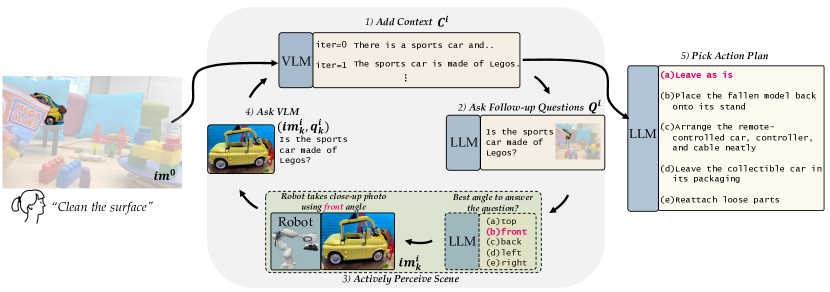
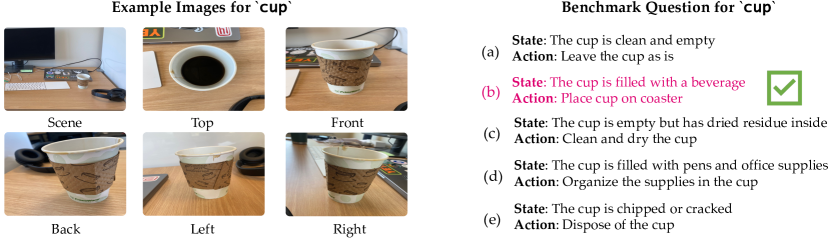
Consider a robot tasked with tidying a desk with a meticulously constructed Lego sports car. A human may recognize that it is not appropriate to disassemble the sports car and put it away as part of the "tidying." How can a robot reach that conclusion? Although large language models (LLMs) have recently been used to enable commonsense reasoning, grounding this reasoning in the real world has been challenging. To reason in the real world, robots must go beyond passively querying LLMs and actively gather information from the environment that is required to make the right decision. For instance, after detecting that there is an occluded car, the robot may need to actively perceive the car to know whether it is an advanced model car made out of Legos or a toy car built by a toddler. We propose an approach that leverages an LLM and vision language model (VLM) to help a robot actively perceive its environment to perform grounded commonsense reasoning. To evaluate our framework at scale, we release the MessySurfaces dataset which contains images of 70 real-world surfaces that need to be cleaned. We additionally illustrate our approach with a robot on 2 carefully designed surfaces. We find an average 12.9% improvement on the MessySurfaces benchmark and an average 15% improvement on the robot experiments over baselines that do not use active perception. The dataset, code, and videos of our approach can be found at https://minaek.github.io/grounded_commonsense_reasoning.
연구 동기 및 목표
- 사람의 간섭 없이 실제 환경에서 사회적으로 적절한 청소 결정을 내릴 수 있도록 로봇을 가능하게 하는 것.
- 수동적인 LLM 및 VLM 추론의 한계를 해결하기 위해 부족한 인지적 맥락을 확보하기 위해 능동적 인지를 도입하는 것.
- 사회적 추론을 위해 무엇이 부족한지 식별하고, 대상 관찰을 통해 이를 능동적으로 확보하는 시스템을 개발하는 것.
- 새로운 실세계 데이터셋과 실제 로봇 실험을 통해 프레임워크를 대규모로 평가하는 것.
- 재현 가능성을 지원하고 향후 기반 사회적 추론 연구를 위한 메시식퍼피스(MessySurfaces) 데이터셋, 코드, 영상 자료를 공개하는 것.
제안 방법
- 프레임워크는 장면 이미지를 분석하고 사회적 추론을 위해 명확화가 필요한 물체에 대해 추가 질문을 생성하기 위해 LLM을 사용한다.
- 로봇은 LLM이 제안한 각도에서 물체의 정밀한 근접 이미지를 찍어 모호성을 해소한다.
- 시각-언어 모델(Vision-Language Model, VLM)은 근접 이미지를 처리하여 의사결정에 필요한 세부적이고 맥락이 풍부한 기술을 제공한다.
- LLM은 추가 관찰 요청을 통해 반복적으로 이해를 정교화하여 사회적으로 적절한 행동 결정을 내릴 수 있게 된다.
- 최종 행동—예를 들어 레고 자동차를 그대로 두거나 음식 쓰레기를 폐기하는 것—은 인라인 학습을 통해 실행 가능한 로봇 API 호출로 변환된다.
- 시스템은 새로운 벤치마크 데이터셋(MessySurfaces)과 통제된 책상 환경을 갖춘 실제 로봇 플랫폼에서 평가된다.
실험 결과
연구 질문
- RQ1수동적인 LLM 및 VLM 질의에 비해 능동적 인지가 사회적으로 적절한 로봇 의사결정 정확도를 크게 향상시키는가?
- RQ2LLM-VLM 루프는 실세계 장면에서 사회적 추론을 위한 인지적 모호성을 효과적으로 식별하고 해소하는 데 얼마나 효과적인가?
- RQ3LLM이 생성한 질문에 의해 안내되는 로봇의 능동적 인지 전략이 실세계 청소 작업의 후행 의사결정 품질을 얼마나 향상시키는가?
- RQ4다양하고 실세계적인 혼잡한 표면에서 다양한 물체 유형과 사회적 규범을 고려할 때, 이 프레임워크는 얼마나 잘 작동하는가?
- RQ5사람의 피드백 없이도 제안된 방법이 예상치 못한 물체와 시나리오에 일반화 가능한가?
주요 결과
- 수동 인지 기반 기준 대비 메시식퍼피스(MessySurfaces) 벤치마크에서 프레임워크는 평균 12.9% 향상된 성능을 달성했다.
- 실제 로봇 실험에서 프레임워크는 수동 기준 대비 사회적으로 적절한 의사결정에서 평균 15% 향상된 성능을 보였다.
- LLM이 생성한 추가 질문은 레고 모형인지 놀이기구인지와 같은 핵심 모호성을 효과적으로 식별하는 데 성공했다.
- LLM이 제안한 각도에서의 근접 이미지 촬영을 통한 로봇의 능동적 인지 전략은 레고 조각이나 음식 부패 여부와 같은 중요한 세부 사항을 감지하는 데 VLM의 능력을 크게 향상시켰다.
- 로봇은 레고 자동차와 같은 복잡한 물체를 성공적으로 보존하고, 반으로 잘린 바나나와 같은 부적절한 물체만 폐기하였다.
- 공개된 메시식퍼피스(MessySurfaces) 데이터셋, 코드, 영상 자료를 통해 실세계 환경에서의 기반 사회적 추론 평가가 재현 가능해졌다.
이 논문 읽기
누빈트 뷰어에서 원문을 열고, 읽으면서 궁금한 곳을 바로 물어보세요.
누빈트에서 이 논문 읽기이 리뷰는 AI가 논문 원문을 바탕으로 만들었습니다. 인용하기 전에 원문을 확인해 주세요.