
[논문 리뷰] VSSD: Vision Mamba with Non-Causal State Space Duality
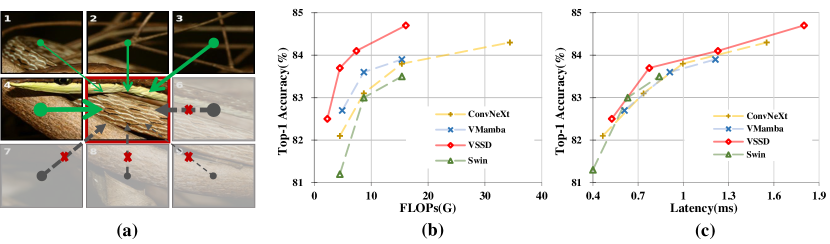
이 논문은 비인과적 비전 머신 모델인 VSSD를 제안하며, 상태공간 이중성(SSD)을 재정의한다. 이는 상태전이행렬 𝐀의 역할을 히든 상태 유지에서 토큰 기여도 제어로 재할당함으로써, 다중 스캔 전략 없이도 완전한 비인과적 모델링을 가능하게 한다. VSSD는 81.8%의 top-1 정확도로 ImageNet-1K에서 최신 기준 성능을 달성하였으며, VMamba와 같은 이전의 SSM 기반 모델보다 1% 높고, 훈련 처리량은 최대 50% 향상되었다.
Vision transformers have significantly advanced the field of computer vision, offering robust modeling capabilities and global receptive field. However, their high computational demands limit their applicability in processing long sequences. To tackle this issue, State Space Models (SSMs) have gained prominence in vision tasks as they offer linear computational complexity. Recently, State Space Duality (SSD), an improved variant of SSMs, was introduced in Mamba2 to enhance model performance and efficiency. However, the inherent causal nature of SSD/SSMs restricts their applications in non-causal vision tasks. To address this limitation, we introduce Visual State Space Duality (VSSD) model, which has a non-causal format of SSD. Specifically, we propose to discard the magnitude of interactions between the hidden state and tokens while preserving their relative weights, which relieves the dependencies of token contribution on previous tokens. Together with the involvement of multi-scan strategies, we show that the scanning results can be integrated to achieve non-causality, which not only improves the performance of SSD in vision tasks but also enhances its efficiency. We conduct extensive experiments on various benchmarks including image classification, detection, and segmentation, where VSSD surpasses existing state-of-the-art SSM-based models. Code and weights are available at \url{https://github.com/YuHengsss/VSSD}.
연구 동기 및 목표
- 상태공간 모델(SSM)의 본질적 인과성 제한을 해결하여 이미지 분류, 검출, 세그멘테이션과 같은 비인과적 비전 작업에 적합하게 한다.
- SSM 처리 과정에서 2D 특징 맵을 1D 시퀀스로 편평화함으로써 발생하는 공간 연속성의 파손을 해결한다.
- 비인과적 모델링을 위해 양방향 스캔에 의존하는 다중 스캔 SSM 접근법의 더 나은 효율성과 정확도를 확보하는 대안을 개발한다.
- 인과 마스크 없이도 단일 전역 히든 상태 계산을 가능하게 하여 훈련 속도와 모델 안정성을 모두 향상시킨다.
제안 방법
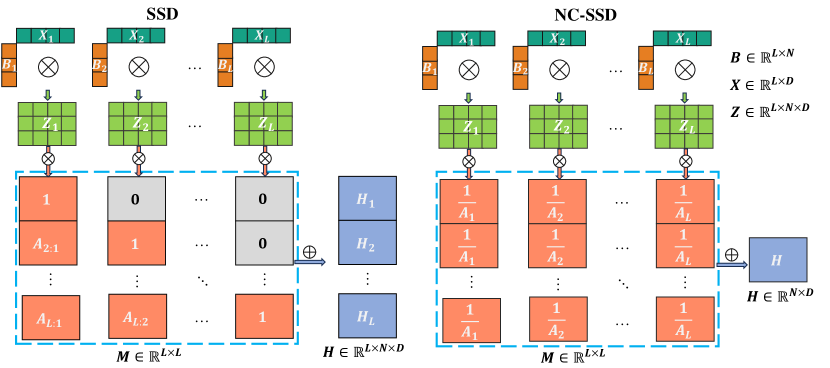
- 히든 상태 유지가 아닌 각 토큰의 기여도를 제어하는 데 상태전이행렬 𝐀을 사용함으로써 SSD를 재구성한다.
- 각 토큰의 기여도를 자기 참조적으로 만들음으로써 인과 마스크를 제거하여 단일 순방향 전파로 비인과적 모델링을 가능하게 한다.
- 학습 안정성을 향상시키고 기울기 폭주를 방지하기 위해 학습 가능한 가중치 벡터 𝐦을 도입하며, 이를 정규화 메커니즘으로 기능시킨다.
- 비인과적 설계를 통해 다중 스캔 전략을 암묵적으로 통합함으로써 명시적 양방향 스캔이 필요 없도록 한다.
- 마지막 단계에서 NC-SSD와 하이브리드 어텐션을 조합하고, 겹치는 다운샘플링을 통합하여 성능과 공간 인도크티브 바이어스를 향상시킨다.
- 각 토큰의 동시에 유도된 단일 전역 히든 상태를 도입함으로써 토큰 기반 히든 상태를 대체하여 효율성과 모델링 능력을 향상시킨다.
실험 결과
연구 질문
- RQ1SSM의 인과적 인도크티브 바이어스를 제거하여 다중 스캔 전략에 의존하지 않고도 비인과적 비전 데이터를 더 잘 모델링할 수 있는가?
- RQ2상태전이행렬 𝐀의 역할을 히든 상태 유지에서 토큰 기여도 제어로 재정의함으로써, 비전 작업에서 안정적이고 효율적인 비인과적 모델링이 가능한가?
- RQ3제안된 비인과적 SSD(NC-SSD)가 일반 SSD 및 Bi-SSD와 같은 다중 스캔 변종과 비교해 정확도, 지연 시간, 훈련 속도 측면에서 어떻게 성능을 냈는가?
- RQ4선형 어텐션 유사 메커니즘에서 정규화가 없을 경우, 학습 가능한 가중치 벡터 𝐦의 영향은 훈련 안정성과 모델 성능에 어떤 영향을 미치는가?
- RQ5표준 어텐션과 겹치는 다운샘플링의 통합이 비전 벤치마크에서 NC-SSD의 성능을 추가로 향상시킬 수 있는가?
주요 결과
- VSSD는 ImageNet-1K에서 81.8%의 top-1 정확도를 달성하였으며, FLOPs와 파라미터 수가 유사한 VMamba를 1% 뛰어넘었다.
- 제안된 NC-SSD는 Bi-SSD 대비 50%, 일반 SSD 대비 20% 향상된 훈련 처리량을 보이며 뚜렷한 효율성 향상을 입증했다.
- 학습 가능한 가중치 벡터 𝐦의 포함은 훈련 안정성에 매우 중요하다. 이가 없을 경우, 특히 대규모 아키텍처에서 모델이 훈련 도중 붕괴된다.
- 패치 기반 다운샘플러를 겹치는 컨볼루션 다운샘플러로 교체함으로써 FLOPs는 0.2G 증가에 그치나 정확도는 0.7% 향상되었다.
- 마지막 단계를 표준 자기어텐션과 하이브리드화함으로써 파라미터 수를 늘리지 않고도 정확도를 0.2% 향상시켰으며, 깊은 레이어에서 어텐션의 효과를 입증했다.
- 절단 분석 결과, NC-SSD는 일반 SSD보다 0.6%, Bi-SSD보다 0.2% 높은 top-1 정확도를 기록하였으며, 처리량도 높았다.
이 논문 읽기
누빈트 뷰어에서 원문을 열고, 읽으면서 궁금한 곳을 바로 물어보세요.
누빈트에서 이 논문 읽기이 리뷰는 AI가 논문 원문을 바탕으로 만들었습니다. 인용하기 전에 원문을 확인해 주세요.