
[논문 리뷰] WatChat: Explaining perplexing programs by debugging mental models
WatChat는 JavaScript 프로그램의 예상치 못한 동작을 언어 의미론에 대한 사용자의 오해를 진단하고 수정함으로써 설명하는 시스템이다. 역방향 프로그램 합성 기법을 사용해 잘못된 정신 모델을 추론하고, 대조적이고 인과적이며 사회적으로 적절한 설명을 생성한다 — 예를 들어 `[] + []`가 빈 문자열을 반환하는 것과 같은 놀라운 동작을 설명하는 데 효과적임을 입증한다.
Often, a good explanation for a program's unexpected behavior is a bug in the programmer's code. But sometimes, an even better explanation is a bug in the programmer's mental model of the language or API they are using. Instead of merely debugging our current code ("giving the programmer a fish"), what if our tools could directly debug our mental models ("teaching the programmer to fish")? In this paper, we apply recent ideas from computational cognitive science to offer a principled framework for doing exactly that. Given a "why?" question about a program, we automatically infer potential misconceptions about the language/API that might cause the user to be surprised by the program's behavior -- and then analyze those misconceptions to provide explanations of the program's behavior. Our key idea is to formally represent misconceptions as counterfactual (erroneous) semantics for the language/API, which can be inferred and debugged using program synthesis techniques. We demonstrate our framework, WatChat, by building systems for explanation in two domains: JavaScript type coercion, and the Git version control system. We evaluate WatChatJS and WatChatGit by comparing their outputs to experimentally-collected human-written explanations in these two domains: we show that WatChat's explanations exhibit key features of human-written explanation, unlike those of a state-of-the-art language model.
연구 동기 및 목표
- 프로그래밍 도구가 코드 버그가 아닌 언어 의미론에 대한 잘못된 정신 모델로 인해 발생하는 예상치 못한 동작을 설명할 수 있는 격차를 메우기 위해.
- 사용자의 오해를 가정한 반사적 의미론으로 모델링함으로써 인간과 유사하고 도움이 되는 설명을 생성하는 시스템을 설계하기 위해.
- 오해를 진단하기 위한 설명 생성과 교육적 예제 생성을 모두 지원하는 프레임워크를 만들기 위해.
- 대조성, 선택성, 인과성, 사회적 맥락과 같은 인지과학 원리를 자동화된 설명 시스템에 통합하기 위해.
- 프로그래밍 환경이 수동적인 디버거가 아니라 협업적이고 인지적 파art너로 기능할 수 있도록 하기 위해.
제안 방법
- JavaScript의 의미론에 대한 오류 해석을 표현하는 반사적 의미론으로 사용자의 정신 모델을 모델링한다.
- 역방향 프로그램 합성을 적용하여 예상치 못한 동작을 유도할 수 있는 타당한 오해(즉, '오해자')를 추론한다.
- 이러한 반사적 의미론에 대한 버그를 식별하고 수정함으로써 설명을 생성하며, 대조적이고 선택적인 설명의 인지과학 원칙을 준수한다.
- JavaScript 의미론의 형식적 명세와 기호 실행 엔진(Rosette)을 사용하여 2^32개의 잠재적 오해 공간을 밀리초 내에 효율적으로 탐색한다.
- 설명 과정을 뒤집어, 특정 오해를 테스트하고 수정할 수 있는 진단용 예제 프로그램을 합성한다.
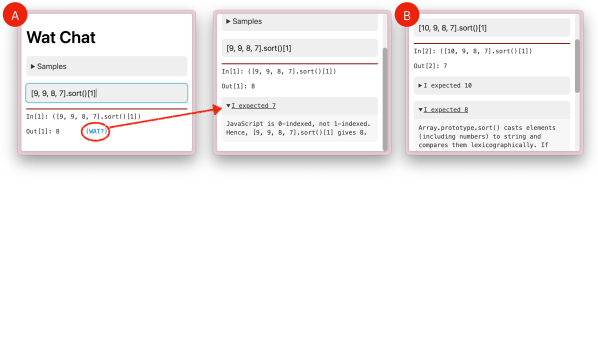
- 사용자의 기대를 묻는 방식(예: '빈 배열을 기대하셨나요?')을 통해 맥락에 민감한 설명 생성을 구현함으로써 적응형 대화형 상호작용을 가능하게 한다.
실험 결과
연구 질문
- RQ1프로그래밍 도구가 코드 수정이 아닌 사용자가 언어 의미론에 대해 가진 오해를 진단하고 수정함으로써 예상치 못한 동작을 어떻게 설명할 수 있는가?
- RQ2대조성, 선택성, 인과성과 같은 인지과학 원리는 프로그래밍 환경에서 인간과 유사한 설명을 생성하는 데 어떻게 안내할 수 있는가?
- RQ3프로그램 합성 기법을 뒤집어 프로그래밍 언어 동작에 대한 잘못된 정신 모델을 추론하고 디버깅할 수 있는가?
- RQ4이러한 시스템이 특정 오해를 대상으로 하는 교육적으로 유용한 진단 예제를 얼마나 정밀하게 생성할 수 있는가?
- RQ5설명 시스템은 사용자 기대와 배경에 맞게 어떻게 맥락에 민감하고 사회적으로 적응 가능한 방식으로 설계될 수 있는가?
주요 결과
- WatChat는 타입 캐스팅과 배열에서 문자열으로의 변환에 대한 오해를 식별하고 수정함으로써 `[] + []`가 ""를 반환하는 놀라운 자바스크립트 동작을 추론하고 설명할 수 있다.
- 시스템은 2^32개의 잠재적 정신 모델 공간을 밀리초 이내에 효율적으로 탐색하여 실시간 설명 생성이 가능하다.
- WatChat가 생성한 설명은 대조적이고 선택적이며, 예상과 실제 동작 간의 핵심 차이점(예: 배열의 문자열화에서 괄호가 없는 것)에 집중한다.
- 사용자의 기대를 묻는 방식으로 사용자 기대를 모델링함으로써 적응형 대화형 정신 모델 디버깅이 가능하다.
- 이 프레임워크는 뒤집어져 특정 오해를 진단할 수 있는 고정밀도 교육적 예제를 생성할 수 있으며, 예를 들어 배열 연결 또는 문자열 변환에 대한 오해를 다룰 수 있다.
- WatChat는 압도적인 LLM 기반 베이스라인(예: GPT-4)보다 대조적이고 인과적이며 사회적으로 적절한 설명을 생성함으로써 설명 품질에서 슈퍼어리어를 보였다. 이는 부정확하거나 너무 긴 단계별 추적을 피하고 있다.
이 논문 읽기
누빈트 뷰어에서 원문을 열고, 읽으면서 궁금한 곳을 바로 물어보세요.
누빈트에서 이 논문 읽기이 리뷰는 AI가 논문 원문을 바탕으로 만들었습니다. 인용하기 전에 원문을 확인해 주세요.