
[논문 리뷰] Watermarking Makes Language Models Radioactive
이 논문은 언어 모델에서 워터마킹이 '방사능' 현상(즉, 워터마크가 부여된 훈련 데이터가 모델을 미세조정할 때 잔여 흔적을 남기는 현상)을 유도함을 보여준다. 단지 5%의 워터마크가 부여된 데이터만으로도 높은 신뢰도(p < 10⁻⁵)로 오염를 감지할 수 있으며, 이는 기계로 생성된 텍스트를 감지하기 위한 목적의 워터마킹이 동시에 합성 출력을 기반으로 한 모델 미세조정의 존재를도 신뢰성 있게 감지할 수 있음을 시사한다.
We investigate the radioactivity of text generated by large language models (LLM), i.e. whether it is possible to detect that such synthetic input was used to train a subsequent LLM. Current methods like membership inference or active IP protection either work only in settings where the suspected text is known or do not provide reliable statistical guarantees. We discover that, on the contrary, it is possible to reliably determine if a language model was trained on synthetic data if that data is output by a watermarked LLM. Our new methods, specialized for radioactivity, detects with a provable confidence weak residuals of the watermark signal in the fine-tuned LLM. We link the radioactivity contamination level to the following properties: the watermark robustness, its proportion in the training set, and the fine-tuning process. For instance, if the suspect model is open-weight, we demonstrate that training on watermarked instructions can be detected with high confidence ($p$-value $< 10^{-5}$) even when as little as $5\%$ of training text is watermarked.
연구 동기 및 목표
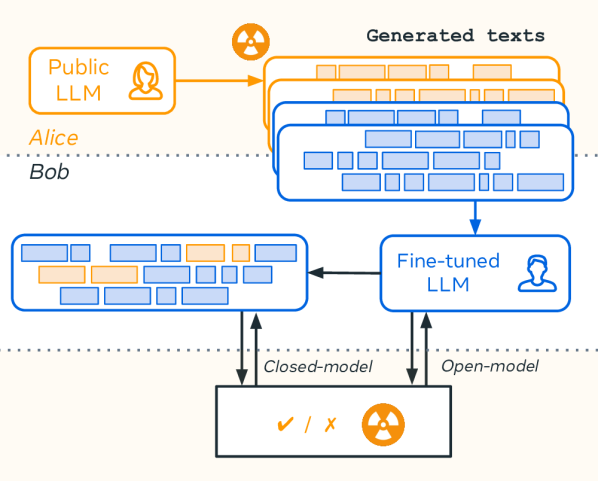
- 워터마크가 부여된 언어 모델 출력물이 다른 모델을 미세조정하는 데 사용될 경우, 이를 감지할 수 있는 흔적이 남는지 여부를 조사하는 것, 이 현상을 '방사능'이라 부른다.
- 훈련 데이터 오염를 감지하는 데 있어 워터마킹 기반 감지 기법과 전통적인 멤버십 추론 공격 간의 성능을 비교하는 것.
- 개방형 모델 접근과 폐쇄형 모델 접근, 그리고 지도 학습 및 비지도 학습 설정에서의 다양한 조건에서 방사능 감지 가능성 평가.
- 워터마킹의 내성, 워터마킹 윈도우 크기, 훈련 데이터 비율이 감지 가능성에 미치는 영향 분석.
- 워터마크가 부여된 합성 지시 텍스트를 기반으로 한 미세조정을 감지하는 실제 적용 가능성 입증.
제안 방법
- 저자는 비밀 키를 기반으로 토큰 샘플링 확률를 조작하는 워터마킹 기법을 사용하여 생성된 텍스트에 감지 가능한 신호를 삽입한다.
- 소스 LLM(Llama-2-chat)가 생성한 합성 지시 텍스트를 대상 LLM(Llama-1)에 대해 제어된 비율로 워터마크가 부여된 콘텐츠를 포함하여 미세조정한다.
- 감지 작업은 미세조정된 모델의 출력에서 워터마크 전용 토큰 패턴의 빈도를 기준선과 비교하는 통계적 검정을 통해 수행된다.
- 개방형 모델 감지의 경우, 모델의 로짓을 활용하여 미세조정된 모델 내 워터마크 신호 존재 여부에 대한 p-값을 계산한다.
- 폐쇄형 모델 감지의 경우, 모델 접근 없이 프롬프트 기반 추론을 통해 워터마크 패턴을 추출하고 검증한다.
- 오염 과정은 워터마킹 내성, 해싱 윈도우 크기, 훈련 데이터 비율(ρ)을 변화시켜 분석한다.
실험 결과
연구 질문
- RQ1특정 훈련 샘플이 알려지지 않은 상태에서도, 워터마크가 부여된 훈련 데이터가 미세조정된 모델에서 신뢰성 있게 감지될 수 있는가?
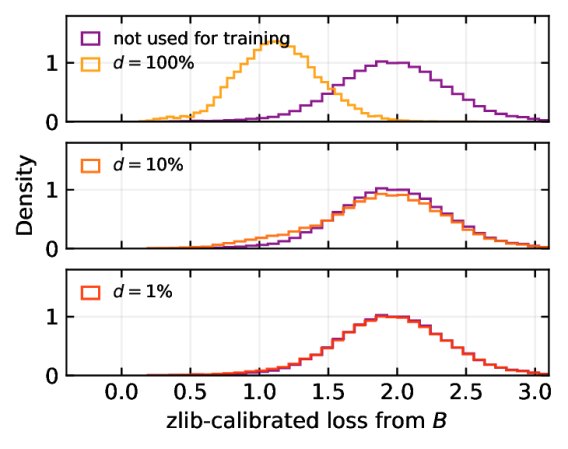
- RQ2워터마크가 부여된 데이터 비율(ρ)이 미세조정된 모델 내 방사능 감지 가능성에 미치는 영향은 어떠한가?
- RQ3워터마킹의 내성과 해싱 윈도우 크기가 감지 가능한 신호의 강도에 미치는 영향는 어떠한가?
- RQ4워터마킹 기반 감지 기법이 멤버십 추론 공격 대비 감지 신뢰도와 실현 가능성 면에서 어떤가?
- RQ5자기 지시 합성 데이터를 사용한 실제 환경에서 방사능을 감지할 수 있는가?
주요 결과
- 워터마크가 부여된 훈련 데이터는 단지 5%의 비율로도 p-값 < 10⁻⁵의 높은 신뢰도로 미세조정된 모델에서 감지 가능하다.
- 특히 로짓 정보가 확보되지 않는 폐쇄형 모델 환경에서 멤버십 추론 공격에 비해 워터마킹 기반 감지 기법이 훨씬 더 신뢰성 있게 작동한다.
- 작은 워터마킹 해싱 윈도우는 방사능 감지 가능성 증가를 유도하며, 이는 미세조정된 모델 내에서 더 강한 신호가 존재함을 시사한다.
- 자기 지시(Self-Instruct) 기반으로 생성된 합성 지시 텍스트를 사용한 실제 사례에서도 방사능이 성공적으로 감지되었으며, 실용적 적용 가능성을 확인하였다.
- 워터마킹 강도와 데이터 비율의 변화에 관계없이, 미세조정된 모델 내 워터마크 신호 존재는 뚜렷하게 유지된다.
- 결과적으로 워터마크는 기계로 생성된 텍스트를 감지하는 데서만 유용한 것이 아니라, 이러한 텍스트가 모델 미세조정에 사용된 사실까지 폭 드러내며 파생 모델 간의 관계를 폭 드러낸다.
이 논문 읽기
누빈트 뷰어에서 원문을 열고, 읽으면서 궁금한 곳을 바로 물어보세요.
누빈트에서 이 논문 읽기이 리뷰는 AI가 논문 원문을 바탕으로 만들었습니다. 인용하기 전에 원문을 확인해 주세요.