
[논문 리뷰] Zero-Shot Text-Guided Object Generation with Dream Fields
Dream Fields는 CLIP 기반 이미지-텍스트 유사도를 통해 자연어 프롬프트에서 세부 정보가 풍부하고 다중 시점 일致하는 3D 기하학 및 색상 정보를 합성하는 제로샷 텍스트 유도 3D 객체 생성 방법을 제안한다. 신경 렌디언스 필드(NeRF)를 CLIP 기반 유사도 최적화를 통해 개선함으로써, 3D 학습 데이터 없이도 고해상도의 다양하고 정확한 3D 객체 생성을 달성한다. 기하학적 사전 지식으로서 투과도 정규화와 시점 경계를 통합함으로써, 개방형 어휘의 다양한 설명에서부터도 정확한 3D 합성을 가능하게 한다.
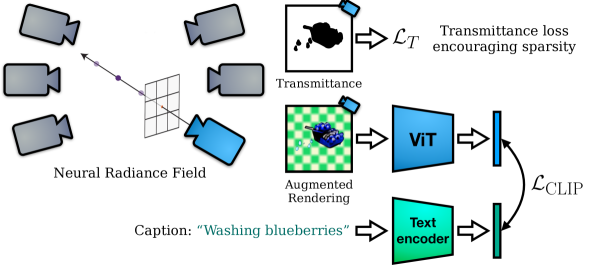
We combine neural rendering with multi-modal image and text representations to synthesize diverse 3D objects solely from natural language descriptions. Our method, Dream Fields, can generate the geometry and color of a wide range of objects without 3D supervision. Due to the scarcity of diverse, captioned 3D data, prior methods only generate objects from a handful of categories, such as ShapeNet. Instead, we guide generation with image-text models pre-trained on large datasets of captioned images from the web. Our method optimizes a Neural Radiance Field from many camera views so that rendered images score highly with a target caption according to a pre-trained CLIP model. To improve fidelity and visual quality, we introduce simple geometric priors, including sparsity-inducing transmittance regularization, scene bounds, and new MLP architectures. In experiments, Dream Fields produce realistic, multi-view consistent object geometry and color from a variety of natural language captions.
연구 동기 및 목표
- 3D 애너테이션을 포함한 학습 데이터 없이 자연어 기반 기술 설명에서 3D 객체 생성을 가능하게 하기 위해.
- 기존의 ShapeNet과 같은 사전 정의된 카테고리에 국한된 3D 생성 모델의 일반화 능력 부족을 해결하기 위해.
- 사전 학습된 이미지-텍스트 모델(예: CLIP)을 활용하여 제로샷, 텍스트 유도 3D 합성의 정확한 시각적 일치도를 달성하기 위해.
- 간단하고 효과적인 기하학적 사전 지식을 도입함으로써 텍스트 유도 하에 NeRF 기반 3D 생성의 정확도를 향상시키기 위해.
- 복합적인 언어 프롬프트를 활용하여 다양한 실제 세계의 객체 카테고리에 걸쳐 개방형 어휘에서의 3D 생성을 구현하기 위해.
제안 방법
- 렌더링된 이미지와 주어진 텍스트 프롬프트 간의 CLIP 이미지-텍스트 유사도 점수를 최대화하도록 신경 렌디언스 필드(NeRF)를 최적화한다.
- 고정된 CLIP 모델을 사용하여 임의의 카메라 자세에서 렌더링된 이미지를 평가함으로써, 3D 감독 없이도 NeRF의 미분 가능 최적화를 가능하게 한다.
- 투과도 정규화를 적용하여 렌디언스 필드의 흐림을 줄이고 잡음과 아티팩트를 감소시켜 기하학적 현실감을 향상시킨다.
- 시점 경계를 강제 적용하여 3D 볼륨을 제한하고 비현실적인 객체 연장선을 방지한다.
- 특징 표현력 향상과 학습 안정성 향상을 위해 위치 인코딩을 적용한 수정된 MLP 아키텍처를 사용한다.
- 전체 360° 애지무스 범위에서 카메라 자세를 샘플링하여 다중 시점 일치성과 일반화 능력을 확보한다.
실험 결과
연구 질문
- RQ13D 감독이나 다중 시점 이미지 없이도 텍스트 프롬프트와 CLIP 기반 이미지-텍스트 유사도만으로 NeRF를 효과적으로 최적화할 수 있는가?
- RQ2투과도 정규화와 시점 경계와 같은 기하학적 사전 지식이 텍스트 유도 3D 생성의 현실감과 정확도에 어떤 영향을 미치는가?
- RQ3언어의 복합적 성격이 개방형 어휘 카테고리에 걸쳐 다양한, 제어 가능한 3D 객체 생성에 얼마나 기여하는가?
- RQ4사전 학습된 이미지-텍스트 모델의 선택(예: CLIP 대비 LiT)이 생성된 3D 객체의 품질과 일치도에 어떤 영향을 미치는가?
- RQ5카메라 자세 샘플링 전략의 선택이 텍스트-기반 3D 합성에서 다중 시점 일치성과 시점 일반화 능력에 어떤 영향을 미치는가?
주요 결과
- CLIP B/32를 사용한 평가에서 Dream Fields는 최대 86.6%의 R-Precision를 기록하여 생성된 3D 객체와 입력 설명 간의 강력한 의미 일치를 보였다.
- CLIP B/32는 CLIP B/16보다 검색 지표에서 뛰어난 성능을 보였으며, 이는 저해상도의 렌더링에 더 큰 패치 크기가 유리할 수 있음을 시사한다.
- LiT${}_{\text{uu}}$ B/32를 검색 모델로 사용할 경우 최고의 R-Precision(88.9%)를 기록하여 개방형 프롬프트에 대한 강력한 일반화 능력을 입증했다.
- 다양한 카메라 자세(360° 애지무스 샘플링)를 사용하여 학습함으로써 다중 시점 일치성이 크게 향상되었으며, 측면 및 뒷면 뷰에서의 잡음과 아티팩트가 감소했다.
- 투과도 정규화와 시점 경계는 다중 시점 감독 없이도 NeRF 아티팩트를 줄이고 기하학적 현실감을 향상시키는 데 핵심적인 역할을 했다.
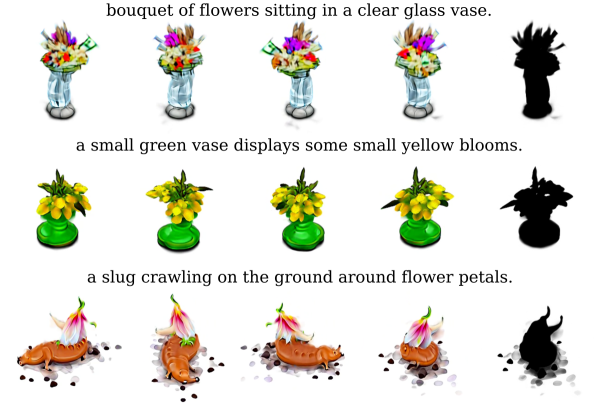
- 정성적 결과에서 Dream Fields는 '파란 플라스틱 냄비에 빨간 꽃과 초록 잎이 있는'과 같은 복잡하고 복합적인 설명에서도 세부 정보가 풍부하고 질감이 있는 다양한 3D 객체를 생성할 수 있음을 보였다.
이 논문 읽기
누빈트 뷰어에서 원문을 열고, 읽으면서 궁금한 곳을 바로 물어보세요.
누빈트에서 이 논문 읽기이 리뷰는 AI가 논문 원문을 바탕으로 만들었습니다. 인용하기 전에 원문을 확인해 주세요.