
[Paper Review] 1D Convolutional neural networks and machine learning algorithms for spectral data classification with a case study for Covid-19
This paper proposes a 1D Convolutional Neural Network (1D-CNN) for classifying spectral data from spectroscopy, particularly applied to SARS-CoV-2 detection. Using Savitzky-Golay filtering for pre-processing, the 1D-CNN achieved 96.5% accuracy, 98% specificity, and 94% sensitivity on a public COVID-19 spectral dataset, outperforming traditional machine learning models like SVM and PLS-DA.
Machine and deep learning algorithms have increasingly been applied to solve problems in various areas of knowledge. Among these areas, Chemometrics has been benefited from the application of these algorithms in spectral data analysis. Commonly, algorithms such as Support Vector Machines and Partial Least Squares are applied to spectral datasets to perform classification and regression tasks. In this paper, we present a 1D convolutional neural networks (1D-CNN) to evaluate the effectiveness on spectral data obtained from spectroscopy. In most cases, the spectrum signals are noisy and present overlap among classes. Firstly, we perform extensive experiments including 1D-CNN compared to machine learning algorithms and standard algorithms used in Chemometrics on spectral data classification for the most known datasets available in the literature. Next, spectral samples of the SARS-COV2 virus, which causes the COVID-19, have recently been collected via spectroscopy was used as a case study. Experimental results indicate superior performance of 1D-CNN over machine learning algorithms and standard algorithms, obtaining an average accuracy of 96.5%, specificity of 98%, and sensitivity of 94%. The promissing obtained results indicate the feasibility to use 1D-CNN in automated systems to diagnose COVID-19 and other viral diseases in the future.
Motivation & Objective
- To evaluate the effectiveness of 1D-CNN in classifying spectral data from chemometric applications.
- To compare 1D-CNN performance against traditional machine learning algorithms (SVM, PLS-DA, KNN, MOCHM) on public spectral datasets.
- To investigate the impact of data pre-processing techniques—particularly Savitzky-Golay filtering—on classification performance.
- To demonstrate the feasibility of 1D-CNN for automated, low-cost, and rapid diagnosis of COVID-19 using infrared spectroscopy data.
- To assess model generalization despite small training datasets, common in spectral analysis.
Proposed method
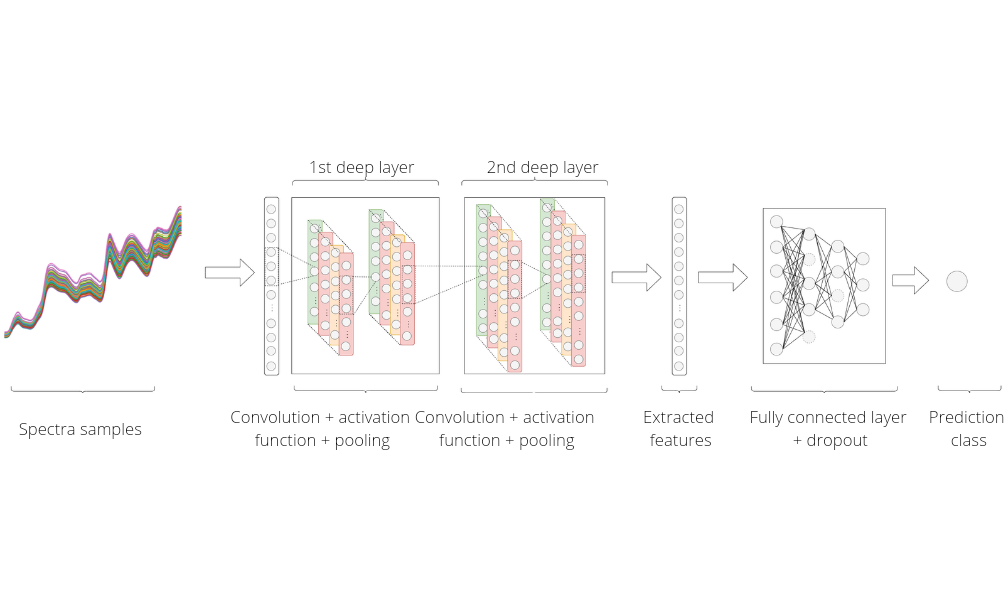
- Applied 1D-CNN to 7 public spectral datasets and a case study dataset of SARS-CoV-2 samples from infrared spectroscopy.
- Pre-processed spectral data using the Savitzky-Golay (SG) filter to reduce noise and enhance signal quality.
- Trained and evaluated 1D-CNN models with ReLU activation, batch normalization, and global average pooling layers.
- Compared 1D-CNN results against SVM, PLS-DA, KNN, and MOCHM using 5-fold cross-validation to ensure robustness.
- Used standard metrics: accuracy, specificity, sensitivity, and standard deviation to evaluate performance.
- Conducted ablation studies to assess the influence of pre-processing on model outcomes.
Experimental results
Research questions
- RQ1How does 1D-CNN performance compare to traditional machine learning models (SVM, PLS-DA, KNN) in classifying spectral data?
- RQ2What is the impact of Savitzky-Golay filtering on the classification accuracy and stability of spectral models?
- RQ3Can 1D-CNN generalize effectively on small spectral datasets typical in biomedical applications?
- RQ4How does 1D-CNN perform on a real-world case study involving SARS-CoV-2 spectral data compared to existing methods?
- RQ5What are the sensitivity and specificity trade-offs of 1D-CNN in detecting COVID-19 from spectral signatures?
Key findings
- The 1D-CNN achieved an average accuracy of 96.5% on the SARS-CoV-2 spectral dataset, outperforming SVM and PLS-DA.
- Specificity reached 98.06% with a standard deviation of 1.86, indicating high reliability in correctly identifying negative cases.
- Sensitivity was 94.06%, demonstrating strong detection capability for positive COVID-19 cases, crucial for minimizing false negatives.
- The combination of Savitzky-Golay pre-processing and 1D-CNN significantly improved model performance and reduced variance in results.
- 1D-CNN outperformed the GA-LDA method reported by Yin et al. (2021), which achieved only 91% accuracy on the same dataset.
- Despite limited training samples (111 controls, 70 positives), the 1D-CNN model generalized well, indicating robustness to small datasets.
Read this paper
Open the full text in the Nubint reader and ask about any passage as you read.
Read this paper on NubintThis review was generated by AI from the original paper. Please check the paper before citing it.