
[Paper Review] 3D Adversarial Attacks Beyond Point Cloud
This paper proposes Mesh Attack, a novel 3D adversarial attack that directly perturbs mesh representations instead of point clouds, enabling physically realizable attacks. By introducing a differentiable sampling module and three mesh regularization losses (chamfer, Laplacian, and edge length), it generates smooth, printable adversarial meshes that outperform state-of-the-art point cloud-based attacks in both digital and physical scenarios, achieving SOTA performance under multiple defenses.
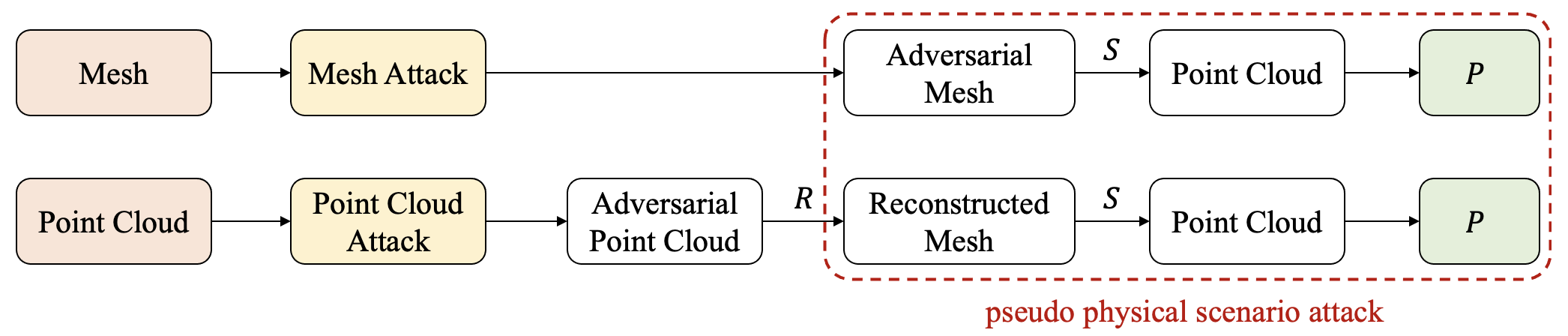
Recently, 3D deep learning models have been shown to be susceptible to adversarial attacks like their 2D counterparts. Most of the state-of-the-art (SOTA) 3D adversarial attacks perform perturbation to 3D point clouds. To reproduce these attacks in the physical scenario, a generated adversarial 3D point cloud need to be reconstructed to mesh, which leads to a significant drop in its adversarial effect. In this paper, we propose a strong 3D adversarial attack named Mesh Attack to address this problem by directly performing perturbation on mesh of a 3D object. In order to take advantage of the most effective gradient-based attack, a differentiable sample module that back-propagate the gradient of point cloud to mesh is introduced. To further ensure the adversarial mesh examples without outlier and 3D printable, three mesh losses are adopted. Extensive experiments demonstrate that the proposed scheme outperforms SOTA 3D attacks by a significant margin. We also achieved SOTA performance under various defenses. Our code is available at: https://github.com/cuge1995/Mesh-Attack.
Motivation & Objective
- To address the physical realizability gap in 3D adversarial attacks, where point cloud-based perturbations degrade significantly when reconstructed into meshes.
- To develop a mesh-based adversarial attack that maintains strong fooling capability through the mesh-to-point cloud reconstruction pipeline.
- To ensure generated adversarial meshes are smooth, printable, and free of outliers that could trigger defensive filters like SOR.
- To evaluate the robustness of the proposed attack under various state-of-the-art defense mechanisms.
- To demonstrate transferability of mesh-based adversarial examples to mesh classifiers, a previously unexplored attack surface.
Proposed method
- The attack directly optimizes mesh vertex positions using gradient-based optimization, bypassing point cloud reconstruction.
- A differentiable sampling module enables backpropagation from the point cloud classifier loss to the mesh vertices, enabling end-to-end training.
- Three regularization losses are applied: chamfer loss to preserve geometric fidelity, Laplacian loss to maintain mesh smoothness, and edge length loss to prevent self-intersections and vertex flying.
- The attack is performed in an iterative optimization scheme, updating mesh vertices to maximize misclassification while minimizing geometric distortion.
- The method ensures adversarial examples are 3D-printable by avoiding outlier-prone perturbations common in point cloud attacks.
- The approach is validated under multiple defenses and tested in black-box settings on mesh classifiers.
Experimental results
Research questions
- RQ1Can adversarial attacks on 3D meshes outperform existing point cloud-based attacks in physical-world applicability?
- RQ2How can gradients from a point cloud classifier be effectively backpropagated to mesh vertices for direct mesh optimization?
- RQ3To what extent do mesh-specific regularization losses improve the physical realizability and robustness of adversarial examples?
- RQ4How effective is the proposed attack under state-of-the-art point cloud defenses like SOR, SRS, DUP-Net, and IF-Defense?
- RQ5Can adversarial examples generated on meshes successfully transfer to and fool mesh-based deep learning models?
Key findings
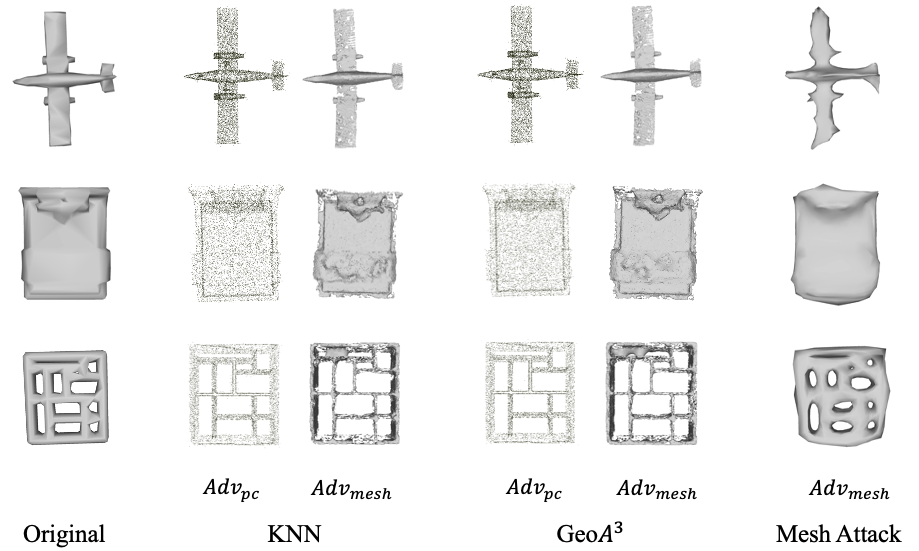
- Mesh Attack achieved a 100% attack success rate on PointNet under the pseudo-physical scenario, significantly outperforming KNN and GeoA³ attacks, which dropped below 10%.
- Under the IF-Defense, Mesh Attack maintained a 63.83% success rate on DGCNN, outperforming all compared attacks, including the point perturbation attack.
- The attack remained effective under SOR and SRS defenses, which are typically effective against outlier-prone point cloud attacks, due to the absence of outliers in the mesh-based examples.
- In black-box transfer attacks, Mesh Attack achieved a 27.19% misclassification rate on MeshNet, demonstrating transferability to mesh classifiers.
- The combination of chamfer, Laplacian, and edge length losses successfully prevented mesh artifacts like self-intersections and flying vertices, ensuring 3D printability.
- The results indicate that mesh-based attacks are significantly harder to defend against than point cloud-based attacks, highlighting a new frontier in 3D adversarial robustness.
Read this paper
Open the full text in the Nubint reader and ask about any passage as you read.
Read this paper on NubintThis review was generated by AI from the original paper. Please check the paper before citing it.