
[Paper Review] 3D Gaussian Splatting for Real-Time Radiance Field Rendering
The paper introduces 3D Gaussian splatting for differentiable radiance fields, enabling high-quality novel-view synthesis at 1080p with real-time rendering (≥30 fps) and competitive training times.
Radiance Field methods have recently revolutionized novel-view synthesis of scenes captured with multiple photos or videos. However, achieving high visual quality still requires neural networks that are costly to train and render, while recent faster methods inevitably trade off speed for quality. For unbounded and complete scenes (rather than isolated objects) and 1080p resolution rendering, no current method can achieve real-time display rates. We introduce three key elements that allow us to achieve state-of-the-art visual quality while maintaining competitive training times and importantly allow high-quality real-time (>= 30 fps) novel-view synthesis at 1080p resolution. First, starting from sparse points produced during camera calibration, we represent the scene with 3D Gaussians that preserve desirable properties of continuous volumetric radiance fields for scene optimization while avoiding unnecessary computation in empty space; Second, we perform interleaved optimization/density control of the 3D Gaussians, notably optimizing anisotropic covariance to achieve an accurate representation of the scene; Third, we develop a fast visibility-aware rendering algorithm that supports anisotropic splatting and both accelerates training and allows realtime rendering. We demonstrate state-of-the-art visual quality and real-time rendering on several established datasets.
Motivation & Objective
- Motivate real-time, high-quality novel-view synthesis for scenes captured with multiple photos or videos.
- Represent scenes using 3D Gaussians initialized from sparse SfM points to avoid reliance on heavy MVS data.
- Optimize 3D Gaussian properties with adaptive density control to produce compact, accurate scene representations.
- Develop a fast, differentiable, visibility-aware renderer that supports anisotropic splatting for real-time rendering at 1080p.
Proposed method
- Use 3D Gaussians defined by a position, anisotropic covariance, and opacity to represent the scene.
- Project 3D Gaussians to 2D splats via a differentiable projection model to enable image formation with alpha-blending.
- Optimize Gaussian parameters (position, covariance via scale and rotation, opacity, SH color coefficients) in an interleaved manner with adaptive density control.
- Densify and prune Gaussians during optimization based on view-space gradients and alpha thresholds to balance coverage and efficiency.
- Implement a fast, tile-based GPU rasterizer that pre-sorts splats per image, enables anisotropic splatting with visibility order preservation, and supports an efficient backward pass for backpropagation.
Experimental results
Research questions
- RQ1Can anisotropic 3D Gaussians provide high-quality radiance-field representations comparable to state-of-the-art NeRF methods while enabling real-time rendering?
- RQ2Does adaptive density control paired with fast differentiable rendering allow training times competitive with the fastest previous methods without sacrificing quality?
- RQ3Is SfM-point-based initialization (without heavy MVS) sufficient to obtain high-quality radiance fields for complex, unbounded scenes?
Key findings
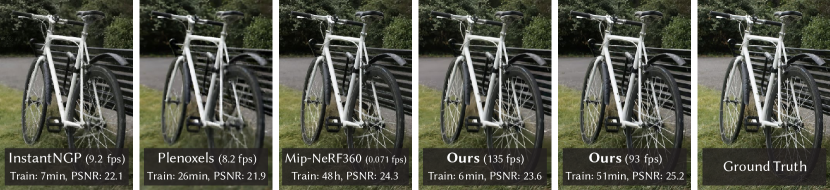
- Achieves real-time rendering at 1080p with quality equal to or better than prior high-quality methods like Mip-NeRF360 under certain training regimes.
- Attains competitive training times comparable to the fastest prior methods (e.g., InstantNGP-like approaches) while delivering high-quality results.
- Represents scenes with 1–5 million Gaussians, produced from SfM points, enabling compact yet accurate scene representations.
- Introduces a fast, differentiable, visibility-aware renderer that supports anisotropic splatting and allows backpropagation through many splats per pixel.
- Demonstrates state-of-the-art visual quality and real-time performance on multiple established datasets (e.g., Tanks&Temples, Deep Blending, Mip-NeRF360).

Read this paper
Open the full text in the Nubint reader and ask about any passage as you read.
Read this paper on NubintThis review was generated by AI from the original paper. Please check the paper before citing it.