
[Paper Review] 3D-Var Data Assimilation using a Variational Autoencoder
This paper proposes a novel neural network data assimilation (NNDA) framework that leverages a variational autoencoder (VAE) to perform 3D-Var data assimilation in a reduced latent space, enabling efficient optimization via auto-differentiable gradients. The method captures flow-dependent, seasonally varying background-error covariances—demonstrating quasi-diagonal B-matrices in latent space—and successfully represents both tropical and extratropical error structures with a single model, enabling accurate analysis increments for a single temperature variable.
Data assimilation of atmospheric observations traditionally relies on variational and Kalman filter methods. Here, an alternative neural-network data assimilation (NNDA) with variational autoencoder (VAE) is proposed. The three-dimensional variational (3D-Var) data assimilation cost function is utilised to determine the analysis that optimally fuses simulated observations and the encoded short-range persistence forecast (background), accounting for their errors. The minimisation is performed in the reduced-order latent space, discovered by the VAE. The variational problem is auto-differentiable, simplifying the computation of the cost function gradient necessary for efficient minimisation. We demonstrate that the background-error covariance ($\mathbf{B}$) matrix measured and represented in the latent space is quasi-diagonal. The background-error covariances in the grid-point space are flow-dependent, evolving seasonally and depending on the current state of the atmosphere. Data assimilation experiments with a single temperature observation in the lower troposphere indicate that the $\mathbf{B}$-matrix simultaneously describes both tropical and extratropical background-error covariances.
Motivation & Objective
- To develop a neural network-based data assimilation (NNDA) framework that replaces traditional background-error covariance modeling in 3D-Var with a learned, low-dimensional representation via a variational autoencoder (VAE).
- To enable efficient minimization of the 3D-Var cost function by performing optimization in the VAE-learned latent space, leveraging auto-differentiation for gradient computation.
- To investigate whether a single VAE-learned latent-space background-error covariance (B-matrix) can represent both tropical and extratropical atmospheric dynamics.
- To assess the capability of the VAE-NNDA framework to produce geostrophically balanced analysis increments in multivariate settings, particularly for wind and geopotential fields.
- To lay the foundation for future extension to 4D-Var and standalone neural network weather prediction by integrating probabilistic autoencoders and hybrid forecast models.
Proposed method
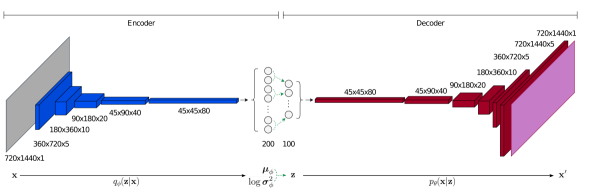
- A variational autoencoder (VAE) is trained on ERA5 reanalysis data to learn a low-dimensional, Gaussian-distributed latent representation of atmospheric state fields (e.g., 850 hPa temperature).
- The 3D-Var cost function is reformulated and minimized in the latent space, where the background state is encoded from the short-range forecast (persistence), and observations are projected into the latent space.
- The background-error covariance matrix (B) is implicitly represented in the latent space and found to be quasi-diagonal, indicating effective low-rank approximation of complex error structures.
- Gradients of the cost function are computed via auto-differentiation, enabling efficient optimization using standard nonlinear solvers such as L-BFGS.
- The analysis increment is computed in the latent space and decoded back to the grid-point space for evaluation.
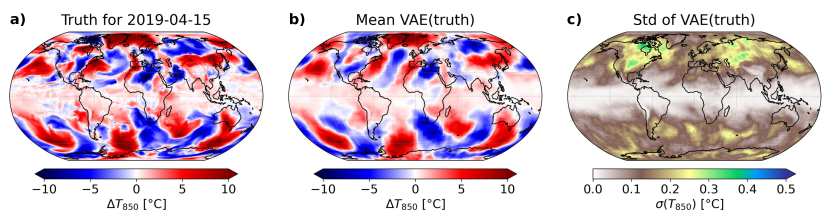
- The framework is tested using synthetic observations of 850 hPa temperature, with validation on the structure of analysis increments and background-error covariances.
Experimental results
Research questions
- RQ1Can a VAE-learned latent space effectively represent the background-error covariance structure required for 3D-Var data assimilation?
- RQ2Does the latent-space B-matrix capture both tropical and extratropical flow-dependent background-error characteristics simultaneously?
- RQ3Can the auto-differentiable nature of the VAE-based 3D-Var framework enable efficient and accurate minimization of the cost function?
- RQ4To what extent can the VAE-NNDA method produce geostrophically balanced analysis increments in multivariate settings?
- RQ5Can this framework be extended to support 4D-Var and standalone neural network weather prediction with minimal architectural overhead?
Key findings
- The background-error covariance matrix (B) in the latent space is quasi-diagonal, indicating that the VAE captures dominant error structures in a low-dimensional, smooth representation.
- The VAE-learned B-matrix successfully represents both tropical and extratropical background-error covariances using a single model, demonstrating flow-dependent and seasonally varying characteristics.
- The method produces geostrophically balanced analysis increments for midlatitude 200 hPa wind and geopotential fields, indicating physical consistency in multivariate assimilation.
- The auto-differentiable nature of the VAE enables efficient gradient computation, simplifying the optimization process in the latent space.
- The framework is capable of representing multivariate background-error covariances, though full validation across multiple variables and vertical levels requires further extension.
- The method shows promise for future integration into 4D-Var and hybrid forecast models, particularly with probabilistic autoencoders and normalizing flows to improve latent space modeling.
Read this paper
Open the full text in the Nubint reader and ask about any passage as you read.
Read this paper on NubintThis review was generated by AI from the original paper. Please check the paper before citing it.