
[Paper Review] 3DTeethSeg'22: 3D Teeth Scan Segmentation and Labeling Challenge
This paper presents the 3DTeethSeg'22 MICCAI challenge for localization, segmentation, and labeling of teeth from intraoral 3D scans, detailing the dataset, annotation process, evaluation metrics, and six top methods.
Teeth localization, segmentation, and labeling from intra-oral 3D scans are essential tasks in modern dentistry to enhance dental diagnostics, treatment planning, and population-based studies on oral health. However, developing automated algorithms for teeth analysis presents significant challenges due to variations in dental anatomy, imaging protocols, and limited availability of publicly accessible data. To address these challenges, the 3DTeethSeg'22 challenge was organized in conjunction with the International Conference on Medical Image Computing and Computer Assisted Intervention (MICCAI) in 2022, with a call for algorithms tackling teeth localization, segmentation, and labeling from intraoral 3D scans. A dataset comprising a total of 1800 scans from 900 patients was prepared, and each tooth was individually annotated by a human-machine hybrid algorithm. A total of 6 algorithms were evaluated on this dataset. In this study, we present the evaluation results of the 3DTeethSeg'22 challenge. The 3DTeethSeg'22 challenge code can be accessed at: https://github.com/abenhamadou/3DTeethSeg22_challenge
Motivation & Objective
- Investigate automated teeth localization, segmentation, and labeling from intraoral 3D scans.
- Provide a large, publicly available dataset with expert-annotated ground truth.
- Establish standardized evaluation metrics for localization, segmentation, and labeling.
- Stimulate development of robust, automated dental analysis algorithms across diverse scanners and anatomies.
Proposed method
- Assemble a dataset of 1800 intraoral scans from 900 patients, with per-tooth annotations created via a human–machine hybrid process.
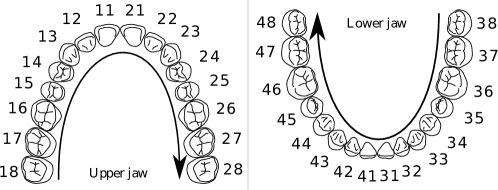
- Define localization (3D centroid), segmentation (tooth boundary vertices), and labeling (FDI-based) for each tooth.
- Organize a MICCAI Satellite Challenge with a training phase and two testing phases, including docker-based evaluation on hidden data.
- Provide ground-truth annotations and JSON-based per-vertex labels and instances for training/testing.
- Evaluate participants using Teeth Localization Accuracy (TLA), Teeth Segmentation Accuracy (TSA), and Teeth Identification Rate (TIR).
- Summarize six top-performing methods with diverse approaches (multi-stage pipelines, 2D/3D CNNs, graph-based and transformer-inspired strategies).
Experimental results
Research questions
- RQ1How accurately can teeth be localized, segmented, and labeled in intraoral 3D scans across subjects and scanners?
- RQ2What is the impact of different algorithmic strategies (point-based, mesh-based, and 2D-augmented approaches) on localization, segmentation, and labeling performance?
- RQ3Can a publicly released dataset with expert annotations drive reproducible advancement in 3D teeth analysis?
- RQ4How effective are standardized evaluation metrics (TLA, TSA, TIR) for comparing diverse methods?
- RQ5What are the practical considerations for annotation, data preprocessing, and post-processing in this domain?
Key findings
- Six top-performing methods are benchmarked on a common 3D intraoral scan dataset.
- The challenge defines three evaluation metrics: TLA, TSA, and TIR to quantify localization, segmentation, and labeling performance.
- A publicly available dataset (train and test splits) with ground-truth per-vertex labels enables reproducible research.
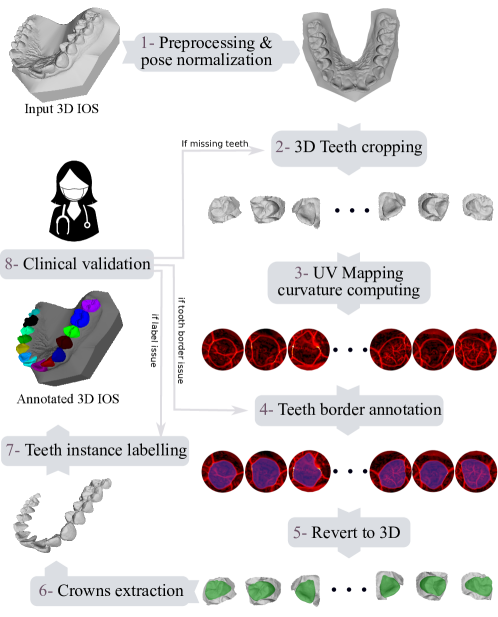
- The annotation pipeline combines preprocessing, pose normalization, UV mapping for boundary annotation, and clinical validation to ensure tooth-wise accuracy.
- Public challenge resources include code and data processing scripts to support future research and development.
- The paper provides a summary of the participating methods and their key components across different methodological families.
Read this paper
Open the full text in the Nubint reader and ask about any passage as you read.
Read this paper on NubintThis review was generated by AI from the original paper. Please check the paper before citing it.