
[Paper Review] 6D Object Pose Regression via Supervised Learning on Point Clouds
This paper proposes a supervised deep learning approach for 6D object pose estimation using only depth-derived point clouds, employing separate networks for rotation (via axis-angle representation and geodesic loss) and translation regression. The method outperforms state-of-the-art techniques on the YCB-Video dataset, demonstrating that geometric-only point cloud features with careful design choices surpass methods using RGB-D data.
This paper addresses the task of estimating the 6 degrees of freedom pose of a known 3D object from depth information represented by a point cloud. Deep features learned by convolutional neural networks from color information have been the dominant features to be used for inferring object poses, while depth information receives much less attention. However, depth information contains rich geometric information of the object shape, which is important for inferring the object pose. We use depth information represented by point clouds as the input to both deep networks and geometry-based pose refinement and use separate networks for rotation and translation regression. We argue that the axis-angle representation is a suitable rotation representation for deep learning, and use a geodesic loss function for rotation regression. Ablation studies show that these design choices outperform alternatives such as the quaternion representation and L2 loss, or regressing translation and rotation with the same network. Our simple yet effective approach clearly outperforms state-of-the-art methods on the YCB-video dataset. The implementation and trained model are avaliable at: https://github.com/GeeeG/CloudPose.
Motivation & Objective
- To address 6D object pose estimation using only geometric depth information from point clouds, avoiding reliance on color data.
- To investigate whether separate networks for rotation and translation regression yield better performance than shared architectures.
- To evaluate axis-angle versus quaternion representations for rotation regression in deep learning.
- To compare geodesic distance and L2 loss for measuring rotational error in a learning framework.
- To demonstrate that point cloud-based deep learning can achieve superior performance compared to RGB-D methods in 6D pose estimation.
Proposed method
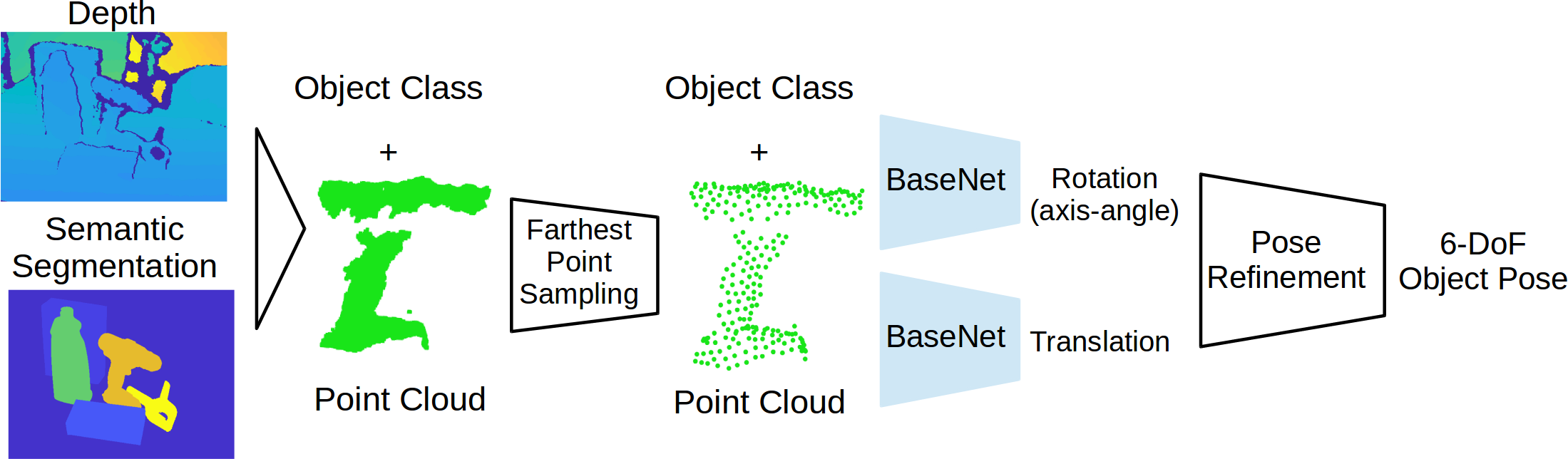
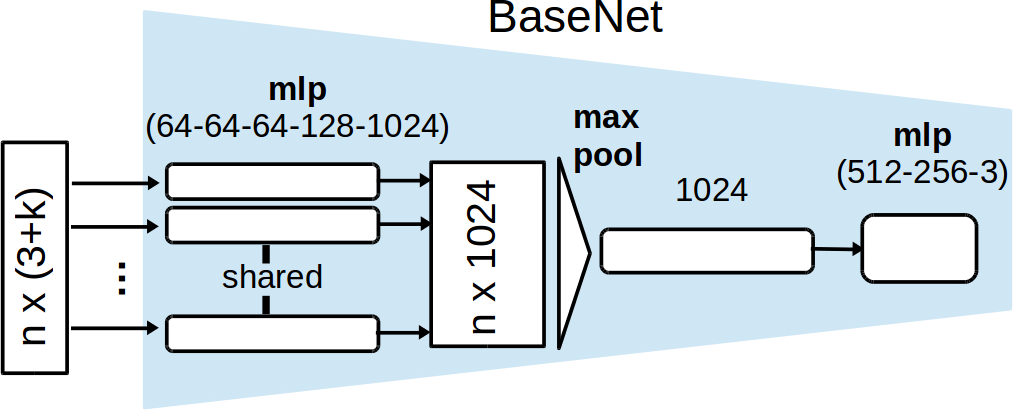
- Uses PointNet-inspired architecture to process unordered point cloud inputs representing 3D object geometry.
- Employs two separate deep neural networks: one for predicting 3D rotation in axis-angle format and another for 3D translation.
- Applies geodesic distance as the loss function for rotation regression to ensure mathematically sound optimization.
- Uses farthest point sampling to downsample point clouds while preserving surface structure for consistent input.
- Applies iterative closest point (ICP) refinement using predicted initial pose to improve accuracy.
- Normalizes quaternion outputs and converts them to axis-angle for comparison, ensuring fair evaluation of rotation representations.
Experimental results
Research questions
- RQ1Can 6D object pose be accurately estimated using only depth information represented as unordered point clouds?
- RQ2Is it better to regress translation and rotation using separate deep networks rather than a shared architecture?
- RQ3Does axis-angle representation outperform quaternion representation for rotation regression in a deep learning framework?
- RQ4Is geodesic distance a more effective loss function than L2 loss for measuring rotational error?
- RQ5Can a purely geometric, point cloud-based deep learning system outperform state-of-the-art methods that use RGB-D data?
Key findings
- The proposed method with separate networks for rotation and translation achieves an AD of 76.0 and ADS of 91.3 on the YCB-Video dataset, outperforming shared-architecture variants.
- Using axis-angle representation for rotation yields 41.3% accuracy for rotation error <10°, compared to 37.1% with quaternions under the same conditions.
- Geodesic loss achieves 41.3% accuracy for rotation error <10°, slightly better than L2 loss (40.8%), with stronger mathematical justification.
- The system outperforms two state-of-the-art methods on the YCB-Video benchmark, even though those methods use both color and depth information.
- Pose estimation via a forward pass takes 0.11 seconds, with 0.3 seconds for 10 ICP refinement iterations on a Titan X GPU.
- Ablation studies confirm that performance degrades when sharing layers between rotation and translation networks, even with doubled capacity.
Read this paper
Open the full text in the Nubint reader and ask about any passage as you read.
Read this paper on NubintThis review was generated by AI from the original paper. Please check the paper before citing it.