
[Paper Review] 6G Underlayer Network Concepts for Ultra Reliable and Low Latency Communication in Manufacturing
This paper proposes a 6G underlayer network architecture for manufacturing that enables ultra-reliable, low-latency communication (uRLLC) through time-deterministic wireless networking using EchoRing technology. By integrating network slicing, spectrum sharing, and centralized management, the system achieves sub-2ms latency and jitter below 0.2ms in closed-loop machine tool control, supporting real-time, secure, and flexible wireless industrial automation in cyber-physical production systems (CPPS).
Underlayer networks in the context of 6G for manufacturing are crucial. They address the evolving needs of highly interconnected and autonomous systems in industry. The digitalization of manufacturing processes, driven by the Internet of Things and increased data availability, enables more efficient and demand-driven production. However, wireless connectivity, which offers flexibility and easy integration of components, comes with challenges such as signal interference or high latency. A new management system is needed to coordinate and route traffic of multiple networks in a specific coverage area. This paper proposes underlayer networks designed for manufacturing, providing low latency, reliability, and security. These networks enable wireless connectivity and integration of wireless technologies into the manufacturing environment, enhancing flexibility and efficiency. The paper also discusses network slicing, spectrum sharing, and the limitations of current wireless networks in manufacturing. It introduces a network concept for underlayer networks and evaluates its application in closed-loop communication for machine tools. The study concludes with future research prospects in this area.
Motivation & Objective
- To address the limitations of current 5G and wireless networks in supporting ultra-reliable, low-latency communication (uRLLC) for autonomous cyber-physical production systems (CPPS).
- To design a novel underlayer network concept that enables robust, deterministic, and secure wireless communication in industrial environments with high interference and dynamic conditions.
- To evaluate the feasibility of wireless closed-loop control in manufacturing using time-deterministic communication protocols.
- To identify the need for a new network management system that coordinates multiple underlayer and overlayer networks in a shared coverage area.
- To enable flexible, scalable, and retrofit-friendly integration of wireless components into existing manufacturing systems.
Proposed method
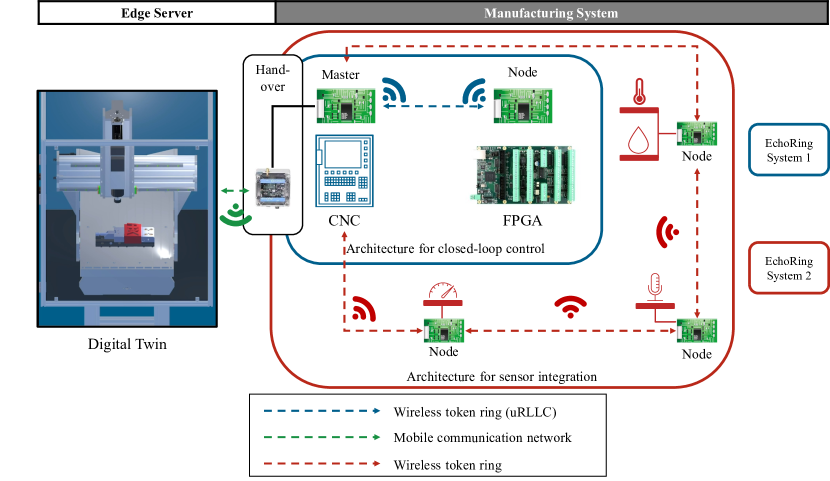
- The paper introduces an underlayer network architecture based on EchoRing, a time-distributed, time-deterministic wireless communication protocol designed for industrial control applications.
- The system employs network slicing to isolate critical uRLLC traffic from other network functions, ensuring quality of service (QoS) and low interference.
- Spectrum sharing is implemented to allow coexistence of multiple wireless systems in the same industrial environment without significant interference.
- A centralized network management system coordinates traffic routing between multiple underlayer networks and the overlying cellular network, enabling dynamic adaptation to changing network demands.
- The architecture integrates with 5G private networks and leverages cellular infrastructure for robustness and scalability.
- The solution is evaluated in a real-world testbed using a CNC machine tool with wireless control, measuring latency, jitter, and cycle time stability.
Experimental results
Research questions
- RQ1Can a 6G underlayer network architecture achieve sub-2ms latency and jitter below 0.2ms in a real industrial closed-loop control scenario?
- RQ2How does the integration of EchoRing with network slicing and spectrum sharing improve reliability and determinism in wireless manufacturing networks?
- RQ3What are the key challenges in synchronizing multiple underlayer networks with different cycle times in a single CPPS environment?
- RQ4How does the proposed network management system coordinate traffic across multiple underlayer and overlayer networks in a dynamic manufacturing setting?
- RQ5What are the practical limitations of deploying such a system in real-world industrial environments with harsh RF conditions and line-of-sight blockages?
Key findings
- The EchoRing-based underlayer network achieved a latency of 0.5ms and jitter of 0.05ms under optimal conditions, meeting stringent uRLLC requirements.
- Jitter remained below 0.2ms for all tested configurations up to 2ms latency, with only a single failure at 0.3ms jitter, indicating high time determinism.
- The system demonstrated stable operation with cycle times matching the CNC machine tool requirements, confirming feasibility for real-time control.
- The architecture supports retrofitting of wireless sensors, actuators, and computing units into existing manufacturing systems without major infrastructure changes.
- The integration of multiple EchoRing systems with different cycle times presents a synchronization challenge requiring further investigation in dynamic environments.
- The solution enables scalable, secure, and deterministic wireless communication, paving the way for fully wireless, agile, and adaptive cyber-physical production systems (CPPS).
Read this paper
Open the full text in the Nubint reader and ask about any passage as you read.
Read this paper on NubintThis review was generated by AI from the original paper. Please check the paper before citing it.