
[Paper Review] A Bright First Day for Tidal Disruption Event
This study uses 3D radiation hydrodynamic simulations to show that stream-stream collisions in tidal disruption events (TDEs) can power bright pre-peak optical emission by converting >5% of stream kinetic energy into radiation, producing luminosities of ~10⁴²–10⁴⁴ erg s⁻¹. The collision generates a super-Eddington radiation region that launches an aspherical outflow, with photospheric size expanding by 1–2 orders of magnitude and temperature reaching ~10⁴ K, consistent with observed TDEs.
Stream-stream collision may be an important pre-peak energy dissipation mechanism in tidal disruption events (TDEs). We perform local three-dimensional radiation hydrodynamic simulations in a wedge geometry including the gravity to study stream self-crossing, with emphasis on resolving the collision and following the subsequent outflow. We find that the collision can contribute to pre-peak optical emissions by converting $\gtrsim5\%$ of stream kinetic energy to radiation, yielding prompt emission of $\sim10^{42-44} m erg~s^{-1}$. The radiative efficiency is sensitive to stream mass fallback rates, and strongly depends on the downstream gas optical depth. Even for a sub-Eddington ($10\%$) mass fallback rate, the strong radiation pressure produced in the collision can form a local super-Eddington region near the collision site, where a fast, aspherical outflow is launched. Higher mass fallback rate usually leads to more optically-thick outflow and lower net radiative efficiency. For $\dot{M}\gtrsim0.1\dot{M}_{ m Edd}$, the estimated photosphere size of the outflow can expand by one to two orders of magnitudes reaching $\sim10^{14} m cm$. The average gas temperature at this photospheric surface is a few $ imes10^{4}$K, roughly consistent with inferred pre-peak photosphere properties for some optical TDEs. We find that the dynamics is sensitive to collision angle and collision radius, but the radiative efficiency or outflow properties show more complex dependency than is often assumed in ballistic models.
Motivation & Objective
- To investigate the role of stream-stream collisions as a pre-peak energy dissipation mechanism in tidal disruption events (TDEs).
- To quantify the radiative efficiency and outflow properties resulting from stream self-crossing in TDEs.
- To assess the impact of mass fallback rate and optical depth on radiation production and outflow dynamics.
- To validate the robustness of collision-driven emission models using high-resolution radiation hydrodynamics.
Proposed method
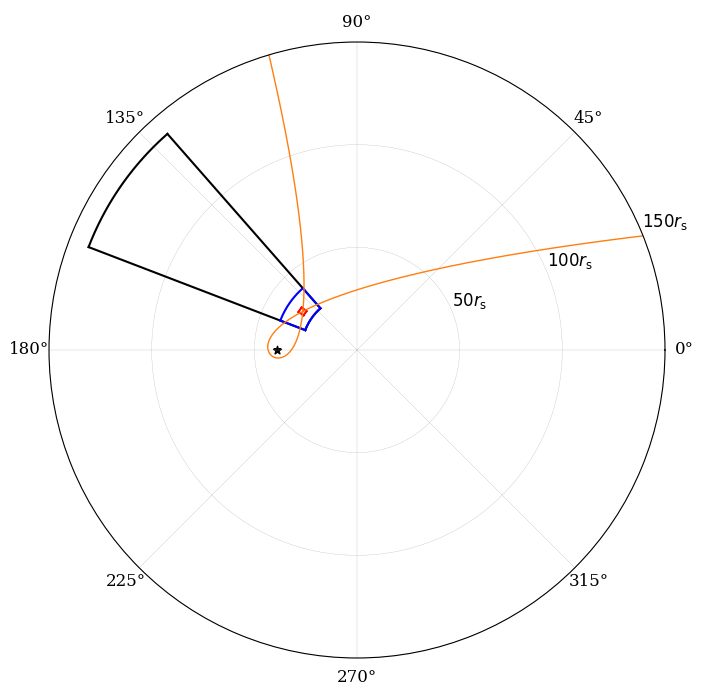
- Perform local 3D radiation hydrodynamic simulations in wedge geometry, including gravity and radiation transfer.
- Use adaptive mesh refinement (AMR) with six levels of refinement in the shock region and four levels for radiation field.
- Model stream self-intersection using ballistic trajectories with apsidal precession to induce collisions.
- Track energy conversion from kinetic to radiation energy via radiation pressure and thermalization.
- Conduct resolution studies with varying spatial and angular resolution to assess numerical convergence.
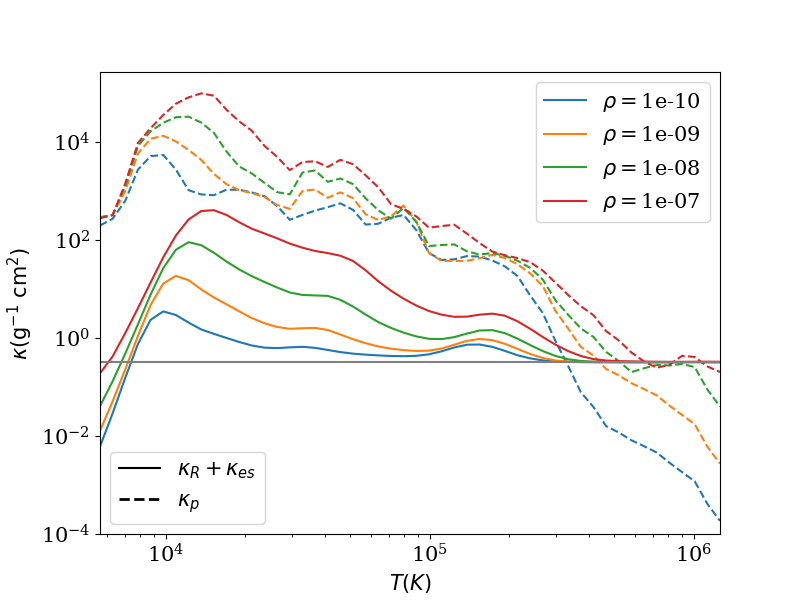
- Define photospheric radius at τ=1 and compute temperature and luminosity from radiation energy density profiles.
Experimental results
Research questions
- RQ1What fraction of stream kinetic energy is converted into radiation during stream-stream collisions in TDEs?
- RQ2How does the radiative efficiency depend on mass fallback rate and downstream optical depth?
- RQ3Can stream-stream collisions produce observable pre-peak optical emission consistent with TDE light curves?
- RQ4What are the properties of the outflow launched by radiation pressure in the collision region?
- RQ5How do resolution and numerical setup affect the simulation of radiation-mediated shocks?
Key findings
- Stream-stream collisions convert >5% of stream kinetic energy into radiation, producing prompt emission of ~10⁴²–10⁴⁴ erg s⁻¹.
- Even at 10% of the Eddington rate, radiation pressure creates a local super-Eddington region near the collision site.
- The outflow is aspherical and launched with high velocity due to strong radiation pressure in the collision zone.
- For mass fallback rates ≥0.1 M_Edd, the photospheric radius expands by 1–2 orders of magnitude, reaching ~10¹⁴ cm.
- The average photospheric temperature is ~10⁴ K, consistent with inferred temperatures in pre-peak optical TDEs.
- Radiative efficiency decreases with higher mass fallback rates due to increased optical depth and more opaque outflows.
Read this paper
Open the full text in the Nubint reader and ask about any passage as you read.
Read this paper on NubintThis review was generated by AI from the original paper. Please check the paper before citing it.