
[Paper Review] A bright triple transient that vanished within 50 minutes
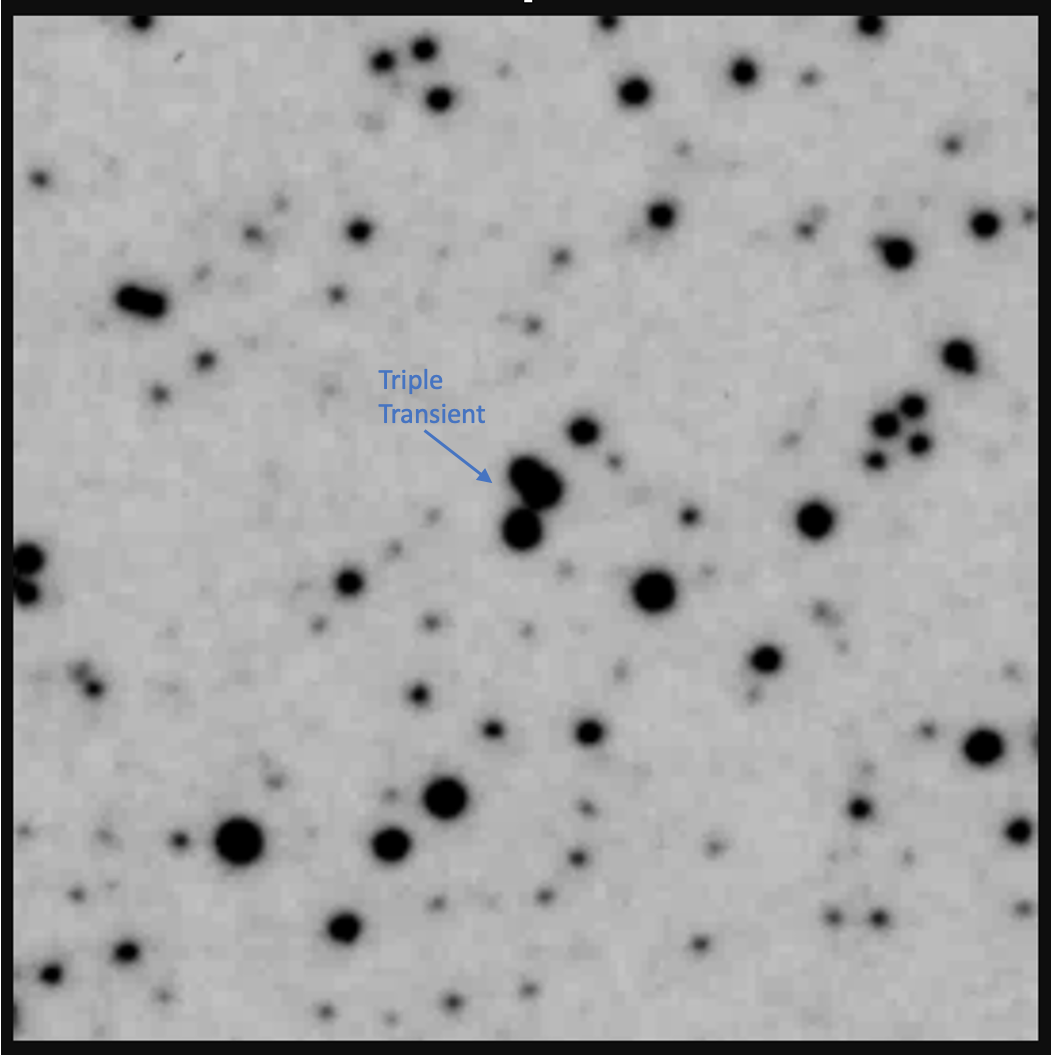
A rare triple transient event—three point-like sources at ~15th magnitude—vanished within 50 minutes in 1952, as observed in Palomar Sky Survey plates. Follow-up with the 10.4-m Gran Telescopio Canarias (GTC) revealed no counterparts down to r ≈ 25.5 mag, indicating a dimming of >10 magnitudes in under an hour, possibly due to micro-lensing by a structured foreground mass producing three images of a brief optical outburst.
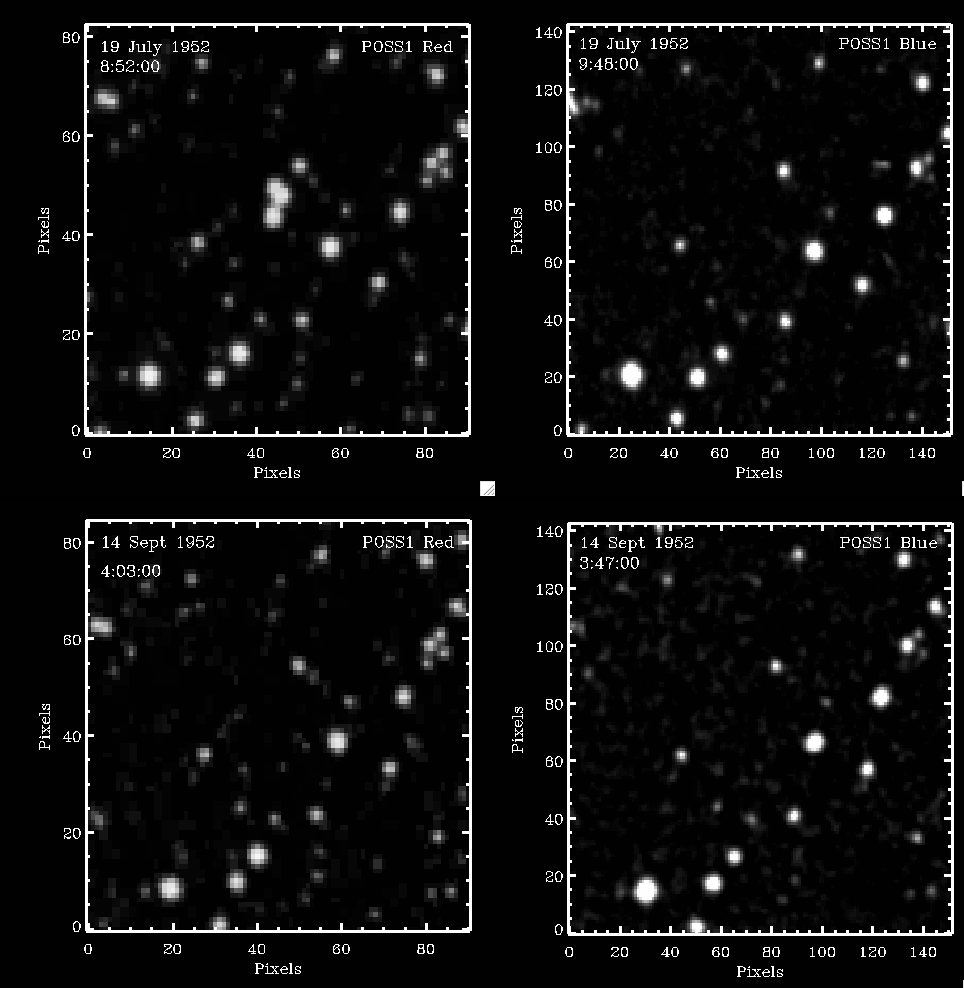
We report on three optically bright, ~15th mag, point-sources within 10 arcsec of each other that vanished within 1 hour, based on two consecutive exposures at Palomar Observatory on 1952 July 19 (POSS I Red and Blue). The three point-sources have continued to be absent in telescope exposures during 71 years with detection thresholds of ~21st mag. We obtained two deep exposures with the 10.4-m Gran Telescopio Canarias on 25 and 27 April 2023 in r and g-band, both reaching magnitude 25.5 (3-sigma). The three point-sources are still absent, implying they have dimmed by more than 10 magnitudes within an hour. When bright in 1952, the most isolated transient source has a profile nearly the same as comparison stars, implying the sources are sub-arcsec in angular size and they exhibit no elongation due to movement. This triple transient has observed properties similar to other cases where groups of transients ("multiple transients") have appeared and vanished in a small region within a plate exposure. The explanation for these three transients and the previously reported cases remains unclear. Models involving background objects that are optically luminous for less than one hour coupled with foreground gravitational lensing seem plausible. If so, a significant population of massive objects with structure serving as the lenses, to produce three images, are required to explain the hundreds of sub-hour transients.
Motivation & Objective
- To investigate the nature of a rare, bright, triple transient event that appeared and vanished within 50 minutes in 1952.
- To determine whether the transient sources are consistent with known astrophysical phenomena or require novel physical explanations.
- To test the hypothesis that the transients resulted from micro-lensing of a brief optical outburst by a foreground mass with complex structure.
- To rule out instrumental artifacts, satellite glints, or observational errors through deep follow-up imaging.
- To assess the statistical significance of such sub-hour transients in historical sky surveys.
Proposed method
- Analysis of digitized POSS I red and blue plates from Palomar Observatory, taken within one hour of each other, to identify transient sources absent in the second exposure.
- Cross-identification of transient candidates with modern surveys (Pan-STARRS, ZTF, SDSS, Gaia EDR3) to confirm absence in later epochs.
- Deep imaging with the 10.4-m Gran Telescopio Canarias (GTC) in r and g bands, reaching 3σ limiting magnitude of 25.5 mag.
- Image processing using SExtractor to detect point sources and compare with reference stars to assess source morphology and angular size.
- Modeling of gravitational lensing scenarios involving a foreground mass with sufficient structure to produce three distinct images of a single background source.
- Statistical comparison with prior reports of multiple transients (e.g., Villarroel et al., 2021; Solano et al., 2022) to assess consistency and rarity.
Experimental results
Research questions
- RQ1What caused three distinct, bright point sources to appear and vanish within 50 minutes in a single sky field in 1952?
- RQ2Could the observed transients be explained by micro-lensing of a brief optical outburst by a foreground mass with complex structure?
- RQ3Why do these transients not reappear in any modern survey, even with deep imaging down to 25.5 mag?
- RQ4Is there a physical mechanism capable of producing a 10,000× luminosity drop in less than an hour, as implied by the observations?
- RQ5Do these events represent a previously undetected population of sub-hour transients linked to fast radio bursts or other high-energy phenomena?
Key findings
- Three point-like sources at ~15th magnitude appeared in a single POSS I exposure on 1952 July 19 and vanished within 50 minutes, with no detection in any subsequent survey.
- Deep GTC imaging in r and g bands revealed no counterparts down to 25.5 mag, confirming a dimming of more than 10 magnitudes in less than an hour.
- The transient sources exhibited no elongation or motion, indicating angular sizes of sub-arcsecond scale and no significant proper motion.
- The triple transient event is consistent with a single background source being gravitationally lensed into three images by a foreground mass with sufficient structural complexity.
- The event is one of only a few known cases of multiple transients (three in this case) appearing and vanishing within a single exposure, with no known counterparts in 71 years of follow-up.
- The observed properties are inconsistent with known transient classes such as flaring M dwarfs, asteroids, or satellite glints, which would not produce such a symmetric, multi-image disappearance.
Better researchstarts right now
From reading papers to final review, dramatically reduce your research time.
No credit card · Free plan available
This review was created by AI and reviewed by human editors.