
[Paper Review] A Collaborative Transfer Learning Framework for Cross-domain Recommendation
This paper proposes a Collaborative Cross-Domain Transfer Learning (CCTL) framework that dynamically weights source domain samples based on their information gain to the target domain, using a symmetric companion network and information flow network to prevent negative transfer. CCTL achieves state-of-the-art performance on offline metrics and delivers 4.37% CTR and 5.43% GMV lift in real-world deployment at Meituan.
In the recommendation systems, there are multiple business domains to meet the diverse interests and needs of users, and the click-through rate(CTR) of each domain can be quite different, which leads to the demand for CTR prediction modeling for different business domains. The industry solution is to use domain-specific models or transfer learning techniques for each domain. The disadvantage of the former is that the data from other domains is not utilized by a single domain model, while the latter leverage all the data from different domains, but the fine-tuned model of transfer learning may trap the model in a local optimum of the source domain, making it difficult to fit the target domain. Meanwhile, significant differences in data quantity and feature schemas between different domains, known as domain shift, may lead to negative transfer in the process of transferring. To overcome these challenges, we propose the Collaborative Cross-Domain Transfer Learning Framework (CCTL). CCTL evaluates the information gain of the source domain on the target domain using a symmetric companion network and adjusts the information transfer weight of each source domain sample using the information flow network. This approach enables full utilization of other domain data while avoiding negative migration. Additionally, a representation enhancement network is used as an auxiliary task to preserve domain-specific features. Comprehensive experiments on both public and real-world industrial datasets, CCTL achieved SOTA score on offline metrics. At the same time, the CCTL algorithm has been deployed in Meituan, bringing 4.37% CTR and 5.43% GMV lift, which is significant to the business.
Motivation & Objective
- To address the challenge of negative transfer and data imbalance in cross-domain CTR prediction, especially when source domains have different data volumes and feature schemas.
- To enable effective knowledge transfer from data-rich to data-scarce domains without degrading performance due to domain shift or local optima in fine-tuning.
- To develop a method that evaluates the true information gain of each source sample on the target domain, avoiding indiscriminate use of all source data.
- To preserve domain-specific features while enabling collaborative transfer through an auxiliary representation enhancement network.
- To achieve superior performance on both public benchmarks and real-world industrial datasets, particularly in low-data regimes.
Proposed method
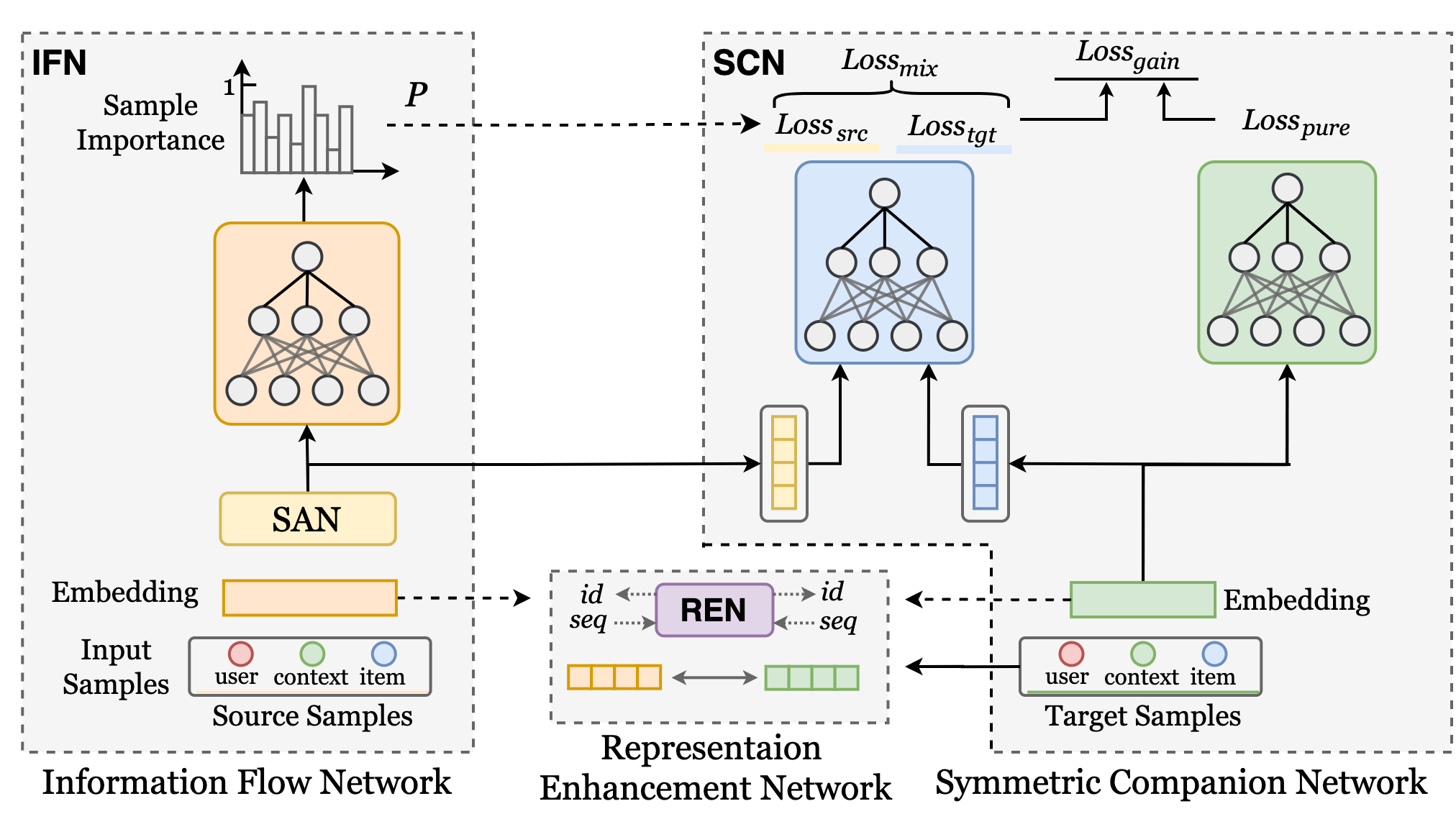
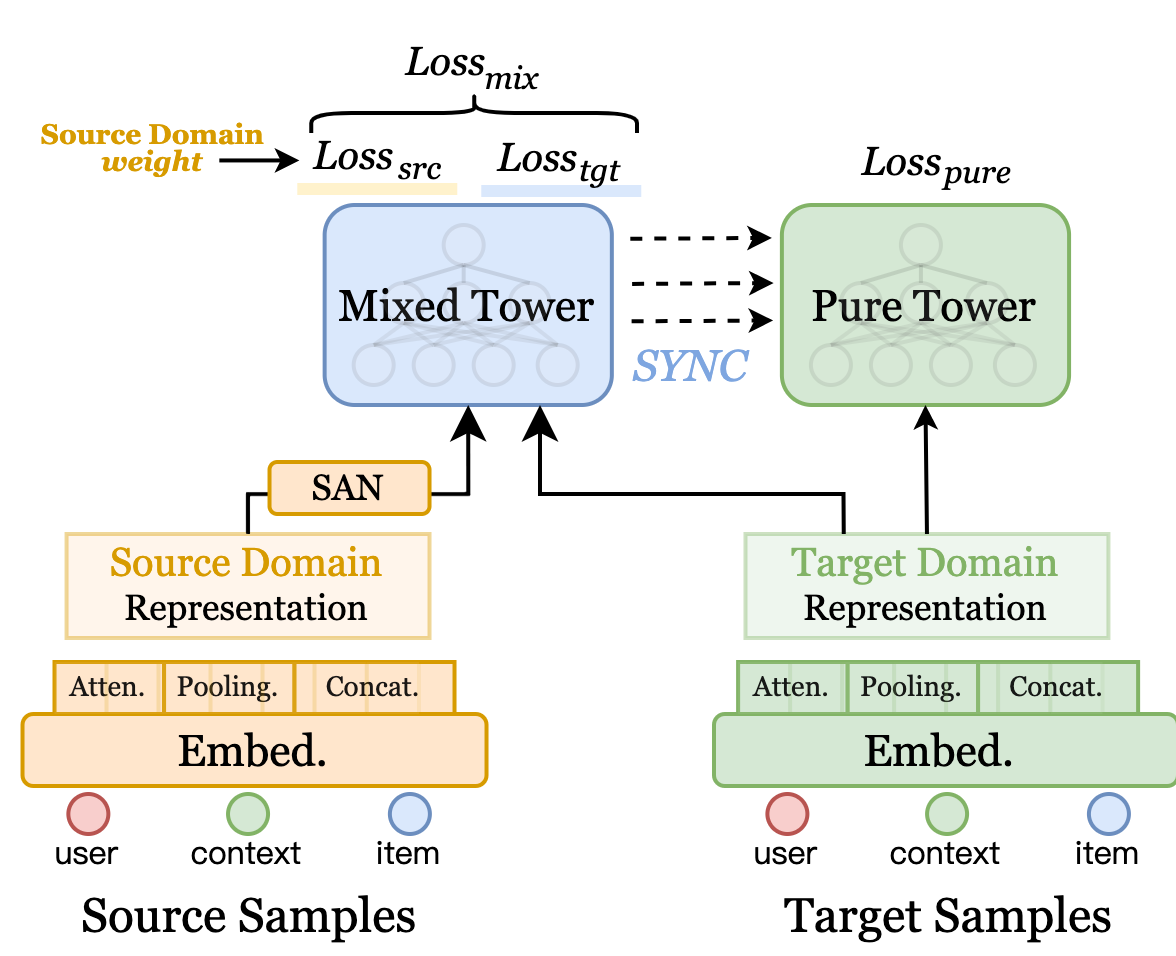
- The Symmetric Companion Network (SCN) trains a mixed model (target + source samples) and a pure target model in a symmetric architecture to estimate the information gain of source samples on the target domain.
- The Information Flow Network (IFN) computes sample-level transfer weights by measuring the difference in prediction performance between the SCN's two branches, enabling dynamic, sample-specific transfer weights.
- The Representation Enhancement Network (REN) uses contrastive learning to preserve domain-specific features, ensuring that the model retains unique characteristics of each domain.
- The framework jointly optimizes the main CTR prediction task with the REN auxiliary task, improving generalization and robustness.
- The SCN and IFN are trained end-to-end with a loss that encourages high transfer weight for beneficial source samples and low weight for harmful or irrelevant ones.
- The model architecture is compatible with existing deep CTR models, allowing integration with techniques like attention, MLP, and embedding layers.
Experimental results
Research questions
- RQ1How can we dynamically assess the information gain of individual source domain samples for transfer to a target domain?
- RQ2What mechanisms can prevent negative transfer when transferring from data-rich to data-sparse domains with significant domain shift?
- RQ3How can we preserve domain-specific features while enabling effective cross-domain knowledge transfer?
- RQ4Can a collaborative transfer learning framework outperform standard multi-task learning and fine-tuning baselines in cross-domain CTR prediction?
- RQ5To what extent can such a framework improve real-world business metrics like CTR and GMV?
Key findings
- CCTL achieved state-of-the-art performance on both public and real-world industrial datasets in offline evaluation metrics.
- The model achieved a 4.37% absolute lift in click-through rate (CTR) when deployed on Meituan’s recommendation system.
- CCTL delivered a 5.43% increase in gross merchandise volume (GMV), demonstrating strong business impact.
- Ablation studies confirmed that both the symmetric companion network and information flow network are essential for performance, with the IFN significantly reducing negative transfer.
- The representation enhancement network effectively preserved domain-specific features, contributing to improved generalization across domains.
- The framework outperformed standard transfer learning and multi-task learning baselines, especially in low-data regimes, by intelligently filtering beneficial source samples.
Better researchstarts right now
From reading papers to final review, dramatically reduce your research time.
No credit card · Free plan available
This review was created by AI and reviewed by human editors.