
[Paper Review] A Common Tracking Software Project
This paper introduces ACTS (A Common Tracking Software), an open-source, experiment- and framework-agnostic toolkit for track and vertex reconstruction in particle physics. Built on lessons from ATLAS, ACTS provides thread-safe, high-performance algorithms that scale efficiently with increasing detector complexity and luminosity, demonstrating compatibility with major experimental frameworks and supporting future collider experiments like FCC-hh.
The reconstruction of the trajectories of charged particles, or track reconstruction, is a key computational challenge for particle and nuclear physics experiments. While the tuning of track reconstruction algorithms can depend strongly on details of the detector geometry, the algorithms currently in use by experiments share many common features. At the same time, the intense environment of the High-Luminosity LHC accelerator and other future experiments is expected to put even greater computational stress on track reconstruction software, motivating the development of more performant algorithms. We present here A Common Tracking Software (ACTS) toolkit, which draws on the experience with track reconstruction algorithms in the ATLAS experiment and presents them in an experiment-independent and framework-independent toolkit. It provides a set of high-level track reconstruction tools which are agnostic to the details of the detection technologies and magnetic field configuration and tested for strict thread-safety to support multi-threaded event processing. We discuss the conceptual design and technical implementation of ACTS, selected applications and performance of ACTS, and the lessons learned.
Motivation & Objective
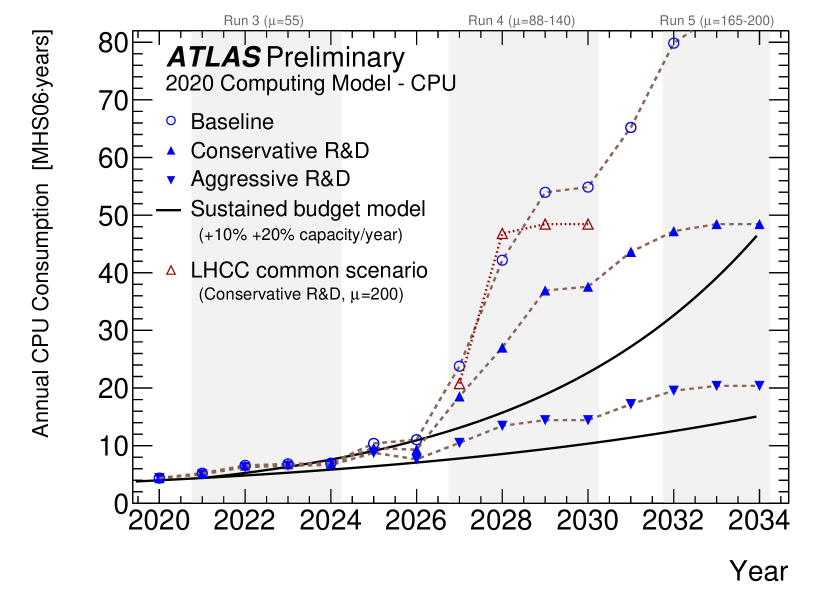
- Address the growing computational burden of track reconstruction in high-luminosity collider experiments like the HL-LHC.
- Develop a reusable, experiment-independent software toolkit to standardize and optimize track reconstruction across diverse detector geometries and magnetic field configurations.
- Enable thread-safe, concurrent event processing to meet the performance demands of future high-rate data environments.
- Facilitate integration with existing experimental software frameworks such as Gaudi and Athena, ensuring broad applicability and extensibility.
- Provide a foundation for future algorithm tuning and hardware portability, including support for heterogeneous computing platforms.
Proposed method
- Design a modular, high-level software toolkit abstracting detector-specific details, enabling reuse across experiments.
- Implement thread-safe algorithms to support concurrent processing of events, critical for high-throughput computing environments.
- Use C++ with optimized template expressions and compile-time optimizations to balance performance and maintainability.
- Integrate contextual data handling via dependency injection, minimizing runtime overhead and enabling flexible configuration.
- Support seamless logging integration with experimental frameworks by allowing replacement of ACTS logging instances with framework-native logging systems.
- Demonstrate compatibility through integration examples in Athena and Gaudi-based frameworks, and include a generic logging demonstrator in the test suite.
Experimental results
Research questions
- RQ1How can a unified, experiment-agnostic software toolkit improve the maintainability and performance of track reconstruction in high-luminosity collider experiments?
- RQ2What architectural patterns enable thread-safety and efficient concurrent processing in track reconstruction software without sacrificing modularity?
- RQ3To what extent can a common software toolkit be integrated into diverse experimental software frameworks like Gaudi and Athena?
- RQ4How does the ACTS toolkit handle varying detector geometries, including forward detectors and time projection chambers, without hardcoding detector-specific logic?
- RQ5What performance and scalability characteristics does ACTS exhibit under high-multiplicity conditions typical of HL-LHC and future FCC-hh events?
Key findings
- ACTS successfully decouples track reconstruction algorithms from detector geometry and magnetic field configuration, enabling broad reusability across experiments.
- The toolkit demonstrates thread-safety and supports concurrent event processing, a critical requirement for handling the high data rates expected at the HL-LHC.
- ACTS has been successfully integrated into Gaudi-based frameworks (e.g., ATLAS, FCC-hh) and Athena, validating its compatibility with major experimental software stacks.
- Initial performance studies using the TrackML detector model show that ACTS can handle up to 4,000 charged particles per event, consistent with HL-LHC expectations.
- The toolkit’s logging and data handling mechanisms are fully compatible with experimental logging infrastructures, enabling seamless debugging and monitoring.
- Despite initial compilation overhead from template-heavy C++ code, refactoring has reduced resource consumption, improving maintainability and paving the way for future hardware portability.
Read this paper
Open the full text in the Nubint reader and ask about any passage as you read.
Read this paper on NubintThis review was generated by AI from the original paper. Please check the paper before citing it.