
[Paper Review] A compact instrument for gamma-ray burst detection on a CubeSat platform I: Design drivers and expected performance
This paper presents GMOD, a compact gamma-ray burst (GRB) detector for the 2U CubeSat EIRSAT-1, using a cerium bromide scintillator and silicon photomultipliers read out by a radiation-tolerant ASIC. Despite a sky-average effective area of only 10 cm² at 120 keV, Monte Carlo simulations predict GMOD will detect 11–14 GRBs per year at >10σ significance, demonstrating technology readiness for future small satellite GRB missions.
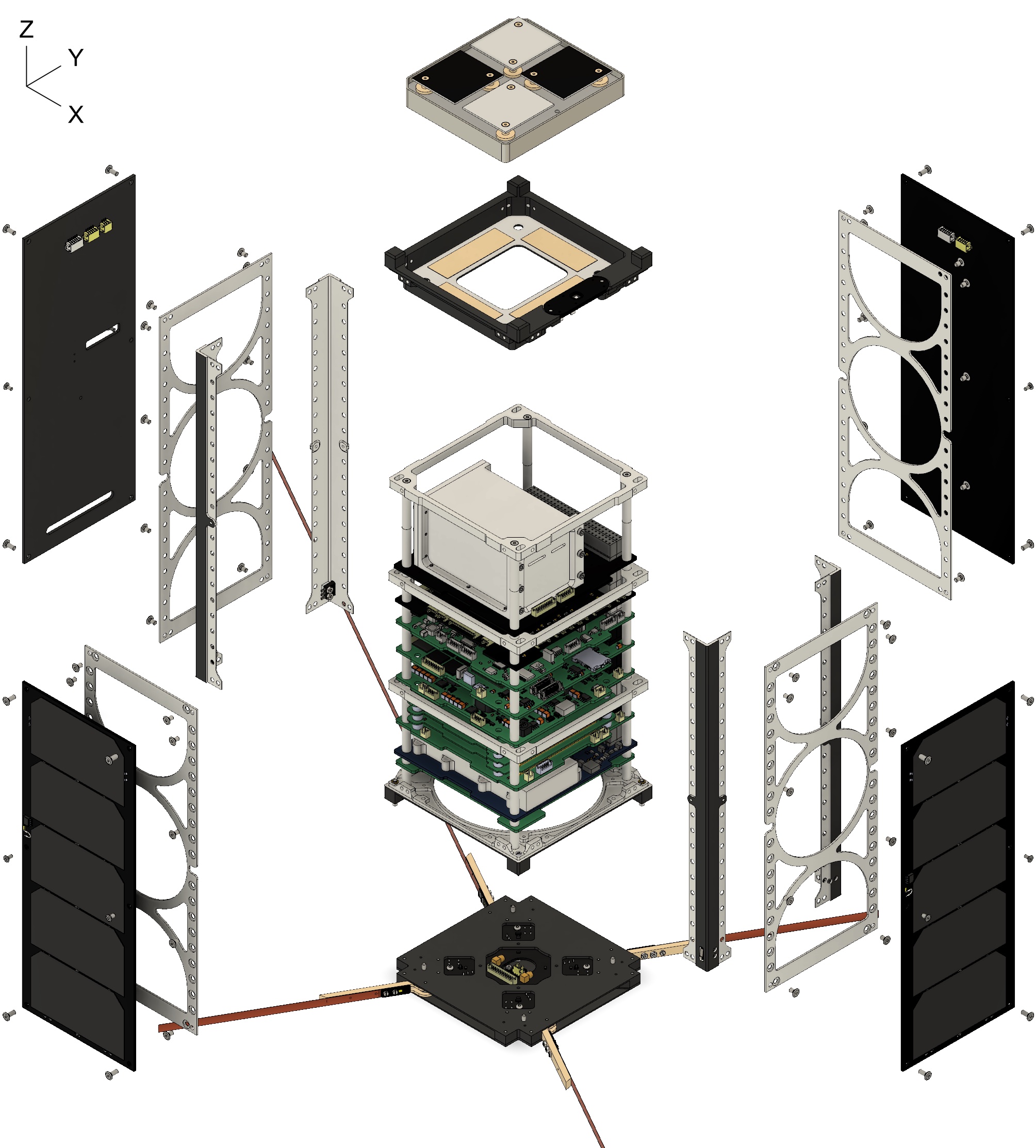
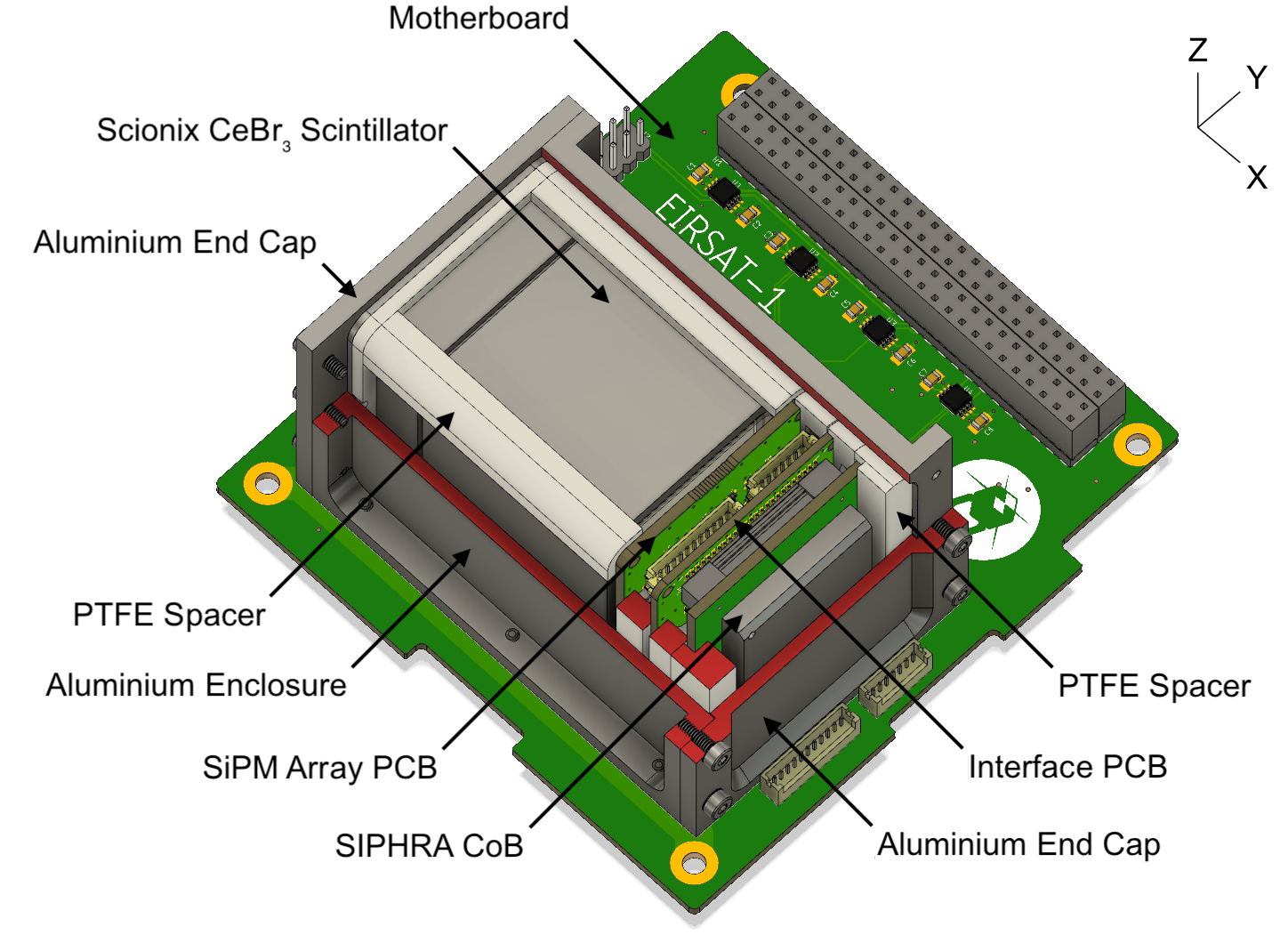
The Educational Irish Research Satellite 1 (EIRSAT-1) is a 2U CubeSat being developed under ESA's Fly Your Satellite! programme. The project has many aspects, which are primarily educational, but also include space qualification of new detector technologies for gamma-ray astronomy and the detection of gamma-ray bursts (GRBs). The Gamma-ray Module (GMOD), the main mission payload, is a small gamma-ray spectrometer comprising a 25 mm × 25 mm × 40 mm cerium bromide scintillator coupled to an array of 16 silicon photomultipliers. The readout is provided by IDE3380 (SIPHRA), a low-power and radiation tolerant readout ASIC. GMOD will detect gamma-rays and measure their energies in a range from tens of keV to a few MeV. Monte Carlo simulations were performed using the Medium Energy Gamma-ray Astronomy Library to evaluate GMOD's capability for the detection of GRBs in low Earth orbit. The simulations used a detailed mass model of the full spacecraft derived from a very high-fidelity 3D CAD model. The sky-average effective area of GMOD on board EIRSAT-1 was found to be 10 cm<sup>2</sup> at 120 keV. The instrument is expected to detect between 11 and 14 GRBs, at a significance greater than 10<i>σ</i> (and up to 32 at 5<i>σ</i>), during a nominal one-year mission. The shape of the scintillator in GMOD results in omni-directional sensitivity which allows for a nearly all-sky field of view.
Motivation & Objective
- To develop and qualify a compact, low-mass gamma-ray detector for a 2U CubeSat platform.
- To demonstrate the spaceworthiness of cerium bromide scintillators, silicon photomultipliers, and the SIPHRA ASIC in a low Earth orbit environment.
- To evaluate the instrument's sensitivity and GRB detection performance using detailed Monte Carlo simulations.
- To enable all-sky GRB detection with a nearly omni-directional field of view despite limited effective area.
- To support future small satellite missions by validating key detector technologies for gamma-ray burst astronomy.
Proposed method
- The GMOD instrument uses a 25 mm × 25 mm × 40 mm cerium bromide (CeBr3) scintillator coupled to 16 silicon photomultipliers (SiPMs).
- Readout is performed via the IDE3380 (SIPHRA) ASIC, chosen for low power and radiation tolerance in space.
- Monte Carlo simulations were conducted using the Medium Energy Gamma-ray Astronomy Library with a high-fidelity 3D CAD model of the full EIRSAT-1 spacecraft.
- The sky-average effective area was computed by accounting for Earth occultation, SAA transits, and instrument downtime, yielding an effective exposure factor of 0.496.
- GRB detection rates were simulated across three trigger bin durations (128 ms, 256 ms, 1024 ms), with the best response across bins used to estimate detection efficiency.
- Sensitivity was evaluated by comparing simulated GRB light curves and spectra to detection thresholds at 5σ and 10σ significance levels.
Experimental results
Research questions
- RQ1What is the effective area of the GMOD instrument across the energy range from tens of keV to a few MeV?
- RQ2How many gamma-ray bursts can GMOD detect per year with significance greater than 10σ, given its orbital constraints and instrument response?
- RQ3How does the choice of trigger integration time (128 ms, 256 ms, 1024 ms) affect the detection efficiency for short and long GRBs?
- RQ4To what extent does the omni-directional sensitivity of the scintillator shape compensate for the instrument’s low effective area in detecting GRBs?
- RQ5Can the SIPHRA ASIC and CeBr3-SiPM system achieve reliable, radiation-tolerant performance in a CubeSat environment for gamma-ray burst detection?
Key findings
- The sky-average effective area of GMOD is 10 cm² at 120 keV, which is an order of magnitude lower than that of Fermi GBM or larger CubeSat GRB missions.
- GMOD is expected to detect between 11 and 14 gamma-ray bursts per year at a significance greater than 10σ, depending on spacecraft attitude.
- At 5σ significance, the detection rate increases to between 28 and 32 GRBs per year, indicating high sensitivity to faint or short-duration bursts.
- The 1024 ms trigger bin performs nearly as well as the best response across all bins, suggesting it can serve as a robust fallback for missions with limited on-board processing.
- Earth occultation and instrument downtime (from SAA and Van Allen belt transits) reduce the effective exposure to 49.6% of the nominal time, which is factored into the detection rate simulations.
- The instrument’s omni-directional sensitivity enables a nearly all-sky field of view, compensating for its limited directional sensitivity compared to thin, directional scintillators.
Read this paper
Open the full text in the Nubint reader and ask about any passage as you read.
Read this paper on NubintThis review was generated by AI from the original paper. Please check the paper before citing it.